
Micah of Radonezh
Our Venerable Father Micah, disciple of Saint Sergius, Wonderworker of Radonezh
Venerable · d. 6 May 1385 (some sources 1392)
Commemorated 6 May — Repose at the Trinity monastery; his relics rest in the Micah church of the Lavra
Micah was among the first disciples of Sergius of Radonezh, and the one who shared his cell. The tradition remembers him for nothing but meekness of soul and purity of heart — and for one thing that no other man in Russia could claim: he was present, and the only witness, when the Mother of God appeared to Saint Sergius with the Apostles Peter and John and promised that his monastery would never be forsaken. He reposed on 6 May 1385, in his master's lifetime, and was buried beside the Trinity church; in 1734 a small church of the Appearance of the Mother of God was built over his grave, where his relics rest to this day. He is commemorated on May 6.

With Saint Sergius
Micah came early to the wilderness of Makovets, in the years when the community that would become the Trinity–Sergius Lavra was still a handful of cells in the forest north-east of Moscow, and he was received by Sergius himself. What the sources record of him is his position rather than his deeds: he lived in the abbot's own cell, which in the discipline of that community meant a life of continuous obedience and continuous observation, and he was singled out among the brethren for gentleness and interior purity. The absence of anecdote is characteristic of the best of Sergius's disciples; the Life of Sergius, written by Epiphanius the Wise and reworked by Pachomius the Serb, mentions Micah only where the story of Sergius requires him.
The witness of the Appearance of the Mother of God
The one episode is the greatest in the history of the monastery. Sergius had finished the night office — the tradition specifies that he had been singing the akathist before the icon of the Theotokos and praying for his community — when he said to his companion: "Be watchful, child, for we are about to have a wondrous visitation." Immediately a light brighter than the sun filled the cell, and a voice was heard: "The All-Pure One draws near." The Mother of God came in with the Apostles Peter and John the Theologian, raised Sergius from the ground, and told him that his prayer for his disciples was heard, that the monastery would abound in all it needed, and that she would not leave the place.
Micah could not bear the vision. He fell on his face as though dead, and Sergius had to lift him afterwards and tell him what had happened, for the disciple had seen only the light and heard only the voice. The date is traditionally set in the Great Fast, in the last years of Sergius's life; Sergius then sent for Isaac the Silent and Simon, who had seen the extraordinary light from outside, and the three of them kept vigil in thanksgiving until morning. The Appearance became the founding vision of Russian monasticism's greatest house, the subject of one of the most reproduced of all Russian icons, and the reason that Micah — a monk of whom scarcely anything else is known — has his own feast.
Repose, relics and shrine
Micah reposed on 6 May 1385, before his abbot, and was buried close to the wooden church of the Holy Trinity, at the spot where the cell had stood. His grave was venerated locally from the first, and the veneration was formalised in the eighteenth century: in 1734 a small church was raised over it, dedicated to the Appearance of the Mother of God to Saint Sergius together with the Apostles Peter and John the Theologian — the vision of which Micah had been the only witness — and universally known in the Lavra simply as the Micah church (Mikheevskaya). His relics lie there beneath a shrine, in the middle of the monastery, between the Refectory church and the Trinity cathedral. He is commemorated with the whole company of Sergius's disciples in the Russian synaxis of the Saints of Radonezh (July 6) as well as on his own day.
Feast and commemoration
May 6 (church date; New Calendar civil May 6, Old Calendar civil May 19). The commemoration is Russian, kept in the Moscow Patriarchate and the Russian diaspora, and is not found in the Greek or Antiochian books, where the day belongs to the righteous Job and the Greek martyrs. At the Trinity–Sergius Lavra it is a local festival with the vigil served in the Micah church over his relics. He is also commemorated in the general synaxis of the Radonezh saints on July 6.
Hymns
Troparion — Tone 8
In thee, O Father, the image of God was preserved unbroken; for taking up the Cross, thou didst follow Christ, and by thy deeds thou hast taught us to despise the flesh, which passeth away, and to care for the soul, which is immortal. Therefore, O venerable Micah, thy spirit rejoiceth with the Angels.
Original translation from the Slavonic
Iconography
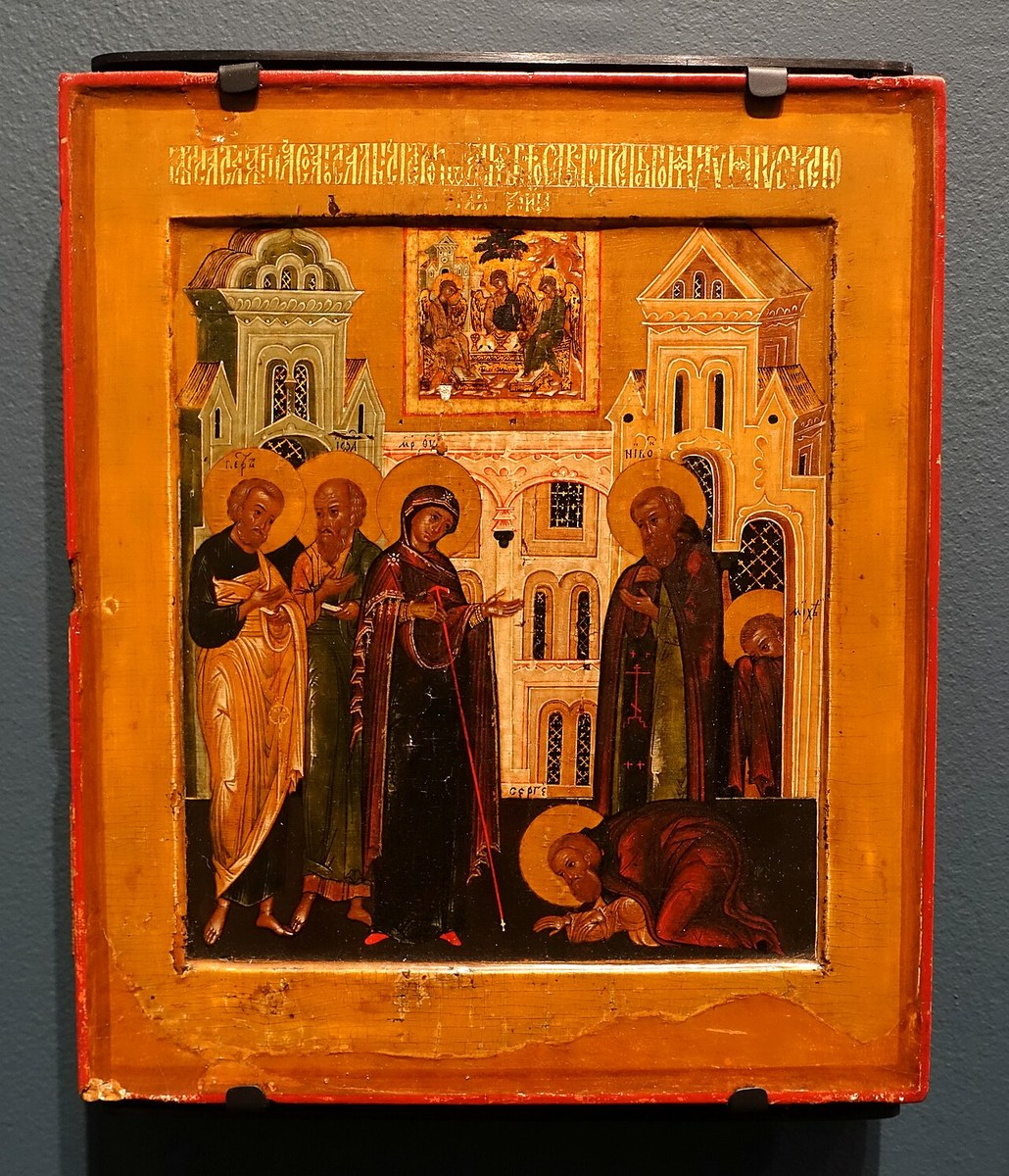
Micah is painted as a monk of the Russian fourteenth century in the mantiya and koukoulion, with a short dark or greying beard, generally young or middle-aged in appearance, the hands in prayer or holding a scroll. He is very rarely shown alone. His proper place is inside the composition of the Appearance of the Mother of God to Saint Sergius, one of the most widely copied of Russian icons: the Theotokos stands with the Apostles Peter and John before the monastery buildings, Sergius prostrates himself at her feet, and Micah — small in scale, often half-hidden behind another figure or behind the abbot, bowing or shielding his face — is the disciple overcome by the light, inscribed МИХѢ or МИХЕЙ. He also appears in the crowded "Saints of Radonezh" icons and in the borders of icons of Sergius.
The stored image is a late sixteenth-century Russian panel of the Appearance (Jordan Schnitzer Museum of Art): above, the Hospitality of Abraham; below, the Theotokos with the Apostles Peter (ПЕТРЪ) and John (ІОАН), Sergius prostrate (СЕРГЕ), and at the right, behind the standing figure inscribed НИКО (Nikon), the small bowing monk inscribed МИХѢ — Micah, in the moment the tradition assigns him.
Disputed questions
The year of repose. The Russian tradition and the jurisdictional calendars give 1385; some reference works, including the Wikidata record, give 1392 — the year of Sergius's own repose — probably by assimilation. 1385 is the date attached to the shrine and to the feast, and is followed here.
The date of the Appearance. The vision is variously placed between about 1379 and Sergius's last years; the Life dates it only by season (the Great Fast) and by the state of the community. The commemoration of the Appearance itself is kept in the Lavra on the day of the dedication of the Micah church, and locally on August 24.
Not to be confused with. Micah of Radonezh is not the Old Testament prophet Micah, son of Imlah (9th c. BC), nor the prophet Micah of Moresheth of the Twelve (August 14); nor, despite the closeness of the Slavonic forms Mikhei and Mikhail, is he any of the saints named Michael.