
Michael of Kiev
Saint Michael, First Metropolitan of Kiev and All Russia
Bishop · d. 992
Commemorated 15 June — Repose (992), 30 September — Translation of the relics into the Great Church of the Kiev Caves Lavra (1730)
Michael (†992) is venerated as the first Metropolitan of Kiev and All Russia: the hierarch who, by church tradition, came to Kiev with Prince Vladimir after his baptism at Korsun (c. 988–989), baptised the people of the newly converted land, made missionary rounds of the Russian towns founding the first churches and schools, and set the Russian hierarchy on its foundations — the old Kievan and Novgorodian records call him "the initiator." He reposed in 992 and was buried in the Tithe Church of the Theotokos in Kiev; his relics were later translated to the Kiev Caves Lavra. His principal feast is June 15; September 30 commemorates the translation of his relics, kept in the Russian and OCA calendars.
.jpg)
Origins and arrival in Rus'
Of Michael's origins the sources speak with divided voices: the Joachim Chronicle calls him a Syrian, other chronicle traditions a Bulgarian or a Serb; the church tradition has him sent from Constantinople by the Patriarch Nicholas II Chrysoberges. He arrived at Korsun (Chersonesus in the Crimea) with other clergy for holy Prince Vladimir (commemorated July 15), not long after Vladimir's baptism there (988), and came with the prince to Kiev, where the mass baptism of the people in the Dnieper inaugurated the Christian history of Rus'.
The first hierarch of the Russian land
As first metropolitan his service was, in the words the Russian tradition preserves, difficult but grace-filled: a missionary episcopate over a newly and thinly converted land. He made the rounds of the Russian towns — preaching, baptising, and teaching the newly illumined people, founding the first churches and the first schools for the teaching of the faith. In Rostov he established the first (wooden) church of the Dormition of the Theotokos and installed Theodore the Greek as its bishop. The tradition remembers him as wise and gentle, yet strict where strictness served the young Church; the Synodikon of the cathedrals of Sophia in Novgorod and Kiev styles him "the initiator" (началовождь) — the one who began the hierarchy of the Russian land. Later tradition also associates the founding of the monastery of the Archangel Michael (the Golden-Domed) in Kiev with his name.
Repose, relics and translations
Michael died in 992 and was buried in the Desyatinnaya — the Tithe Church of the Theotokos — Vladimir's great church in Kiev. About the year 1103, under the igumen Theoctistus of the Caves (afterwards bishop of Chernigov, commemorated August 5), his relics were transferred to the Near (Antoniev) Caves of the Kiev Caves monastery; and on October 1, 1730 they were solemnly translated into the Great Church of the Dormition of the Caves Lavra. It is this translation that the September 30 commemoration reflects. Formerly his memory was kept on September 2 together with the venerables Anthony and Theodosius of the Caves, and a trace of that usage survives in his service: "Having begun the new year, we offer thee our first songs, O blessed one, for thou wast the beginning of the hierarchy in the Russian land."
Feast and commemoration
Michael is commemorated twice in the year: June 15, his principal feast (the repose of 992), and September 30 (church dates; Old Calendar civil June 28 and October 13), the commemoration connected with the translation of his relics into the Great Church of the Caves Lavra (October 1, 1730). Both feasts belong to the Russian tradition — the Russian and Ukrainian Churches and the OCA — and are not found in the Greek Menaion; the Antiochian usage follows the universal Byzantine calendar, where the day belongs to Gregory the Illuminator, and Michael's entry is carried here with his jurisdictional footprint recorded. Formerly he was also commemorated on September 2 with Anthony and Theodosius of the Caves.
Hymns
Troparion — Tone 4
Today the prophecy of the first-called apostle is fulfilled: for behold, upon these hills grace has shone forth and faith has been multiplied; and they who had grown old in unbelief have been reborn of the divine font and become a people of renewal — a royal priesthood, a holy nation, the flock of Christ — whose first shepherd thou wast shown to be, as first serving it with baptism. And now, standing before the Master, Christ God, pray that all the sons of the Russian land may be saved; for thou hast boldness as God's hierarch and minister.
Original translation from the Slavonic
Kontakion — Tone 2
Thou wast shown forth as a second Moses for the Russian land, O father, bearing the spiritual vine out of the idolatry of Egypt into a land foreseen by prophecy: "There shall be," it said, "an establishment of faith upon the earth, and upon the summits of the hills of Kiev its fruit, nourishing the whole world, shall be exalted above Lebanon." Tasting of that fruit, we call thee blessed, O Michael, hierarch of God.
Original translation from the Slavonic
Iconography
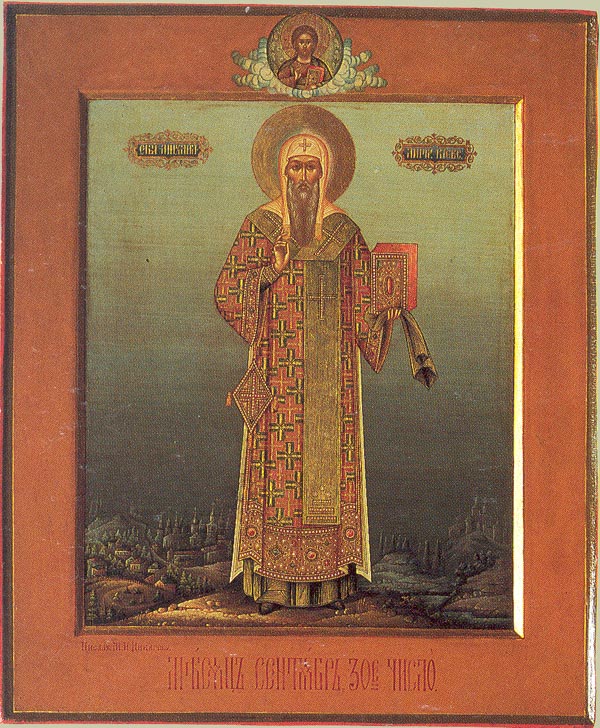
Michael is painted as a vested metropolitan — in sakkos or polystavrion, with white klobuk or mitre in the later Russian manner — holding the Gospel and blessing, often against a ground showing the hills and churches of Kiev; in narrative icons he baptises the people of Kiev in the Dnieper. The stored image is a menaion icon for September 30 by the Moscow icon painter Mikhail Dikarev (late 19th century; State Hermitage), the saint standing full-length in episcopal vestments between vistas of the Kiev Caves Lavra, with the inscription of his name and, below, the date of the feast.
Disputed questions
- Was Michael historically the first metropolitan? The earliest strata of the chronicles are silent on the first metropolitans' names, and Byzantine and later Russian lists diverge: some scholarship holds the first metropolitan of Kiev attested by name to be Theophylact (transferred from Sebasteia c. 988) or Leontius, with Michael's primacy resting on later tradition, above all the Church Statute attributed to Vladimir and the 17th-century compilations that drew on it. The Church's liturgical tradition — Russian, Ukrainian and OCA alike — names Michael first, and his cultus at the Caves Lavra is many centuries old. The divergence is recorded here; the entry follows the Church's commemoration.
- Origins. Syrian (Joachim Chronicle), Bulgarian or Serb (other chronicles), or Greek (the general assumption of a Constantinopolitan appointment): the sources allow no certainty.
- The relics after 1941. The Great Church of the Lavra, into which the relics were translated in 1730, was destroyed in the Second World War and rebuilt only in 2000; the present disposition of the relics is bound up with the complex modern history of the Lavra's shrines and is not asserted here.
- Not to be confused with the other sainted Michaels of the Russian calendar, above all Michael of Chernigov (†1246, September 20), the martyred prince — a different person and a different age.