
Moses the Hungarian
Our Venerable Father Moses the Hungarian, of the Near Caves of Kiev
Venerable · Confessor · b. late 10th century, in Hungary — d. c. 1043, at the Kiev Caves monastery
Commemorated 26 July — Repose of the venerable Moses in the Caves monastery, 28 September — Synaxis of the venerable fathers of the Kiev Caves whose relics repose in the Near Caves
Moses was a Hungarian in the service of the Kievan prince Boris — one of three brothers, with George, who was killed at his master's side in 1015, and Ephraim, who became the founder of the monastery at Novy Torg. Moses escaped the murder on the Alta, was carried off to Poland as a prisoner of war when Bolesław the Brave took Kiev in 1018, and there was bought by a rich Polish widow who wanted him for a husband. He refused her for five years and more; she had him flogged a hundred strokes a day and at last mutilated. When her protector died and Poland rose in revolt she was killed, and Moses came at last to Kiev, to the caves of St Anthony, where he lived about ten years in silence and reposed about 1043. His relics lie in the Near Caves. The Kievan Church keeps him as the confessor of chastity, and those troubled by the passions of the flesh have been sent to his relics for a thousand years.

Three Hungarian brothers in the service of Boris
The Kiev Caves Paterikon — the collection of Caves lives put into shape in the thirteenth century, in which the account of Moses is given by the monk Polycarp — opens with the household of St Boris, son of Vladimir. Three brothers of Hungarian birth (Угрины, "Ugrians") served him: George, who wore a gold torque given him by the prince; Ephraim, his steward; and Moses.
On the Alta in 1015, when Boris was murdered by the men of Svyatopolk, George threw himself over his master's body and was killed with him; the assassins cut off his head to get at the torque. Ephraim, coming later, found the head, kept it by him all his life, and had it buried with him; he withdrew from the world, built a hospice for travellers and then a monastery of Saints Boris and Gleb at Novy Torg (Torzhok), and is himself numbered among the saints — his disciple is Arcadius of Novotorzhok.
Moses alone got away. He fled to Kiev and was sheltered by Predislava, sister of Prince Yaroslav.
Captivity in Poland
In 1018 Bolesław I the Brave of Poland, intervening on Svyatopolk's side, took Kiev and carried off a great train of captives — Predislava among them, and with her household Moses. He was, the Paterikon says at some length, a young man of exceptional strength and beauty; and in Poland a wealthy widow of the nobility saw him among the prisoners and bought him from his captor for a large sum, intending to make him her husband and the master of her estates.
He would not. When she reasoned with him, he answered that he would not exchange what does not perish for what does; when she promised him freedom, lands and rank, he told her that they were not worth the loss of his soul. The Paterikon reports the exchange at length and without prurience, and it is the reason the story was told: Moses is the Kievan Joseph, and the parallel with Genesis 39 is drawn explicitly in the text and in his service.
The widow tried flattery, then starvation, then force. She had him beaten with a hundred strokes daily. In the middle of this a monk from the Holy Mountain who was travelling through Poland reached him in secret and tonsured him, so that he bore the habit under his captivity — the detail matters, because it makes his refusal a monastic vow and not merely obstinacy. When she learned of it she had him castrated, and left him for dead.
Deliverance and the Caves
Bolesław died in 1025, and in the disorders that followed — the Paterikon compresses them into a single night — there was a rising against the great landowners and against the Latin clergy who had backed the king's Russian adventure; the widow was killed. Moses, broken in body, made his way to Kiev and to the caves where Anthony had gathered his first disciples.
There he lived, the account says, about ten years, in almost total silence, never speaking of Poland, keeping a rule of severe fasting, and refusing to let his sufferings be made a matter of conversation. He reposed about 1043, and was buried in the caves; his relics rest in the Near (Anthony's) Caves, where they are still shown.
The staff, and the patronage of chastity
One episode fixed his cultus. A brother of the monastery, tormented past bearing by carnal temptation, came to Moses and begged his prayers. Moses gave him the staff he leaned on and told him to strike himself with it; and from that hour, the Paterikon says, the passion left the man and never returned. From this the Kievan Church made Moses the patron specifically invoked against fornication and impure thoughts, and generations of Russian and Ukrainian spiritual fathers have sent the tempted to his relics. It is a patronage grounded not in a miracle-motif but in what he actually endured.
Feast and commemoration
July 26 (church date; New Calendar civil July 26, Old Calendar civil August 8) — the day of his repose, and his principal feast. He is commemorated a second time with the Synaxis of the Venerable Fathers of the Near Caves on September 28, and with all the Caves fathers in the movable commemoration on the Saturday of the second week of Great Lent.
The feast is kept by the Russian, Ukrainian and other Slavic Churches and by the OCA; it is not part of the older Greek or Antiochian menaia, though Antiochian parishes using the OCA and Russian calendars will find him there. In Hungary his memory has been taken up in recent decades by the Orthodox communities of Budapest and Nyíregyháza as the country's own saint of the undivided Church.
His feast falls two days after that of Boris and Gleb (July 24), the passion-bearers in whose household he began — a proximity the Kievan books notice.
Hymns
Troparion — Tone 8
In thee, O father, was the divine image surely preserved: for taking up the cross thou didst follow Christ, and by thy deeds thou didst teach us to despise the flesh, which passeth away, and to care for the soul, which is immortal. Wherefore, O venerable Moses, thy spirit rejoiceth with the angels.
Original translation from the Slavonic
Kontakion — Tone 2
A captive in body, thou wast free in soul, O Moses; for gold could not buy thee, nor the scourge bend thee, nor the knife take from thee the chastity thou hadst vowed. Wherefore the caves received thee as a confessor, and thou dost loose from the bonds of the passions all that call upon thee.
Original translation from the Slavonic
Iconography
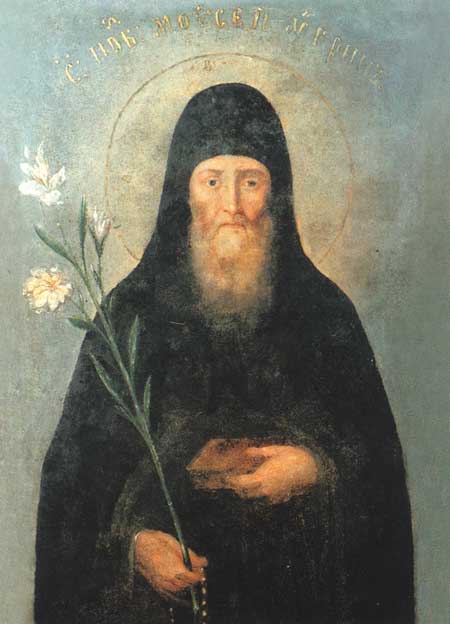
Moses is painted as a Caves monastic: in the black mantiya and koukoulion, mature but not aged, with a moderate brown beard, standing or half-length. His attribute in the Lavra tradition is a stem of white lilies — the flower of virginity, given him precisely for the reason his Life records — held in the left hand, often together with a prayer rope; a scroll or a hand raised in prayer appears in other examples. In the great composite icons of the Synaxis of the Fathers of the Near Caves, and in the printed Lavra panorama engravings sold to pilgrims from the eighteenth century onward, he stands in the ranks with his name inscribed beside him.
He is not usually given a martyr's cross, since he did not die by violence; his sufferings are indicated, where at all, by the lilies and by the pallor of the face.
The stored image is a Kiev Caves Lavra panel of the eighteenth to nineteenth century, in the painterly Ukrainian manner of the Lavra workshops: the saint half-length against a grey ground, in the black monastic habit, holding lilies and a prayer rope, with the Slavonic inscription С. ПР(е)П(одобный) МОѴСЕЙ УГРИНЪ running through the halo.
Disputed questions
- Chronology. The Paterikon's own arithmetic is loose. If Moses was taken in 1018, resisted the widow "for five years", was delivered at Bolesław's death (1025) and then lived ten years in the caves, the repose falls about 1035–43; the calendars give c. 1043, which is followed here. Some Russian editions give 1041.
- Where he was tonsured. The text has an Athonite monk tonsure him in Poland, in secret. A variant tradition, followed by some later Russian writers, has him tonsured only after he reached the Caves. The Paterikon's version is the older and is the one the service presupposes.
- The widow's death. The Paterikon attributes it to a rising in which "many were killed"; Polish sources record the pagan reaction and the revolt of the 1030s rather than one of 1025. The hagiography has telescoped a decade.
- "Ugrin". The Slavonic Угринъ means simply "the Hungarian". It has occasionally been read as a family name or as denoting a Ugric (rather than Magyar) origin; the plain sense — a Hungarian in Rus' service, of whom there were many in Vladimir's and Boris's retinues — is almost certainly right. He is the earliest saint of Hungarian birth venerated in the Orthodox East.