
Boris of Bulgaria
The Holy Equal-to-the-Apostles Boris, Prince of Bulgaria, called Michael in Holy Baptism
Equal to the Apostles · Prince · d. 907, on May 2, as a monk
Commemorated 2 May — Repose of the Baptizer of Bulgaria (†907)
Boris, prince (knyaz) of the Bulgarians from 852 to 889 and called Michael at his baptism about 864, is the Baptizer of Bulgaria: the ruler who brought a pagan Turkic-Slavic state into the Church, secured for it a church of its own under Constantinople, received the exiled disciples of Cyril and Methodius in 886, and by that act made Bulgaria the nursery of Slavonic letters and the Slavonic liturgy for the whole Orthodox Slavic world. He laid down his power in 889 to become a monk, came out of the monastery once — to depose and blind his own eldest son for attempting to restore paganism — and having set his son Symeon on the throne returned to his cell, where he died on 2 May 907. The Church honours him as equal-to-the-apostles, and his commemoration on May 2 is kept by the Bulgarian, Russian and other Slavic Churches.

Origins and the years before baptism
Boris was the son of Presian and grandson of Khan Omurtag, of the house of Krum, and succeeded to the Bulgarian throne about 852. The realm he inherited was large, warlike and religiously divided: the Bulgar aristocracy held to the sky-god Tangra and the old rites of the steppe, while the great mass of the Slav population had its own paganism, and Christianity was present in pockets — among captives, in the old Roman towns of the Danube and Thrace, and at court, where Boris's own sister had been a captive in Constantinople and returned a Christian.
The tradition remembers that the faith had already cost blood in his own family. His kinsman Boyan, called Enravota, brother of the khan Malamir, had been put to death for Christ a generation earlier — the first Bulgarian martyr — and the synaxarion preserves the memory that Boyan foretold, before his death, that the faith would triumph in Bulgaria and that one of his own house would bring it in. Boris's later hagiographers naturally read the prophecy of him.
The baptism of the prince and the nation
Boris's diplomacy first inclined westward: in 862 he made an alliance with Louis the German and appears to have contemplated receiving missionaries from the Frankish church. Constantinople answered with a show of force — an army on the frontier and a fleet on the Black Sea coast — at a moment when Bulgaria was crippled by famine and earthquake. Boris made peace, and with the peace accepted baptism from the Byzantines, about 864 (some sources 865 or 866), at his capital Pliska. The emperor Michael III stood as his godfather by proxy, and the prince took the emperor's name: from that day the documents call him Boris-Michael, or simply Michael.
The conversion of the nation followed by command, and it was resisted. In 866 a confederacy of fifty-two boyars rose in the name of the old gods; Boris put the rising down and executed its leaders with their families. Later Bulgarian tradition softened nothing of this, and it is worth stating plainly: the Christianisation of Bulgaria was the act of a ruler, carried through with a ruler's severity, and its saint is honoured for the fruit and not for the method.
Rome, Constantinople, and the Bulgarian church question
What Boris wanted, and pursued for six years with remarkable skill, was a church of his own — a patriarch or at least an autonomous archbishop resident in Bulgaria, not a Greek bishop taking orders from the capital. When Constantinople would not grant it, he turned to Rome. In 866 his envoys carried to Pope Nicholas I a list of questions about Christian life, law and government; the Pope's reply, the Responsa Nicolai ad consulta Bulgarorum — one hundred and six answers on everything from fasting and marriage to warfare, trial by ordeal and the treatment of rebels — is among the most valuable documents of ninth-century church history, and a window onto the pastoral problems of a freshly baptised people. Latin clergy came under Formosus of Porto (later pope) and Paul of Populonia; but when Boris asked that Formosus be given him as archbishop and was refused, and when Rome proved no more willing than Constantinople to concede a real autonomy, he turned back.
The matter was settled at the council held at Constantinople in 869–870 (counted in the West as the Fourth Council of Constantinople), in a session on the Bulgarian question in the spring of 870: Bulgaria was assigned to the jurisdiction of Constantinople, but as an autonomous archbishopric with its own see, and the Latin clergy withdrew. Boris had in substance won. His manoeuvring between the two Romes had meanwhile poured oil on the quarrel of Photius and Nicholas — the Bulgarian mission is one of the immediate occasions of the Photian schism — and Photius, restored, afterwards wrote for Boris a treatise on the duties of a Christian prince, one of the few surviving mirrors of princes from the Byzantine ninth century.
The reception of the disciples of Cyril and Methodius
The act for which the Slavic Churches chiefly honour Boris came late in his reign. In 885–886, after the death of Methodius, the Slavonic mission in Moravia was destroyed by the Frankish clergy, and its surviving teachers were sold, imprisoned or driven out. Three of them — Clement, afterwards of Ohrid, Naum, and Angelar — came down to the Danube and were brought to Pliska, where Boris received them with honour as men sent by God.
He gave them houses, pupils and authority, and set them to work: Clement in the south-west, at Devol and then at Ohrid, Naum and the others at Pliska and the new capital Preslav. Out of these two centres came the schools that translated the liturgical and patristic books into Slavonic, trained a native clergy, and — at Preslav, in the following reign — produced the simplified alphabet that the world calls Cyrillic. At the council of Preslav in 893 the Slavonic tongue was made the language of the Bulgarian church and state in place of Greek. The whole later literature of Orthodox Slavdom, Russian included, descends from this decision; Bulgaria under Boris is the channel through which the work of Cyril and Methodius reached the Slavs at all.
Monastic repose, and the deposition of Vladimir-Rasate
In 889 Boris did what few early medieval rulers did: he resigned the throne and took the monastic habit, retiring to a monastery near Pliska and leaving the rule to his eldest son Vladimir-Rasate. Within four years the news reached his cell that Vladimir had turned to the Franks and was restoring the sacrifices of the old gods and persecuting the clergy.
Boris came out, resumed his authority long enough to depose his son, had him blinded and imprisoned, and summoned the council of Preslav in 893, at which he set his third son Symeon — who had been educated at Constantinople and was intended for the church — upon the throne, with the warning, remembered in the Bulgarian sources, that the same fate awaited him if he betrayed the faith. Then he returned to the monastery. Bulgarian tradition adds that he was called out once more, about 895, to help meet a Magyar invasion, and that he went back again to his cell when the danger passed. He died there, a monk, on 2 May 907.
Feast and commemoration
May 2 (Old Calendar civil May 15), the day of his repose. The feast is kept by the Bulgarian Orthodox Church, whose national saint he is, and by the Russian Church and the Orthodox Church in America, which carry him in their calendars for May 2; he is named in the synaxis of the Bulgarian enlighteners and stands beside the Seven Apostles of the Slavs (Cyril, Methodius, Clement, Naum, Angelar, Gorazd and Sabbas), commemorated together on July 27, whose work he made possible. On May 2 his commemoration falls with the repose and translation of the relics of Athanasius the Great and with the translation of the relics of the passion-bearers Boris and Gleb.
Hymns
Apolytikion — Tone 4 (common of one equal-to-the-apostles)
Having become a partaker of the ways of the Apostles and a teacher of thy people, O Boris named Michael, thou didst lead a whole nation from the darkness of idols to the light of Christ; and laying down thy princely power, thou didst take up the yoke of the monks. Wherefore, O equal of the Apostles, intercede with Christ God that our souls may be saved.
Iconography
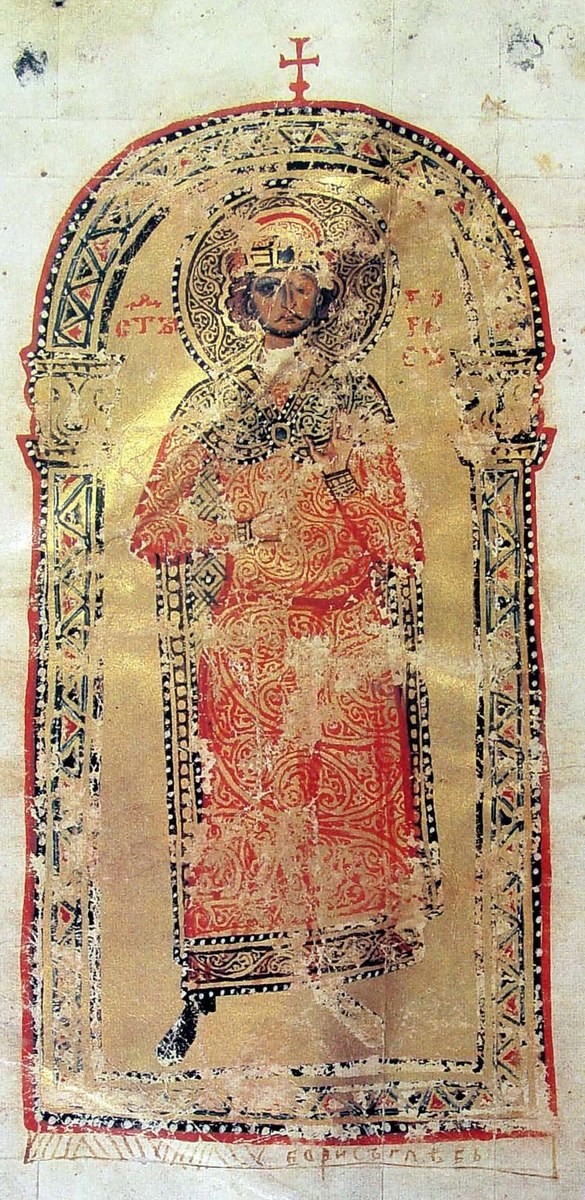
Boris-Michael is painted as a crowned ruler — in later Bulgarian and Russian icons with the closed crown and the loros or the jewelled sakkos of a Byzantine emperor, holding a cross in the right hand and often a model of a church or a scroll in the left, the signs of the founder and lawgiver; the beard is dark and full, the face middle-aged. Because he died a monk, a second and rarer type shows him in the monastic habit and schema, the crown set aside at his feet — the visual statement of his abdication. In narrative painting the two great scenes are his baptism, in the font with the Byzantine clergy about him, and his reception of the disciples of Cyril and Methodius, in which the prince stands to greet the Slavonic teachers; both are frequent in Bulgarian church decoration, including a sixteenth-century fresco of the meeting at the Eleshnitsa monastery. The stored image is the manuscript portrait of Tsar Boris from Constantine of Preslav's Didactic Gospel — the prince-convert standing crowned and haloed, in the book his own court produced.
Disputed questions
- The year of the baptism. 864 is the commonest date; 865 and 866 are defended, and the confusion goes back to the divergence between the Byzantine and the Latin sources. The entry follows the majority.
- His title. Boris ruled as knyaz (the Greek documents call him archon); the imperial title tsar was assumed by his son Symeon in 913. The liturgical books and Bulgarian popular usage nevertheless style him "Tsar Boris," anachronistically but universally, and the taxonomy of this collection accordingly classes him among the princes.
- Not to be confused with Boris, the passion-bearer of Rus', son of Vladimir of Kiev, killed in 1015 and commemorated with his brother Gleb — whose translation of relics is kept on this very same day, May 2. The coincidence of name and date is the confusion most likely to arise: the Bulgarian Boris is a tenth-century ruler and enlightener who died a monk in his bed, the Russian Boris an eleventh-century prince murdered by his brother. Nor should he be confused with the later Bulgarian and Russian bearers of the name.
- The place of his monastery and grave. The sources do not name them certainly; proposals cluster around Pliska and the great basilica there, and no relics are identified.