
Vitalis of Ravenna
The Holy Martyr Vitalis, who suffered at Ravenna
Martyr · d. at Ravenna; 1st or 2nd century by the tradition, undetermined in fact
Commemorated 23 July — With Apollinaris of Ravenna in the Greek synaxarion
Vitalis is the martyr in whose honour the emperor Justinian's mosaic masterpiece, the Basilica of San Vitale at Ravenna, was raised over the reputed place of his death, and whose figure stands in its apse receiving the martyr's crown from the hand of Christ. The tradition makes him a citizen — by some accounts a soldier — of Milan, husband of Valeria and father of the martyrs Gervasius and Protasius, who came to Ravenna in the train of the judge Paulinus, encouraged the martyr Ursicinus not to falter, buried him honourably, was denounced for it, racked, and then thrown into a pit and buried alive under stones and earth. The Greek synaxarion of July 23 keeps him with Apollinaris and styles both of them "bishops of Ravenna," a title the Western sources never give him; his own place, date and even his existence as distinct from other martyrs of the name are matters of long scholarly doubt, and the entry sets them out.
-edit.jpg)
The received account
The passion known in the West places Vitalis at Milan — a man of substance, and in some tellings a soldier of rank — married to Valeria, and the father of the twin martyrs Gervasius and Protasius, whose relics Ambrose of Milan uncovered in 386. Vitalis is said to have travelled to Ravenna in the company of a judge named Paulinus, and to have found there a Christian physician, Ursicinus, standing at the place of execution and beginning to waver at the sight of the sword. Vitalis called out to him not to lose at the last what he had held all his life. Ursicinus was steadied and died; and Vitalis took up the body and buried it with honour.
The burial gave him away. Denounced as a Christian, he was seized on Paulinus's order, stretched on the rack, and — when he would not sacrifice — thrown into a deep pit, where he was covered over with stones and earth and so buried alive. The account adds that Valeria, returning toward Milan, was set upon by peasants at Milan's gate for refusing to join in a sacrifice to their gods, was beaten, and died of it some days later.
The basilica
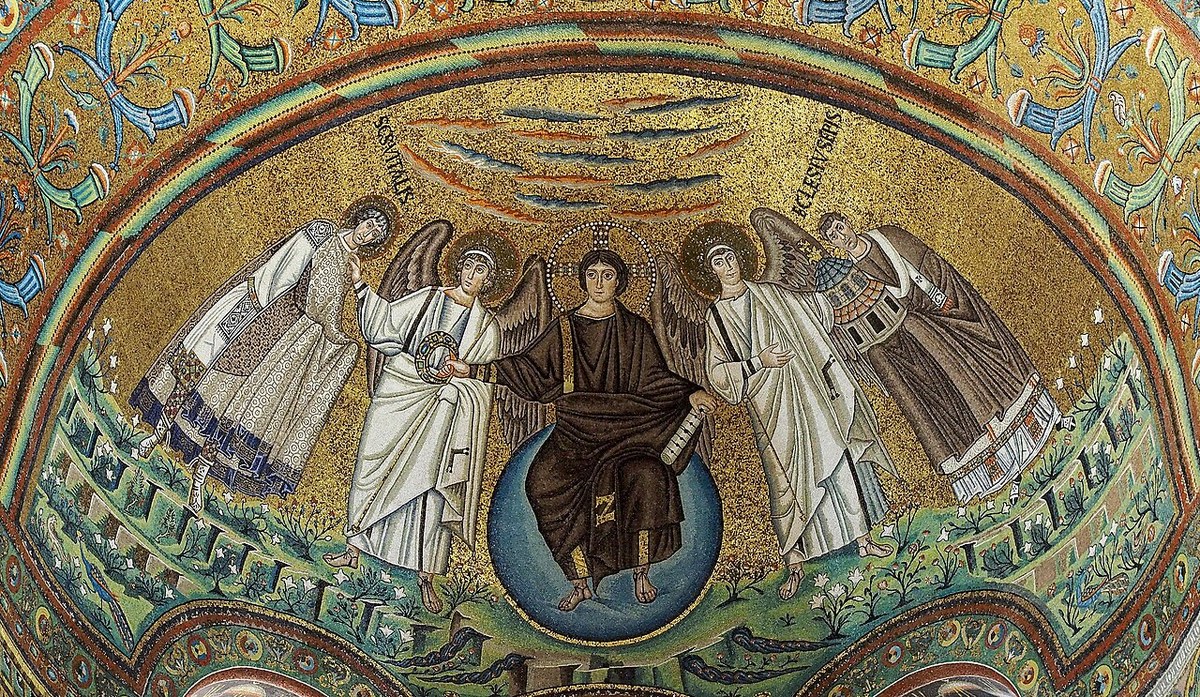
Whatever the historical residue of that story, the cult at Ravenna was firmly established by the sixth century. Over the place identified as his martyrdom the banker Julianus Argentarius paid for the building of an octagonal church begun under Bishop Ecclesius (c. 522–532) and consecrated by Bishop Maximian in about 547–548 — the Basilica of San Vitale, which survives as the greatest surviving monument of Justinianic art in the West, and whose sanctuary carries the famous panels of Justinian and Theodora with their courts. In the apse the young beardless Christ sits enthroned upon the globe of the world between two archangels; on the left, in the patterned court dress of a Roman noble and with hands veiled in reverence, stands SCS VITALIS, receiving from Christ, through the angel's hands, the jewelled crown of martyrdom; on the right Bishop Ecclesius offers the model of the church itself.
Beneath the church, a crypt was venerated as the pit into which he had been thrown. The Roman calendar keeps him on April 28, with Valeria; the Byzantine calendars keep him at Ravenna on July 23 with Apollinaris.
Feast and commemoration
July 23 (church date; Old Calendar civil August 5) in the Greek synaxarion, joined to Apollinaris of Ravenna, and thence in the OCA calendar. The Slavonic calendars of the day do not list him; the Latin West keeps him with Valeria on April 28, the day of the dedication of his basilica, and Ravenna honours him among the patrons of the city. He has no proper service anywhere in the Byzantine books.
Hymns
Troparion — Tone 4
Thy martyr Vitalis, O Lord, in his contest received from Thee our God the crown of incorruption; for having Thy strength he cast down the tyrants, and shattered the feeble boldness of the demons. By his intercessions save our souls.
Original translation from the Greek
Iconography
Vitalis is shown, when he is shown alone, as a Roman layman-martyr: beardless or lightly bearded, in tunic and mantle or in the dress of a court official, holding the cross of witness, and sometimes with the crown; Western painting from the Renaissance onward gives him the armour and the white horse of a soldier-saint, a development with no warrant in the Byzantine tradition.
The image stored with this entry is the apse mosaic of the Basilica of San Vitale, of about 547. Christ, beardless and youthful, sits on the blue globe of the world in the gold of the apse, the four rivers of paradise at his feet and the scroll of the seven seals in his hand; two archangels present to him, on the left, the martyr Vitalis — inscribed SCS VITALIS, in the heavy patterned chlamys of a Roman noble, his hands veiled in the folds of his mantle in the gesture of one who receives an imperial gift — and on the right Bishop Ecclesius, holding out the model of the octagonal church. The crown that the angel holds toward Vitalis is the martyr's crown; the whole composition is a court audience turned into theology, in which the martyr is decorated by his Emperor.
Disputed questions
- "Bishop of Ravenna." The Greek synaxarion of July 23 reads "the holy martyrs Apollinaris and Vitalius, bishops of Ravenna" (Ἀπολιναρίου καὶ Βιταλίου, Ἐπισκόπων Ῥαβέννης), and the OCA follows the Greek in styling him "Hieromartyr Vitalius, Bishop of Ravenna" — while carrying no life for him at all ("no information available at this time"). No Western source, and no episcopal list of Ravenna, knows a bishop Vitalis. The likeliest explanation is that the Byzantine notice, joining two Ravennate names, allowed the title proper to Apollinaris to carry across to his neighbour. This entry therefore classifies him martyr, not hieromartyr or bishop, and records the Greek title as a variant rather than a fact.
- Milan or Ravenna, and how many Vitalises. The passion links him to Milan through Valeria and their sons, but the shrine and the whole weight of the cult are at Ravenna. Scholars from the Bollandists onward have judged the narrative "partly fanciful" and have suspected that the characters in it are other martyrs of the same common name — Vitalis, "the vital one," is among the most frequent names in the Latin martyrologies — drawn together to furnish a life for a shrine whose occupant had ceased to be remembered. On this reading the historical Vitalis is simply a martyr buried at Ravenna, of unknown date, around whom the Milanese family story gathered later. The date offered in the sources ranges from the reign of Nero to that of Marcus Aurelius; the corpus records century: 2 as a mid-point of the tradition, and flags that it is not evidence.
- Not to be confused with. He is a different person from Vitalis of Gaza (Apr 22), the monk of Abba Seridos who spent his nights buying the harlots of Alexandria out of their sin; from the Vitalis numbered among the martyrs of Corfu with Kerkyra (Apr 28); and from the several Western Vitalises of the Latin martyrologies. His connection to Nazarius, Gervasius, Protasius and Celsius (Oct 14) is through the passion's claim that Gervasius and Protasius were his sons — a claim that entry likewise treats as traditional rather than established.