
Nicephorus of Antioch
The Holy Martyr Nicephorus of Antioch
Martyr · d. c. 257, at Antioch
Commemorated 9 February — Martyrdom by the sword at Antioch; the leavetaking of the Meeting of the Lord
Nicephorus of Antioch (†c. 257) was a layman of Syrian Antioch whose martyrdom the Church keeps as its great parable of forgiveness. He and the priest Sapricius had been friends as close as brothers until the devil turned their love to hatred; and though Nicephorus again and again begged pardon, Sapricius would not be reconciled. When persecution came, Sapricius the priest was arrested, confessed Christ under torture, and was condemned to be beheaded — but on the very ground of execution, refusing still to forgive his brother, he was abandoned by grace, lost his nerve, and apostatised at the last, casting away the crown already in his hand. Nicephorus, who had run after him to the place of death still pleading for pardon, then confessed himself a Christian in the apostate's stead, and was beheaded, receiving the martyr's crown that Sapricius had forfeited. The two together — the one who suffered everything but would not forgive and was lost, the one who forgave and inherited the crown — are read by the Church as a living commentary on Saint Paul's word that though a man give his body to be burned and have not love, it profits him nothing.
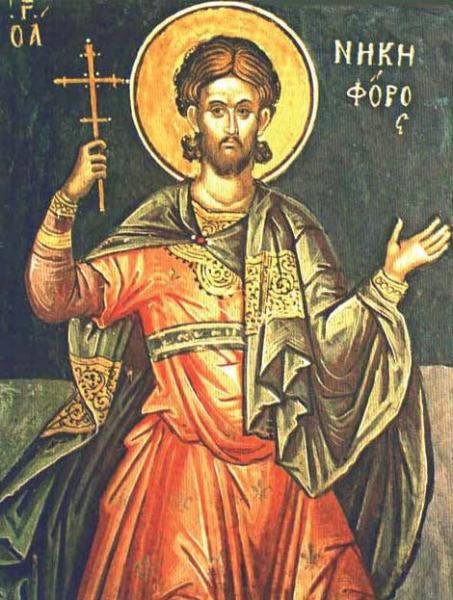

Antioch, and two friends
Nicephorus belongs to the church of Antioch on the Orontes, the great metropolis of the Roman East and the see of Ignatius the God-bearer, in the middle of the third century — the years of the empire-wide persecutions of Decius (250–251) and of Valerian (257–260), under one of which his passion is set. He was, so far as the account tells us, a layman; his name, Nikēphoros, "bearer of victory," the hymnography plays upon as the victory he was to win. His companion in the story is Sapricius (Σαπρίκιος), a priest of the same city. The two men were bound, the Acts say, in a friendship so intimate that they were taken for brothers, sharing one mind and one affection — the very picture of the love the Gospel commands.
That friendship is the hinge of the whole account, for it did not last. "The enemy of mankind, who hates all good," sowed between them a quarrel — the cause of it the tradition does not specify, and the omission is deliberate, for the lesson lies not in the occasion but in what was made of it — and the brotherly love of the two men curdled into a bitter and settled enmity. They ceased to speak; they turned their faces from one another; and what had been the closest of friendships became the coldest of hatreds. So it stood between them for a long time.
The refused forgiveness
Then Nicephorus came to himself. Recognising the quarrel for what it was — a snare of the devil, and a thing hateful to God — he resolved to be reconciled, and he sought reconciliation not once but with a persistence that is the heart of his sanctity. He sent friends to Sapricius as intermediaries, begging him to lay aside the enmity and be at peace; Sapricius refused. Nicephorus sent again, and a third time, entreating pardon through others; and each time the priest hardened his heart and would not hear. At last Nicephorus went to him in his own person, fell down before him, and begged forgiveness face to face: "Father, forgive me, if in anything I have offended you." Still Sapricius would not relent. The layman humbled himself to the utmost that one man can before another; the priest, in whom the office of reconciliation itself resided, refused to be reconciled. The account dwells on the reversal without labouring it: the one who had wronged — or was thought to have wronged — sought peace with tears; the one who held the grievance clung to it as to a treasure.
The persecution and the confession of Sapricius
Into this unhealed breach the persecution broke. The imperial edict against the Christians was published at Antioch, and Sapricius, as a priest, was among the first seized and brought before the governor. There he bore himself nobly. Questioned, he confessed himself a Christian without wavering; commanded to sacrifice to the gods, he refused; subjected to torture — the account has him stretched upon the wheel or the rack — he endured it with courage, answering that he was a Christian and a priest of the true God, and that no torment would move him from Christ. The governor, defeated by his constancy, pronounced the sentence: that Sapricius be led out and beheaded. To all appearance the crown of martyrdom was as good as his; he had confessed, he had suffered, and he had only to bow his neck to be numbered forever among the martyrs.
"Forgive me" — on the road to death
As Sapricius was led to the place of execution, Nicephorus met him on the road. Seeing his estranged friend going to the death that would seal him a martyr, and moved — the account is careful to say — not by fear but by love and by longing to be at peace with a soul about to depart, Nicephorus threw himself down before him: "Martyr of Christ, forgive me, if I have sinned against you." Sapricius, his mind fixed on his own coming glory, passed him by in silence. Nicephorus, undeterred, ran ahead by another way, met him again further on, and again fell at his feet with the same words; again the priest turned away. A third time, and a fourth, at each stage of the road, Nicephorus renewed his plea, and each time Sapricius, hardened, refused to speak the word of pardon — going to lay down his life for Christ while refusing the one thing Christ had made the condition of forgiveness, "if ye forgive not men their trespasses, neither will your Father forgive your trespasses" (Matthew 6:15; cf. 18:35).
The fall of Sapricius and the crown of Nicephorus
They came to the place of execution. The soldiers made ready; Sapricius was bidden kneel and bare his neck for the sword. And there, on the very threshold of the crown — his confession made, his tortures behind him, the blade already raised — grace departed from the man who would not forgive, and his courage failed. He asked the executioners, as if suddenly waking, why they meant to kill him; they answered, because he had refused to sacrifice to the gods and would not obey the emperors. "Do not kill me," said Sapricius; "I will do what the emperors command; I will sacrifice to the gods." In a single sentence, at the last possible moment, the confessor became an apostate, and the martyrdom he had all but won was thrown away — not for any new torment, but because the heart that had hardened itself against a brother could not, in the end, hold fast to God.
Nicephorus, who stood by, was stricken with horror and grief. He cried out to Sapricius, imploring him not to do this terrible thing, not to lose in a moment what he had gained through so much suffering, not to deny the Lord "for whose sake you have already endured so much": "Do not deny, I beg you, the Lord and Saviour Jesus Christ; do not throw away the crown that is already yours." But Sapricius, blind and obstinate, would not turn back. Then Nicephorus, seeing the crown lying as it were forsaken on the ground, and filled with the Spirit, declared himself openly before the soldiers: "I am a Christian; I believe in the Lord Jesus Christ, whom Sapricius has denied. Behead me in his place." The executioners, uncertain, sent word to the governor; the order came back that if he would not recant, he should die; and Nicephorus, confessing Christ with joy, bowed his neck and was beheaded. He received the crown that Sapricius, for want of forgiveness, had let fall.
The meaning the Church draws
The Church has never told this passion as a mere history but as a parable in act, and it draws the moral plainly. Sapricius had everything the martyr needs save one: he confessed the Name, he despised the tortures, he came within a sword's breadth of death for Christ — "and yet, because he would not forgive his brother, all was in vain." Nicephorus had nothing the martyr is supposed to need — no office, no long torment, no sentence of his own — but he had love, the love that humbles itself and seeks reconciliation to the last; and love carried him into the crown. The fathers read the two men through the thirteenth chapter of First Corinthians: "though I bestow all my goods to feed the poor, and though I give my body to be burned, and have not charity, it profiteth me nothing" (1 Corinthians 13:3) — Sapricius is the very figure of the body given to be burned without charity, and Nicephorus of the charity that suffers long and is kind. And they read it through the Lord's own teaching that the unforgiving are not forgiven, and through the petition of the Prayer, "forgive us our trespasses, as we forgive them that trespass against us." The commemoration is kept, accordingly, not only as the memorial of a martyr but as one of the Church's sharpest warnings: that no ascetic labour, no confession, not martyrdom itself, avails anything in the soul that will not be reconciled with its brother.
Feast and commemoration
Nicephorus is commemorated on February 9 (church date; New Calendar civil February 9, Old Calendar civil February 22). The day is the leavetaking (apodosis) of the Meeting of the Lord (see the Meeting of the Lord), on which the whole festal office of February 2 is sung once more; the martyr's office is kept together with the closing of the feast, so that his memory falls on the day the Church takes leave of the Light met in the Temple. His passion is set in the mid-third-century persecutions at Antioch, and the year is given with "c." — the Acts name neither emperor nor governor with certainty, and the tradition places the martyrdom under Valerian (c. 257–258), some reckonings under Decius (c. 250) or a little later. He is kept on the same day, February 9, in the Greek, Slavic, and Antiochian calendars, and the Roman Martyrology commemorates him and Sapricius together on the same date.
The commemoration is a layman's: Nicephorus held no office, and the Church honours him simply as martyr. Sapricius, by contrast, though he suffered as a confessor, is not venerated — his name is remembered only as the shadow against which Nicephorus shines, the confessor who fell, and the tradition names him precisely to teach by his loss. This is one of the few commemorations in the calendar built around a pairing of the saved and the lost.
Hymns
Apolytikion — Tone 3
Winged, O renowned one, by the love of the Lord, and bearing his glorious Cross upon thy shoulders, thou didst put to shame the devices of the devil; thou didst contend even unto death and for the truth. Wherefore thou wast shown forth a warrior and an initiate of the grace of God.
Iconography
Nicephorus is shown as a young or middle-aged layman-martyr — beardless or short-bearded, in the tunic and cloak of a layman rather than any vesture of office, holding the cross of martyrdom and often the palm; where the scene is narrative, he is depicted beheaded, kneeling beneath the sword, or meeting the doomed Sapricius upon the road and falling at his feet in the act of begging forgiveness — the moment that is the whole meaning of his feast. The stored image is an Eastern Orthodox fresco of the saint (the work of a painter dead more than a century, retained under the public-domain provision for pre-modern works), identified on its source page as Saint Nikephoros of Antioch.
Disputed questions
- Not to be confused with Nicephorus I, Patriarch of Constantinople (c. 758–828), the great iconodule confessor and historian who was deposed and exiled for the veneration of the icons and is kept on June 2 (repose) and March 13 (translation of his relics) — a wholly different saint of a later age and a higher office; nor with the several later hierarchs named Nicephorus of the Constantinopolitan and Antiochene sees. This Nicephorus is the third-century layman-martyr of Antioch, honoured for his forgiveness.
- Not to be confused, on his own day, with the Nikephoros of Vazheozersk commemorated with Gennadius on the same February 9 — a sixteenth-century Russian monastic disciple of Alexander of Svir, a namesake only (see the Pending entries of the day).
- Sapricius's fate. That Sapricius apostatised at the point of death and so lost the crown is the constant and essential datum of the passion; the received Acts do not preserve what became of him afterward, and the tradition, having made its point, lets him disappear. He is named in the commemoration but is not himself venerated.
- Date and emperor. The Acts give the martyrdom no securely fixed year or ruler; the mid-third-century Antiochene persecutions (Decius, 250; Valerian, 257–258) are the setting, and the date is given as "c. 257." The February 9 liturgical day is firm across the calendars.