
Nicholas Mystikos
Our Father among the Saints Nicholas the Mystikos, Archbishop of Constantinople and Ecumenical Patriarch
Patriarch · Bishop · Confessor · b. 852, in Byzantine Italy — d. 15 May 925, at Constantinople
Commemorated 16 May — Commemoration of his repose (†15 May 925)
Nicholas the Mystikos (852 – 15 May 925) was twice Ecumenical Patriarch of Constantinople, and is honoured as a saint for the one act that cost him his throne: his refusal to bless the fourth marriage of the emperor Leo VI the Wise. A kinsman and pupil of Photios the Great, he had served as mystikos — the emperor's confidential secretary, whence his surname — before his elevation in 901. When Leo, having buried three wives, took a fourth, Nicholas baptised the child of that union, the future Constantine VII, but shut the emperor out of the church; for this he was deposed and exiled in 907. Restored on Leo's death in 912, he was for a time head of the regency for the boy emperor, negotiated with Simeon of Bulgaria at the walls of the City, and lived to preside over the Tomos of Union of 920, which closed the schism his own resistance had begun by forbidding fourth marriages outright in the Church's law.

Origins and imperial service
Nicholas was born in 852 in the Byzantine provinces of southern Italy, of Greek stock. He came young to Constantinople and was formed in the household and the learning of Photios the Great, to whom the sources make him a kinsman as well as a disciple. When Photios fell a second time in 886 and the Ignatian party triumphed, Nicholas withdrew from the world; he founded, or richly endowed, the monastery of Galakrenai on the Bithynian shore near Chalcedon, which remained his refuge to the end of his life.
He did not stay in retirement. Under Leo VI he entered the palace as mystikos, an office of the emperor's private chancery — the keeper of the confidential correspondence, close to the emperor's person and to his secrets. The surname stayed on him ever afterwards, so that the Church remembers him not as Nicholas I but as Nicholas the Mystikos. On the death of the patriarch Antony II Kauleas he was raised to the patriarchal throne on 1 March 901.
The tetragamy of Leo VI
The affair that defines him is the tetragamia — the fourth-marriage crisis, the gravest struggle over canonical order between the Church and the throne between Iconoclasm and the eleventh century.
Leo VI had married and buried three wives: Theophano, whom the Church herself canonised; Zoe Zaoutzaina; and Eudokia Baïana, who died in childbirth in 901 with her son. Byzantine canonical practice regarded even a third marriage as a scandal tolerated only under penance; a fourth it did not regard at all. Yet Leo had no heir, and he took as his mistress Zoe Karbonopsina, "of the coal-black eyes," who on 3 September 905 bore him a son.
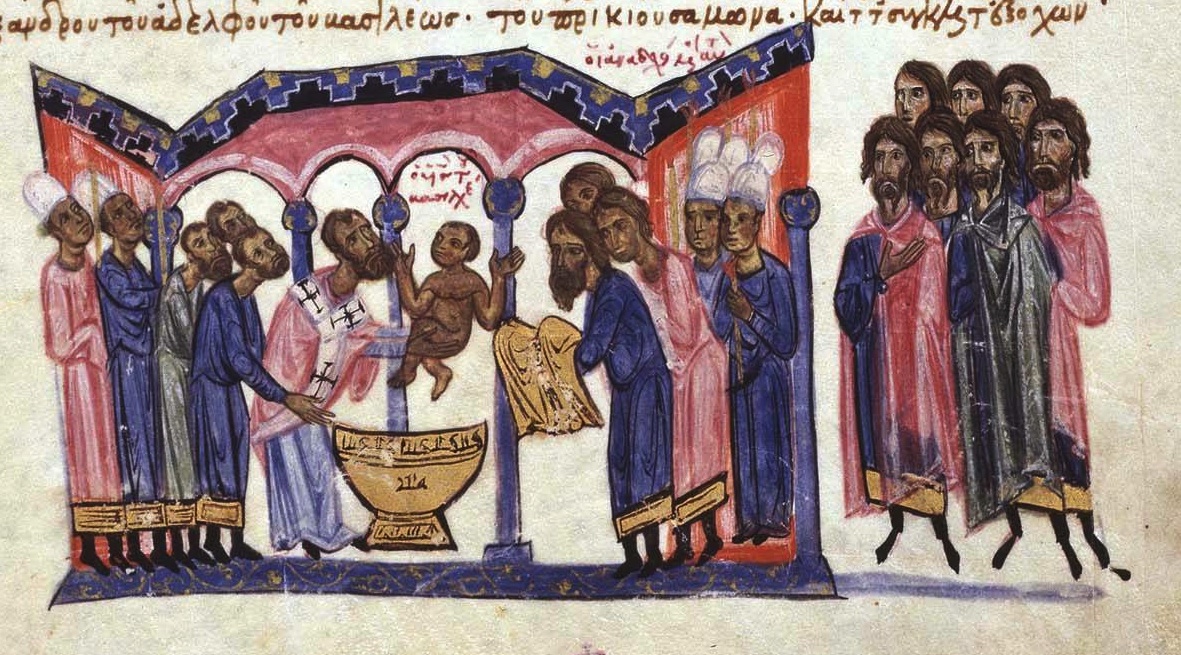
Nicholas consented to baptise the child in the Great Church on 6 January 906 — the infant was the future emperor Constantine VII Porphyrogennetos — on the express condition that the emperor put the mother away. Leo instead married her, the ceremony performed by a court priest named Thomas and Leo crowning her himself, since no bishop would do it. Nicholas answered by barring the emperor from the churches: Leo was made to stand outside the doors of Hagia Sophia among the penitents at the great feasts, as the Church's discipline required of a man in an unlawful union.
Leo, unable to move his patriarch, went round him. He gathered the opinions of the other patriarchs and obtained from Pope Sergius III a dispensation by economy for the marriage. Then, in February 907, on the pretext of Nicholas's supposed sympathy with the conspiracy of Andronikos Doukas, he had him deposed and shut up in his own monastery of Galakrenai. In his place was set the holy monk Euthymios the Syncellus, himself venerated as a saint — so that the schism which followed had a saint on either side of it, and the Byzantine Church was divided for years into "Nicholaites" and "Euthymians."
Restoration, regency, and Simeon at the walls
Leo VI died on 11 May 912. His brother Alexander, who had no love for his brother's arrangements, restored Nicholas on 15 May 912; Euthymios was deposed, and handled with brutality by Nicholas's partisans — a violence the sources report to Nicholas's discredit. Restored, he struck at the whole settlement of 906: he deposed the clergy who had communed with the emperor in his fourth marriage, refused the Roman dispensation, and for a time had the pope's name struck from the diptychs.
Alexander died on 6 June 913, leaving the seven-year-old Constantine VII on the throne, and Nicholas became the leading member of the council of regency. He sent Zoe Karbonopsina to a convent. Almost at once Simeon of Bulgaria came down on Thrace and appeared before the land walls. Nicholas went out to meet him at the Hebdomon and bought peace with a recognition that scandalised the court: he placed on Simeon's head — the tradition says his own epirriptarion, for want of a crown — acknowledging him in some measure as basileus of the Bulgarians, and agreed that a daughter of Simeon should marry the boy emperor. The court would not have it. Zoe returned from her convent in February 914, overthrew the regency, and repudiated the Bulgarian marriage; the war resumed and lasted a generation. Nicholas kept his throne but lost his political power, and turned back to the Church.
The Tomos of Union and his letters
His last years were his best. Under Romanos I Lekapenos the wound of the tetragamy was at length closed on 9 July 920 by the Tomos of Union (Τόμος τῆς Ἑνώσεως), read in the presence of the emperors and subscribed by both parties: fourth marriages were forbidden absolutely and without exception, third marriages hedged about with conditions of age and childlessness, and the two factions reconciled. It was in substance the vindication of the stand Nicholas had taken in 906, and it remains a foundation of Orthodox marriage law to this day. Communion with Rome was restored a few years later when papal legates accepted the tomos.
Nicholas is also, unexpectedly, one of the best-documented churchmen of his century, because his correspondence survives — some hundred and ninety letters, a body of material of the first order for the tenth century. He writes to Simeon of Bulgaria in the tone of a father rebuking a son and pleading for the peace of Christians; he writes to the emir of Crete and to the caliph's court at Baghdad on behalf of Christian captives and of the churches under Muslim rule, invoking the common humanity of the two peoples; he writes to bishops on discipline, to monks on their quarrels, and to the palace on the limits of imperial power in the Church. The letters, more than any hagiography, show why he was remembered as a saint.
He reposed on 15 May 925, and was buried at his monastery of Galakrenai.
Feast and commemoration
May 16 (church date; Old Calendar civil May 29). The commemoration is Greek in origin and is carried by the Greek synaxaria and by the Constantinopolitan list of patriarch-saints; it is not in the Slavic menologion for this day. No proper hymnography is appointed in the printed Menaion, and the office is taken from the common of a hierarch. He is classed here also as a confessor, on the strength of the deposition and exile of 907–912 endured for the Church's canonical order.
Hymns
Troparion — Tone 4 (common of a hierarch)
O God of our fathers, who dealest with us ever according to thy gentleness: take not away thy mercy from us, but by the prayers of thy hierarch Nicholas direct our life in peace.
Original translation from the Greek
Iconography
Nicholas is painted as a hierarch of the Byzantine capital: an elderly bishop, greying and long-bearded, in the crossed polystaurion phelonion of a patriarch with the omophorion, blessing and holding the Gospel; where he is named in the ranks of the patriarch-saints of Constantinople — in the narthex programmes of Greek churches and in the patriarchal portrait-series — he stands with Photios, Ignatius and Euthymios among the hierarchs of the ninth and tenth centuries. No devotional icon of him alone has been located for this repository, and he was never a saint of popular cult; what survives instead is the historical portraiture of the illuminated chronicles. The stored image is a miniature from the Madrid Skylitzes, the thirteenth-century Sicilian-Byzantine manuscript of John Skylitzes' history in the Biblioteca Nacional de España, showing the very scene on which the tetragamy turned: the patriarch, in the cross-patterned phelonion, lifting the naked infant Constantine VII from the font in the Great Church on 6 January 906, with the court ranged on either side. It is a chronicler's picture and not an icon, and is stored here as such.
Disputed questions
- The year of his repose. 925 is fixed by the chronicles and by the sequence of patriarchs (Stephen II followed him in 925). A date of 930 occasionally appears in handlists and in some devotional literature; it is an error, arising from confusion with later patriarchs of the same name or from miscounting his second tenure, which ran from 15 May 912 to his death thirteen years later, day for day.
- The day of the feast. He died on 15 May; the synaxaria commemorate him on May 16, the following day, since May 15 is occupied by Pachomius the Great. The feast is kept chiefly in Greek usage; the Slavic menologia for this day do not carry him.
- Sanctity and the schism. Both Nicholas and his rival Euthymios (August 5) are in the calendar, and both cannot have been right about the same question at the same time. Byzantine hagiography made no attempt to resolve this, and neither does this entry: the Church canonised the two men for their integrity in an impossible position, not for the correctness of their party. The violence done to Euthymios in 912 by Nicholas's followers is recorded against Nicholas by the Life of Euthymios, a hostile source, and is not to be passed over in his praise.
- The crowning of Simeon. What exactly Nicholas conferred at the Hebdomon in 913 — the imperial title, a lesser royal dignity, or nothing that a Byzantine would have recognised as a coronation — was already disputed by contemporaries and is still argued by historians; it is one of the central questions of medieval Bulgarian claims to empire.
- Not to be confused with Nicholas Chrysoberges, patriarch of Constantinople 979–991, nor with the various other Nicholases of the calendar, beginning with Nicholas the Wonderworker of Myra.