
Nicholas of Japan
Our Father among the Saints Nicholas, Equal-to-the-Apostles, Archbishop of Japan
Equal to the Apostles · Bishop · b. August 1, 1836, Beryozovsky Pogost, Smolensk province — d. February 3, 1912, Tokyo
Commemorated 3 February — Repose at Tokyo of the enlightener of Japan
Nicholas of Japan (Ivan Dmitrievich Kasatkin, 1836–1912) was the founder and first hierarch of the Orthodox Church in Japan, honoured as Equal-to-the- Apostles for a missionary labour of half a century. A Russian priest who came to the consulate at Hakodate in 1861, he gave himself to the language, literature, and mind of Japan so completely that he rendered the Scriptures and the whole round of the services into Japanese, and gathered from nothing a native Church of tens of thousands, served by Japanese clergy and catechists. As bishop and then archbishop he built the great Holy Resurrection Cathedral in Tokyo — known to the city as Nikolai-do, "Nicholas's house" — and through the Russo-Japanese War he remained at his post, bidding his Japanese flock pray for their own country and its soldiers even as he, a Russian, kept silence. He reposed in Tokyo on February 3, 1912, and was glorified as a saint in 1970. He is one of the great apostolic missionaries of the modern age.

Origins and calling
He was born Ivan Dmitrievich Kasatkin on 1 August 1836 in the village of Beryozovsky Pogost in the Smolensk province of Russia, the son of a deacon. He was educated at the seminary of Smolensk and then at the Saint Petersburg Theological Academy, where, reading of the openings then appearing in the Far East, he conceived the desire to carry the Gospel to Japan — a country only just, and warily, opening to foreigners after two centuries of seclusion, and where the profession of Christianity had until lately been a capital crime. In 1860 he was tonsured a monk with the name Nikolai, ordained, and appointed chaplain to the Russian consulate at Hakodate on the northern island of Hokkaido; he arrived in 1861.
The long apprenticeship
Nicholas understood from the first that a mission to Japan could not be an importation but must become Japanese. He set himself, with famous discipline, to master the Japanese language — and beyond the language, the history, the Confucian and Buddhist classics, and the temper of the people — spending years in study before he sought a single convert, on the conviction that the Gospel must be preached to the Japanese in their own tongue and within their own inheritance. His first converts came in the late 1860s, among them a Shinto priest, Sawabe Takuma, who had come to kill the foreign teacher and stayed to be baptised, and who became one of the first Japanese Orthodox priests. Around such men Nicholas built not a chaplaincy but a native Church: Japanese catechists whom he trained and sent out, Japanese clergy, and congregations that governed much of their own life through regular councils.
The Church of Japan
In 1870 the Russian Church erected the Russian Ecclesiastical Mission in Japan with Nicholas at its head, and the work moved to the capital. From Tokyo he directed an enterprise of extraordinary range: a seminary, schools for boys and girls, a translation bureau, and a printing press. Above all he labored, with his collaborator Nakai Tsugumaro, at the translation of the Holy Scriptures and the liturgical books into Japanese — the Gospels, the Epistles, the Psalter, the Octoechos, the Lenten and Festal Triodia, the Menaion — so that the Japanese Church might worship wholly in its own language, a task that occupied him for the rest of his life. In 1880 he was consecrated bishop; and in 1891 the great Cathedral of the Holy Resurrection was completed on the Surugadai hill in Tokyo, so dominating and so identified with him that the Japanese called it, and call it still, Nikolai-dō — "Nicholas's house." By the turn of the century the Church of Japan numbered some thirty thousand faithful in hundreds of communities.
The Russo-Japanese War
The supreme test of Nicholas's apostolate came with the Russo-Japanese War of 1904–1905, which set his adopted country at war with his native one. He chose to remain in Tokyo with his flock rather than withdraw; but, holding that a Russian bishop could not lead public prayers for the defeat of Japan, he ceased for the duration to take part in the public services of intercession, and bade his Japanese Christians pray for their own Emperor, their country, and their army — for it was their patriotic duty — while he gave himself privately to prayer and to the care of the many Russian prisoners of war held in Japan, whom he served through his clergy with sacraments, books, and comfort. His conduct won him the respect of the Japanese themselves, and the young Church came through the war not broken but confirmed, having learned from its bishop that the Gospel is above the nations. In 1906 he was raised to the dignity of archbishop.
Repose
Worn out by a lifetime of labour, Archbishop Nicholas reposed in Tokyo on 3 February 1912 (16 February by the civil New Calendar reckoning of his day), after more than fifty years in Japan. His funeral drew an immense concourse of mourners, Christian and non-Christian alike, and a message of condolence from the Emperor of Japan — a mark of honour extraordinary for a foreign missionary. He was buried in the Yanaka cemetery in Tokyo, where his grave became a place of veneration, and he left behind a self-standing Orthodox Church of Japan with its own clergy, its own translated services, and its cathedral.
Glorification
On 10 April 1970 the Church of Russia glorified Nicholas of Japan as a saint, numbering him among the Equal-to-the-Apostles — the rank of the great missionary saints, of Constantine and Helen, of Nina of Georgia, of Cyril and Methodius, of Vladimir of Kiev — in acknowledgement of an apostolate that had planted the Church in a whole nation. His memory is kept on the day of his repose, February 3, and he is venerated as the enlightener of Japan and a patron of the Church's mission in the modern world.
Feast and commemoration
Nicholas is commemorated on February 3 (church date; Old Calendar civil February 16), the day of his repose in 1912, which falls within the afterfeast of the Meeting. He is kept above all in the Church of Japan and the Russian Church, and, since his glorification, more widely across the Orthodox world as one of the modern Equal-to-the-Apostles. Because his glorification is recent (1970), his liturgical office is a modern composition (see Hymnography).
He is not to be confused with the Russian fool-for-Christ Nicholas (Salos) of Pskov (†1576, kept February 28), nor with the great Nicholas the Wonderworker of Myra; "the Enlightener of Japan" belongs to this Nicholas alone.
Iconography
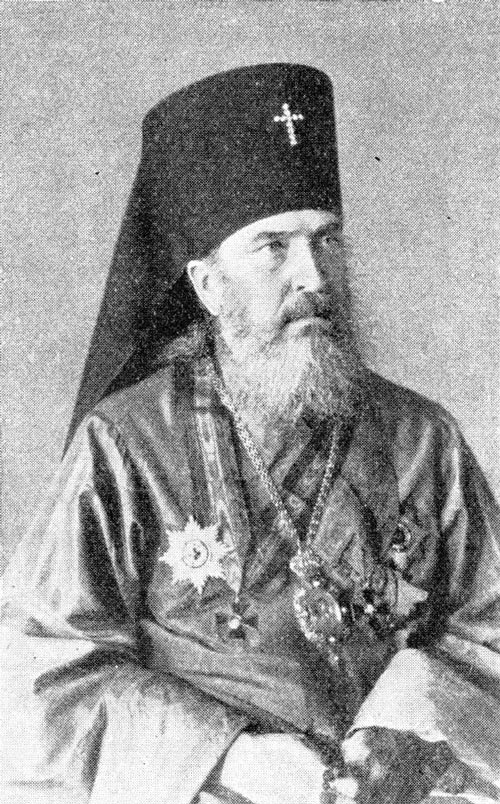
As a saint glorified in 1970, Nicholas is depicted in modern icons in the type of an apostolic hierarch: an archbishop in the sakkos and omophorion or in a monastic mantle, a full grey beard, blessing with one hand and in the other holding the Gospel-book or a scroll, sometimes with the Holy Resurrection Cathedral of Tokyo behind him and Japanese faithful at his feet, or holding the Japanese Gospel he translated. These painted icons are the work of living or recent iconographers and are under copyright; none is stored.
The stored image is instead a lifetime photograph of the archbishop, taken before 1910 and thus public domain by age — a documentary portrait, not a painted icon, showing Nicholas as an aged, full-bearded hierarch (source, public domain, pd-old-work). A written icon of the saint remains wanted.