
Nicholas the Studite
Our Venerable Father and Confessor Nicholas, Abbot of the Studion
Venerable · Confessor · b. c. 793, Kydonia in Crete — d. 868, Constantinople
Commemorated 4 February — Repose at the Studion; within the afterfeast of the Meeting
Nicholas the Studite (c. 793 – 868) was a monk, confessor, and twice abbot of the great Studion monastery at Constantinople in the age of the second iconoclasm. Born in Crete and sent as a boy to Constantinople under the care of his uncle, he entered the Studion and became a disciple of its renowned abbot Theodore the Studite, whom he served as secretary and followed into exile when the veneration of the holy icons was again outlawed. Beaten and imprisoned for the icons, he confessed the faith without dying for it, and after the Triumph of Orthodoxy in 843 he governed the Studion in his old age. When the deposition of the patriarch Ignatius divided the Church, Nicholas withdrew rather than commune with the intruded Photius, sharing Ignatius's disgrace, and reposed on February 4, 868. He is kept universally on that day, within the afterfeast of the Meeting.
.jpg)
Origins and entry into the Studion
Nicholas was born about the year 793 in the village of Kydonia on the island of Crete, of Christian parents. At the age of ten he was sent to Constantinople to his uncle, a monk of the imperial capital, and was placed for his schooling in the monastery of Stoudios (the Studion), the most famous and disciplined house of the Byzantine world. There he came under the direct formation of its great abbot Theodore the Studite, the reformer of Byzantine monasticism and the tireless champion of the holy icons, and in due course received the monastic tonsure. Gifted with a fine hand, he became one of the monastery's calligraphers and served Theodore as a secretary — a role that bound the young monk closely to the abbot in the struggles that were about to break over the Church.
Confessor of the icons
Under the emperor Leo V the Armenian (813–820) the imperial policy of iconoclasm, condemned at the Seventh Ecumenical Council in 787, was revived: the images of Christ and the saints were again ordered removed and their veneration forbidden. Theodore the Studite led the resistance, and his community suffered with him. Nicholas shared his master's exiles and imprisonments, following him from place to place as the abbot was banished and moved about, and himself enduring scourging and confinement for refusing to renounce the icons. The tradition records the harshness of these years — floggings, hunger, and prison — borne by the young monk at his abbot's side; because he suffered for the faith but was not put to death, the Church numbers him among the confessors. The persecution slackened and hardened again through the reigns of Michael II and Theophilus, and only with the death of Theophilus and the regency of the empress Theodora was the veneration of icons finally and permanently restored at the Triumph of Orthodoxy in 843.
Abbot of the Studion
After the restoration of the icons Nicholas, now an elder of tried holiness and one of the last living links to the age of Theodore (who had died in exile in 826), was chosen abbot of the Studion. He governed the great community in the spirit of his master's rule, a living memory of the confessing Church. But his abbacy fell across a new and bitter division. In 858 the patriarch Ignatius was deposed and exiled by the imperial power, and Photius was raised to the patriarchal throne in his place. Nicholas held Ignatius to be the lawful patriarch, unjustly deposed, and refused to enter into communion with Photius. For this he was removed from the abbacy and himself sent into a kind of confinement or withdrawal, sharing the disgrace of the Ignatian party — a second confession, in old age, for the sake of the Church's order as he understood it.
Repose
When Ignatius was at length restored to the patriarchate (867), Nicholas too returned to his monastery; but he was very old, and he reposed at the Studion on February 4, 868, full of years and of sufferings for the faith. He had lived through the whole arc of the second iconoclasm and its aftermath — from the generation of Theodore the Studite to the eve of the great settlement of the Eastern Church — and had confessed Christ twice over, once for the icons and once for the honour of a wronged patriarch.
Feast and commemoration
Nicholas is kept universally on February 4 (church date; Old Calendar civil February 17), within the afterfeast of the Meeting of the Lord, together with Isidore of Pelusium, who leads the day. His office is sung with the afterfeast hymns of the Presentation. The Greek and Slavic calendars agree on the day. He is to be distinguished from his own master Theodore the Studite (kept November 11 and January 26) and from the many other saints named Nicholas.
Hymns
Troparion — Tone 8
O dweller of the wilderness and angel in the body, thou wast shown to be a wonderworker, O Nicholas our God-bearing father; by fasting, vigil, and prayer receiving heavenly gifts, thou dost heal the sick and the souls of them that run to thee with faith. Glory to him that gave thee strength; glory to him that crowned thee; glory to him that worketh healings for all through thee.
Original translation from the Greek
Iconography
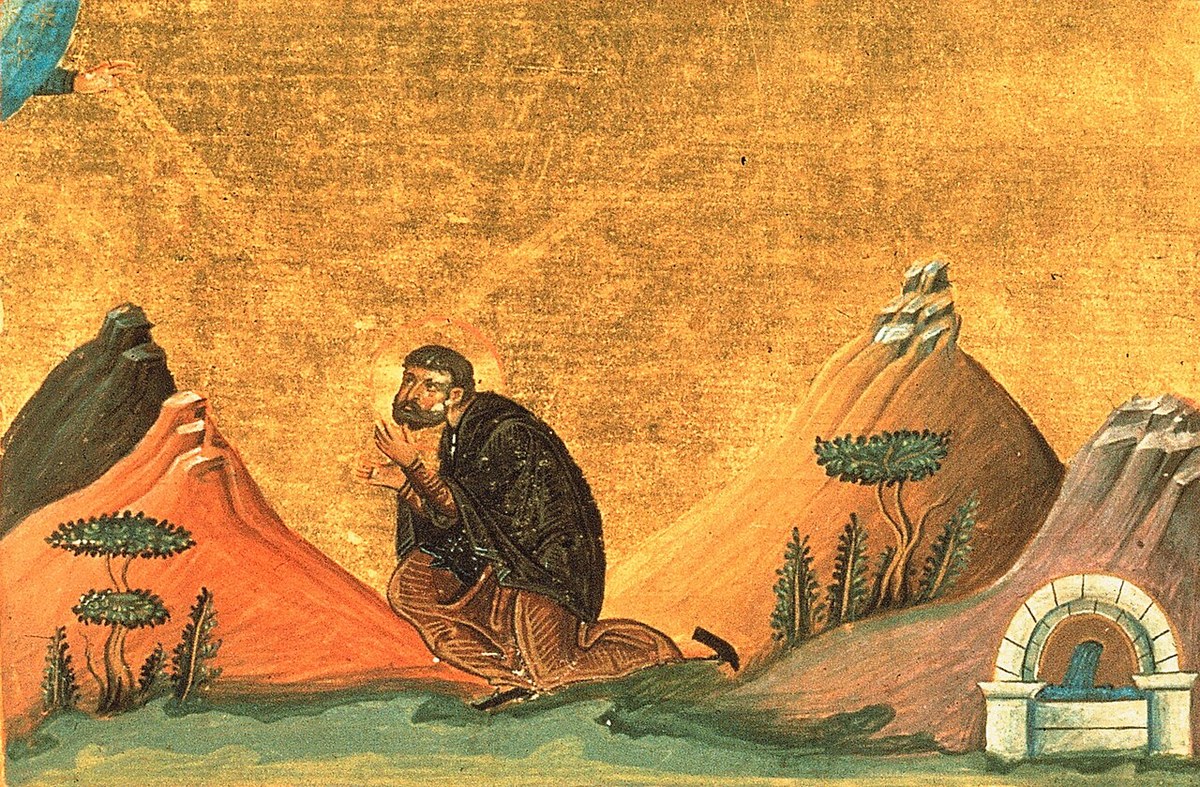
Nicholas is depicted as an aged monk in the schema, grey-bearded, holding a scroll or a cross — the settled type of the venerable confessor-abbot. His proximity to the great Studite tradition means he is sometimes shown in company with Theodore the Studite.
The stored image is the miniature for February 4 from the Menologion of Basil II (Constantinople, c. 985; Vatican, Vat. gr. 1613), depicting Nicholas as an aged monastic father (source, public domain, pd-old-work).