
Nicodemus the Righteous
The Holy and Righteous Nicodemus, the Secret Disciple, who came to Jesus by night
Righteous · d. 1st century, at Jerusalem
Commemorated 2 August — Finding of his relics at Kaphar Gamala with those of the Protomartyr Stephen (415), Pascha offset 14
Nicodemus was a Pharisee and a ruler of the Jews, a member of the Sanhedrin, who came to Jesus by night to ask about the Kingdom and received from Him the teaching on being born again of water and the Spirit (John 3). He appears twice more in the Fourth Gospel: pleading in the council that the Law does not condemn a man unheard (John 7:50–51), and coming at last into the open on Great Friday with a hundred pound weight of myrrh and aloes to help Joseph of Arimathea take the body of the Lord from the Cross and lay it in the tomb (John 19:39–42). Tradition has him baptised by the Apostles Peter and John, expelled from the Sanhedrin and driven from Jerusalem, and sheltered in the country house of the teacher Gamaliel, in whose tomb at Kaphar Gamala his relics were found together with those of the Protomartyr Stephen in the year 415.
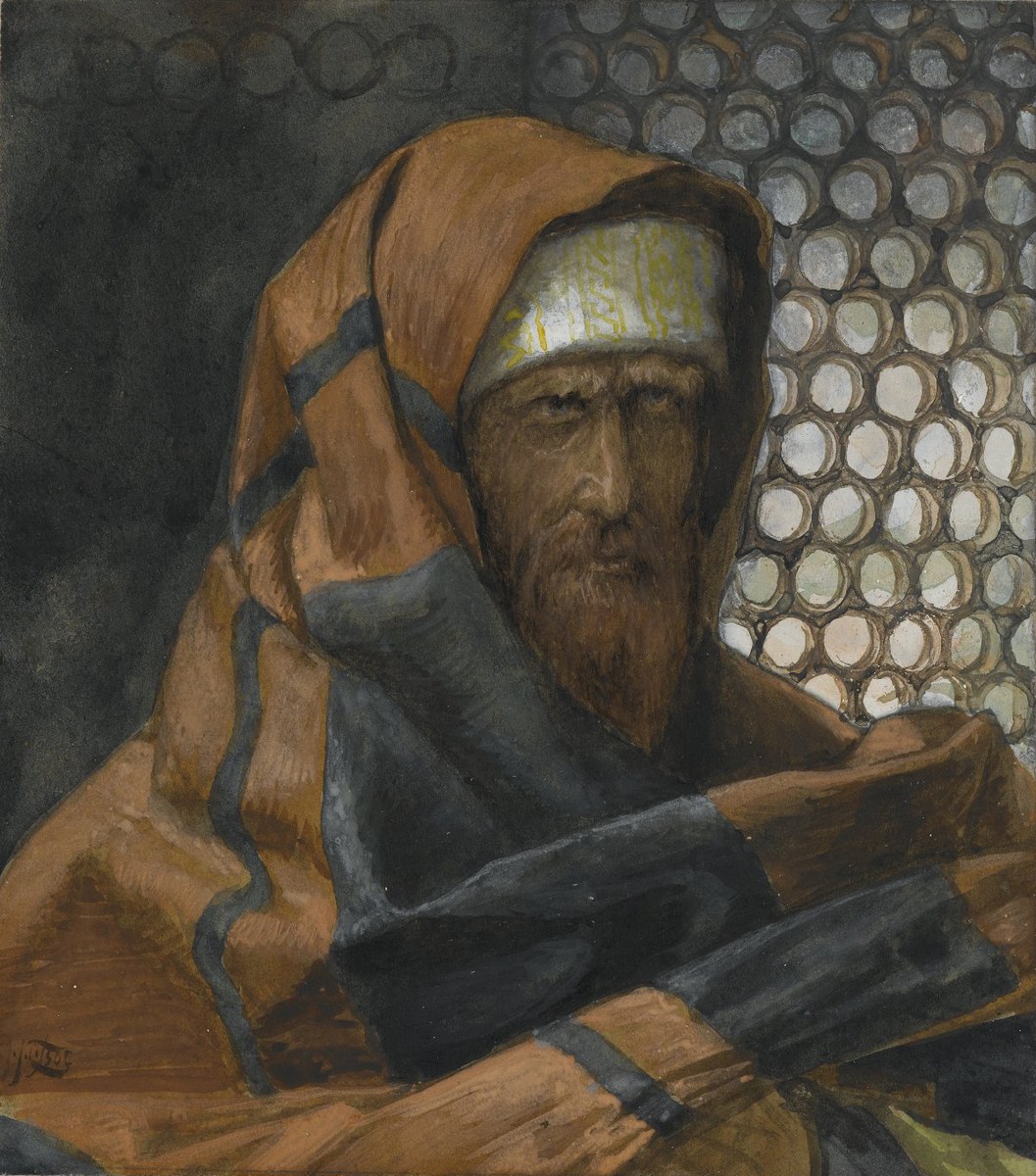

The ruler who came by night
Nicodemus is introduced in John's Gospel as "a man of the Pharisees, a ruler of the Jews" (John 3:1) — that is, a member of the Sanhedrin and a teacher of the Law; Jesus addresses him as "the teacher of Israel" (John 3:10), the definite article suggesting a man of standing among the rabbinic authorities of Jerusalem. He came to Jesus by night, a detail the Evangelist repeats every time he names him, and which the Fathers read in two ways at once: as prudence in a man with much to lose, and as the darkness out of which every soul comes to the Light.
The conversation that followed is one of the great discourses of the Fourth Gospel. Nicodemus began with a courteous confession — "we know that thou art a teacher come from God, for no man can do these signs except God be with him" — and was answered with a demand that overturned him: "except a man be born again, he cannot see the kingdom of God." His literal-minded objection, how can a man be born when he is old?, drew out the teaching on baptismal regeneration — "born of water and of the Spirit" — the wind that blows where it wills, the Son of Man lifted up as Moses lifted the serpent, and the verse that has carried more of the Gospel to more people than any other, "God so loved the world" (John 3:1–21). The Church reads this passage at the Vigil of Pentecost and in the Paschal season, and Nicodemus is thus the interlocutor through whom the Church's own baptismal theology is delivered.
The defender in the council
He is heard from again when the temple officers return empty-handed and the chief priests rage that the crowd is deceived. Nicodemus — the Evangelist reminds us pointedly that he was "he that came to Jesus by night, being one of them" — asks: "Doth our law judge any man, before it hear him, and know what he doeth?" (John 7:50–51). It is a lawyer's intervention, cautious and procedural, and it is brushed aside with a sneer about Galilee; but it is the only voice raised for Christ in the Sanhedrin that the Gospels record before the Passion.
The burial of the Lord
On the evening of Great Friday the caution ends. Joseph of Arimathea went to Pilate and begged the body; and "there came also Nicodemus, which at the first came to Jesus by night, bringing a mixture of myrrh and aloes, about an hundred pound weight" (John 19:39). The quantity is royal — the spices of a king's burial — and the act was made in full public view, at the moment when the apostles had scattered and when to touch the body of a man crucified for sedition was to declare oneself. Together the two took the Lord down from the Cross, wound the body in clean linen with the spices, and laid it in the new tomb in the garden. From this the Church names them among the myrrhbearers, and the Byzantine rite sings of "the noble Joseph" and Nicodemus in the same breath on Great Friday and on the third Sunday of Pascha.
After the Resurrection
Beyond the Gospel the record is traditional. Nicodemus is said to have been baptised by the Apostles Peter and John, and, when this became known, to have been stripped of his rank, expelled from the Sanhedrin and driven out of Jerusalem, his goods confiscated. The teacher Gamaliel — his kinsman by some accounts, his colleague in the council by all — took him into his country estate at Kaphar Gamala outside the city, where Nicodemus lived out his days in poverty and prayer and died; and Gamaliel buried him there, in the same tomb in which he had earlier laid the body of the Protomartyr Stephen, and in which he and his son Abibas would afterwards be laid themselves.
The apocryphal Acts of Pilate circulated from an early date under the title the Gospel of Nicodemus, on the strength of his presence at the trial and burial; the attribution is conventional and no one now supposes he wrote it, but it preserves the sense of the early Church that Nicodemus was the insider whose testimony reached into Pilate's court.
The finding of the relics, 415
In the year 415 a priest of Kaphar Gamala named Lucian received in a vision, three times repeated, an aged man in white who named himself Gamaliel and showed him the place where four bodies lay: the Protomartyr Stephen, Nicodemus, Gamaliel himself, and Gamaliel's son Abibas. The tomb was opened in the presence of Bishop John of Jerusalem with Eutonius of Sebaste and Eleutherius of Jericho, and the relics — identified, the account says, by inscribed tablets — were carried in procession to Jerusalem. The Church keeps the finding on August 2, together with the translation of Stephen's relics to Constantinople; the uncovering itself is also commemorated on September 15.
Feast and commemoration
August 2 (church date; Old Calendar civil August 15), within the Dormition fast (August 1–14) — the finding of his relics at Kaphar Gamala, kept with those of Gamaliel, Abibas and the translation of the relics of the Protomartyr Stephen, all four being the occupants of the one tomb. He is commemorated again on September 15 with the uncovering of Stephen's relics, and on the movable Sunday of the Myrrhbearers (the third Sunday of Pascha) together with Joseph of Arimathea and the myrrhbearing women — which is in practice his principal commemoration in parish life, though the fixed feast of August 2 carries the rank here.
Hymns
Troparion — Tone 2
Thou camest to the Light by night, O righteous Nicodemus, and wast taught the birth from above; and when the disciples were scattered thou didst come forth openly with myrrh and aloes, to take down from the Tree the Life of all and lay Him in the tomb. Wherefore, entreat Christ God that our souls may be saved.
Original translation from the Greek
Iconography
Nicodemus is almost never painted alone. He belongs to the two great Passion compositions: the Descent from the Cross, where he stands at the foot of the Cross drawing the nails from the Lord's feet with pincers while Joseph receives the body, and the Entombment / Epitaphios, where he supports the feet of the winding-sheet. He is shown as a middle-aged or elderly Jewish elder, dark-bearded and greying, bare-headed, in tunic and himation, often with a jar or bundle of spices. Where he appears in a menologion strip for August 2 he stands with Gamaliel and Abibas beside the open tomb of the Protomartyr. The stored image is a Western work per §34: Tissot's portrait-study of Nicodemus (1886–1894, Brooklyn Museum), the night-visitor of John 3 in his years. An Eastern image remains wanted and is listed among the upgrade-wanted icons.
Disputed questions
- Nicodemus and Nakdimon ben Gurion. Rabbinic literature knows a wealthy Jerusalemite named Nakdimon ben Gurion, ruined in the siege of 70, whose name has often been identified with the Gospel's Nicodemus. The identification is old and attractive but cannot be demonstrated; the chronology strains, and the name was not rare.
- Whether he was of the Seventy. Some late lists draw him among the Seventy Apostles. The standard Byzantine catalogues of the Seventy do not include him, and this collection classes him, with Joseph of Arimathea, simply as righteous.
- The date of his repose is not transmitted; the first century is assumed from the narrative, not attested.