
Nikodemos of Kozheozero
Our Venerable Father Nikodemos, Hermit of the Khuzyuga and Wonderworker of Kozheozero
Venerable · Wonderworker · b. c. 1550s, at Ivankovo near Rostov — as Nikitas — d. 3 July 1640, at the Kozheozero monastery
Commemorated 3 July — Repose at Kozheozero (1640), foretold to him forty days before
Nikodemos (in the world Nikitas, c. 1550s – 3 July 1640) was a peasant's son from near Rostov who was called by name out of a field as a boy, learned the trade of blacksmith, was recognised in a Moscow street by a fool-for-Christ as "the ascetic of the Khuzyuga" before he had ever heard of the place, and became a monk of the Chudov monastery. Refusing preferment when his abbot was made a metropolitan, he went north to the Kozheozero monastery in the forests of the Onega, and thence to a cell on the little river Khuzyuga, five versts off, where he lived thirty-five years without coming out. He was granted tears, unceasing prayer, clairvoyance and healing; wild deer walked past his hut unafraid; and forty days before his death two saints in shining garments told him the day he would depart, which was July 3, 1640.
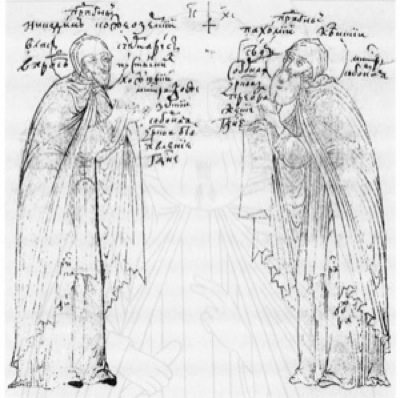
._%D0%A0%D1%83%D1%81%D1%8C._XVII_%D0%B2%D0%B5%D0%BA._%D0%A1%D0%B8%D0%B9%D1%81%D0%BA%D0%B8%D0%B9_%D0%BB%D0%B8%D1%86%D0%B5%D0%B2%D0%BE%D0%B9_%D0%BF%D0%BE%D0%B4%D0%BB%D0%B8%D0%BD%D0%BD%D0%B8%D0%BA,_%D0%BB._489.jpg)
The voice in the field
He was born Nikitas, into a peasant family of the village of Ivankovo near Rostov. While still a boy, working in the fields with his father, he heard a voice call him twice by a name that was not his — "Nikodemos! Nikodemos!" — the name he would receive at his tonsure many years later. The Life places the call at the very beginning, before anything else is told of him, as the whole shape of his life given in advance.
After the death of his parents he went to Yaroslavl and learned the trade of blacksmith, and from there to Moscow, where he worked at it.
"The ascetic of the Khuzyuga has come"
The second call was as strange as the first. Passing through Kulishki in Moscow, Nikitas stopped at the hut of the fool-for-Christ Elias, who looked up at him and cried out: "the Khuzyugsk ascetic has arrived" — naming a river in the far northern forests that the young smith had never heard of and would not see for years.
The words struck him, and he took them for a call to the monastic life. He gave away everything he had and went to Archimandrite Paphnutius of the Chudov monastery in the Kremlin — the monastery of the Miracle of the Archangel Michael at Chonae — asking to be received among the brethren. There he was tonsured Nikodemos, and for eleven years he was an example to that community in humility, obedience, non-acquisitiveness and brotherly love.
North
In 1602 Paphnutius was made Metropolitan of Sarsk and Podonsk (the Krutitsy see) and took Nikodemos with him — the beginning of a career in the church administration of the capital. Nikodemos wanted nothing of it. A year later, with the metropolitan's blessing, he went north, and entered the cenobitic monastery of Kozheozero — "Kozhe Lake," in the roadless forest country between the Onega and the White Sea — where he stayed a year and a half.
Thirty-five years on the Khuzyuga
Even the Kozheozero cenobium was too much company. He went out to the rivulet Khuzyuga, five versts from the monastery, built himself a small cell in the thicket, and did not come out of it for thirty-five years. The Life compares him deliberately to Paul of Thebes (January 15), the first hermit.
His rule was prayer for the world, kept in complete silence and solitude. He fished, and shared what he caught, and the fruit of his labour, with the brethren of the monastery. Wild deer walked about the hermitage without fear of him. He spent the nights in prayer and allowed himself sleep only occasionally, and then sitting up. By this life he was granted the gift of tears and unceasing prayer, and God gave him clairvoyance and the power to heal the sick — so that the solitude was never quite complete, and people came the five versts through the forest to find him.
The forty days' warning
Two radiant men appeared to him in his cell: Alexis, Metropolitan of Moscow (February 12) and Dionysius, Archimandrite of the Trinity–Sergius Lavra (May 12), in the angelic habit. They told him that he would go to the Lord in forty days, on July 3, 1640. He did, on that day.
His relics rest beneath a crypt in the Theophany church of the Kozheozero monastery. His Life was written by his disciple, the hieromonk James, which is why so much of the interior detail of a hermit's life survives at all.
Feast and commemoration
July 3 (church date; New Calendar civil July 3, Old Calendar civil July 16), the day of his repose, which was foretold to him. Russian usage; kept also by ROCOR and the OCA. He is one of the chief saints of the Onega and White Sea north, honoured with Pachomius of Kena, his neighbour in that country, and an akathist to him is appointed. The Kozheozero monastery, suppressed and ruined in the Soviet period, has been partly revived, and his relics remain on the site.
Hymns
Troparion — Tone 8
Called by name while yet a child, and named a hermit of the wilderness before ever thou hadst seen it, thou didst forsake the city and its honours, O father Nikodemos, and for five and thirty years didst pray in the forest for the whole world; wherefore, having known beforehand the day of thy departure, thou wast taken up in peace. Entreat Christ our God that our souls may be saved.
Original translation from the Slavonic
Iconography
Nikodemos is painted as an elderly monk of the northern Russian type: long narrow face, a full beard of moderate length, the koukoulion thrown back or the head bare, in the dark mantiya over the rason, with the right hand raised in prayer or blessing and the left holding a scroll. His attributes are the standard hermit's — no wheel, no book, no instrument — and he is identified in practice by his inscription and by the company he keeps: he is very often painted with Pachomius of Kena, the other ascetic of that corner of the Onega, and, in the larger northern compositions, with the Solovki fathers Zosimas and Sabbatius above the lake and the monastery.
The stored image is the traced drawing from an icon preserved in the Siya illuminated icon-painter's manual (Сийский лицевой подлинник, fol. 489), a seventeenth-century Russian workshop compilation: Nikodemos stands at the left in the mantiya with hands extended in prayer, Pachomius of Kena at the right holding a scroll, both inscribed, with the hand of God in the rays between them. As a workshop podlinnik drawing rather than a finished panel it gives the type in its purest form — the outline that painters were to follow — which is why it is preferred here to any later coloured version.
Disputed questions
- The year of his birth is not transmitted; it is inferred from the eleven years at the Chudov monastery before 1602 and the thirty-five years on the Khuzyuga before 1640, which put his birth in the middle of the sixteenth century.
- Thirty-five years, or thirty-six? Russian sources vary between the two, and some count the year and a half at Kozheozero into the total. Nothing of substance turns on it.
- The name in the field. That a boy should be called by his future monastic name years before his tonsure, and greeted in a Moscow street by the name of a river he had never heard of, is the double marvel on which the Life is built; it is transmitted from his own account, through his disciple James, and is not independently attested.
- Not to be confused with Nikodemos the Hagiorite (July 14), the Athonite editor of the Philokalia, nor with Nikodemos of the Kiev Caves the prosphora-baker (October 31), nor with the Nikodemos who was archbishop of Serbia. The Kozheozero saint is a Russian hermit of the far north and shares nothing with them but the name.