
Nikon Metanoeite
Our Venerable Father Nikon "Metanoeite," the Preacher of Repentance
Venerable · b. c. 930 — d. 998
Commemorated 26 November — Repose; falls within the Nativity Fast
Nikon Metanoeite (c. 930–998) — "Preach Repentance" — was the great missionary monk of the tenth-century Byzantine world, whose whole preaching was compressed into the one cry with which he opened every sermon, "Repent!" (μετανοεῖτε). Born in Pontus and tonsured at the monastery of the Golden Rock, he travelled through Armenia, Crete newly recovered from the Arabs, Euboea, Aegina and the whole Peloponnese, recalling Christians to the Church and confirming the faith. He settled at last at Lacedaemon (Sparta), where he built a church of Christ the Saviour and a monastery, and where his relics remained a source of healing. He is commemorated on November 26.
_-_Nikon_Metanoeite.jpg)
Origins and monastic beginnings
Nikon was born at the beginning of the tenth century in Pontus Polemoniacus, on the south-eastern shore of the Black Sea, the son of a wealthy landowner, and received in baptism the name Nicetas. Having no desire to take up the management of the family estates for which his father intended him, he left home and entered the monastery of Chrysopetro — the "Golden Rock" — where he shone in prayer and ascetic labour and, at his tonsure, received the new name Nikon, a name that for the monastic tradition signifies the putting off of the old man and the beginning of a new life in the Spirit.
The preaching of repentance
Nikon was given a remarkable gift of preaching: when he spoke of virtue and of the things of God, his hearers were filled with compunction and love. His words bore such fruit that he was sent out to preach through the eastern lands, and he travelled across Armenia and then through the islands and provinces of the Byzantine south — Crete, only lately reconquered from the Arabs by Nikephoros Phokas and needing to be won back to a firm Christian life, and afterward Euboea, Aegina and the whole of the Peloponnese.
Wherever he came he began his sermon with the single word "Repent" — μετανοεῖτε — the message of John the Forerunner (Matthew 3:2) and of Christ himself (Matthew 4:17); and from this he received the surname by which he has always been known, Metanoeite, "Preach Repentance." At first the people gave him little heed, but gradually, through his preaching, his miracles and his gentle and loving nature, he won their hearts. He warned against a false and easy repentance — a few sighs and groans mistaken for conversion — and taught that true sorrow for sin is cultivated by prayer, self-denial, almsgiving, ascetic effort and confession to one's spiritual father, urging those who had begun to amend their lives to strengthen their souls in virtue lest they be overwhelmed again by the cares of the world.
Sparta and repose
Nikon settled at length in a cave outside Lacedaemon (Sparta), but so many came to hear him that he moved into the city itself, where in its centre he built a church dedicated to Christ the Saviour, about which a monastery grew up. There he continued to preach, to heal the sick and to work many miracles until he fell asleep in the Lord in 998. His memory was cherished by the people of Sparta, and, though during the Turkish centuries he was all but forgotten elsewhere, his veneration revived after the Greek Revolution: a service to him was composed by Father Daniel Georgopoulos on the basis of the Life written in 1142 by Gregory, abbot of the saint's own monastery, and in 1893 the cathedral of Sparta was dedicated to him when he was named patron of the diocese of Monemvasia and Lacedaemonia.
Feast and commemoration
November 26 (church date; Old Calendar civil December 9), his repose, within the Nativity Fast. His feast is kept especially in the Greek Churches — above all at Sparta, of which he is patron — and in the Orthodox Church in America; the Greek Menaion joins his service with that of Alypius the Stylite, with whom he shares the day.
Hymns
Troparion — Tone 3
Lacedaemon rejoiceth, possessing the sacred shrine of thy relics, which poureth forth fountains of healing and delivereth from every affliction all who run to thee in faith, O father. O venerable Nikon, entreat Christ God to grant us great mercy.
Original translation from the Greek
Kontakion — Tone 6
Imitating the angelic way of life, thou didst reckon the delights of the world as refuse, showing unto us the path of repentance, O God-bearing venerable Nikon. Therefore we honour thee, keeping now thy memory; for thou art truly a well-spring of healings.
Original translation from the Greek
Iconography
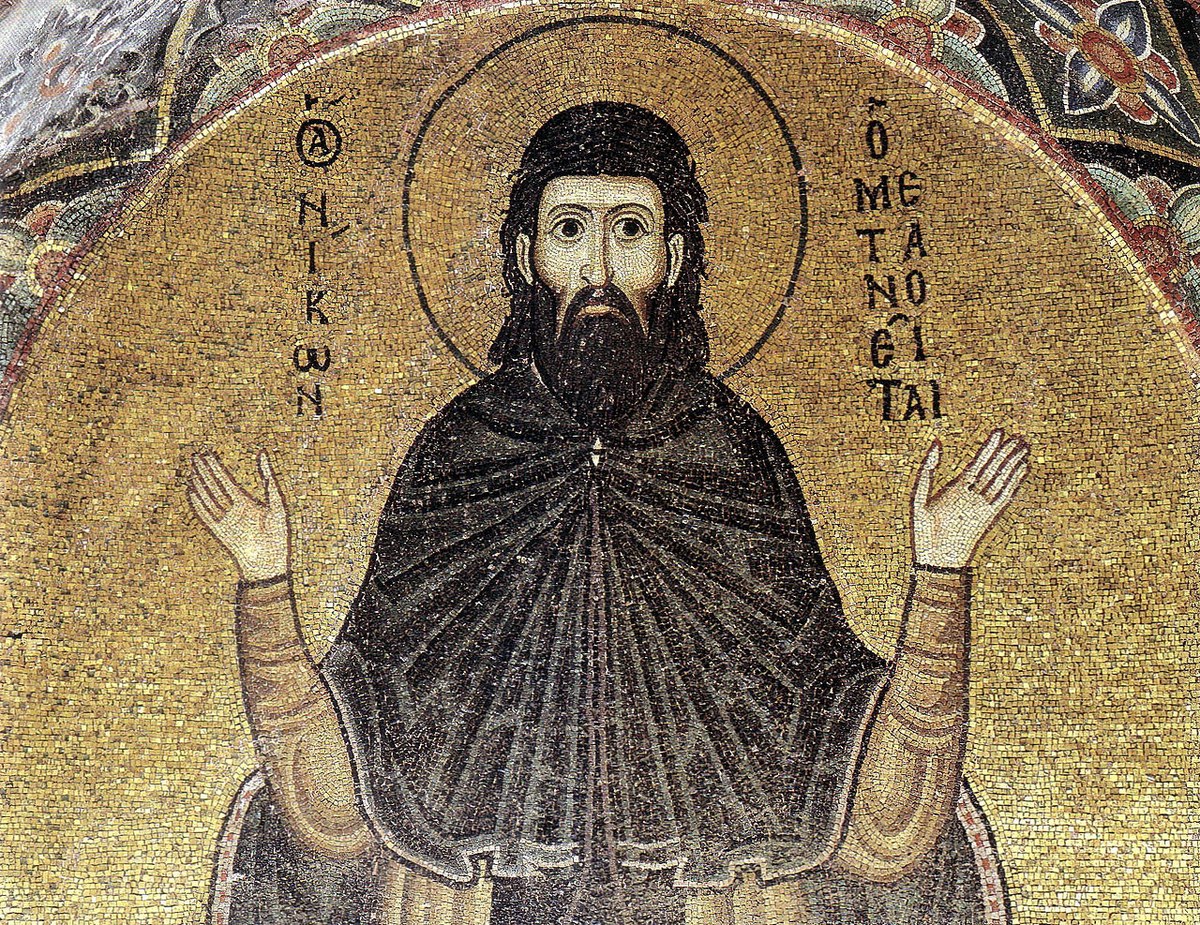
Nikon is depicted as a monk of middle age with a dark, moderately full beard, in the monastic habit, most often holding a scroll — sometimes inscribed with his watchword "Repent" — or with his hand raised in preaching. The stored image is the early eleventh-century mosaic of the saint in the katholikon of Hosios Loukas in Boeotia, near the region of his mission, one of the oldest surviving portraits of him, labelled with his name.
Disputed questions
- Not to be confused with two other monastic saints of the same name: Nikon of Radonezh (d. 1426, commemorated November 17), the disciple and successor of Sergius of Radonezh; and Nikon the Dry (Sukhoy) of the Kiev Caves (twelfth century), a former captive of the Cumans. The three are kept distinct by their epithets — Metanoeite, of Radonezh, and the Dry.