
Nikon of Radonezh
Our Venerable Father Nikon, Abbot of Radonezh
Venerable · b. c. 1352 — d. 1426
Commemorated 17 November — Repose, 1426
Nikon of Radonezh (c. 1352–1426) was the disciple, chosen successor, and second abbot of the Trinity-Sergius Lavra, the foremost monastery of Russia. Called by his brethren a "zealot of obedience," he took up the governance of the community six months before the repose of its founder, Sergius of Radonezh, rebuilt it from the ashes after the Tatar raid of Edigei in 1408, uncovered the incorrupt relics of Sergius in 1422, and raised over his master's grave the stone Trinity Cathedral for which Andrei Rublev painted his icon of the Holy Trinity. He is venerated among the wonderworkers of Radonezh and commemorated on November 17.

Origins and monastic beginnings
Nikon was born about 1352 at Yuriev-Polsky, north-east of Moscow. Hearing while still young of the angelic life of Sergius, the wonderworker of Radonezh, he came to the Trinity monastery and begged to be tonsured. Sergius, whether on account of the young man's age or for the testing of his resolve, would not receive him, but sent him instead to his own disciple Athanasius, abbot of the Vysotsk monastery at Serpukhov. Athanasius too made him wait, and clothed him in the monastic habit only after his persistence had proved him. Under Athanasius, Nikon gave himself to prayer, the study of Scripture, and an unquestioning readiness in every task, so that he earned the name of a "zealot of obedience." At the age of thirty he was ordained priest.
With Saint Sergius
When Nikon had matured in the monastic life, Athanasius blessed him to return to Sergius, who this time received him with joy — "It is good that you have come, my child Nikon" — and set him to serve the brethren. Nikon spent his days in the labours of the house and his nights in prayer. Sergius, granted a special insight into his disciple, took him at last to share his own cell, that Nikon might learn from him the inner substance of the spiritual life. Six months before his repose Sergius appointed Nikon his successor as abbot and withdrew into silence. Sergius reposed on September 25, 1392, and the burden of the monastery fell upon Nikon.
Abbot of the Trinity
Nikon governed exactly as his teacher had instructed him, attending every service and sharing the common work of the brethren on an equal footing. But the weight of the office oppressed a man who longed for stillness; recalling the quiet of his years under Athanasius and Sergius, he laid down his charge and retired to his cell. For six years the monastery was led by Sergius's disciple Savva, later of Storozhevsk; when in 1400 Savva went to found his own house near Zvenigorod, the brethren entreated Nikon to resume the abbacy, and he consented, but reserved to himself a fixed portion of each day for silence before God.
The raid of Edigei and the rebuilding
In 1408, as the armies of the Tatar khan Edigei advanced into the Russian land, Nikon prayed earnestly that the monastery might be spared. In a dream the Moscow hierarchs Peter and Alexis appeared to him together with Sergius, telling him not to grieve at the coming destruction, for the house would not be laid waste but would flourish the more. The monks withdrew, carrying with them the relics, books, and sacred vessels, and returned to find their beloved place burnt to ashes. Nikon did not despair. He set the brethren to rebuild, raising first a wooden church of the Holy Trinity, consecrated on September 25, 1411 — the anniversary of Sergius's repose — and then, over the founder's grave, a church of stone.
The uncovering of Sergius's relics and the Trinity Cathedral
While the workmen were digging the foundations of the stone church, on July 5, 1422, they uncovered the incorrupt relics of Sergius. Amid universal rejoicing the relics were translated to a new shrine, and Nikon completed the stone Cathedral of the Holy Trinity, into which he solemnly transferred them. For its adornment he summoned the finest iconographers of the age, Andrei Rublev and Daniel Cherny; and it was for this cathedral, in memory of what had been revealed to Sergius, that Rublev painted his icon of the Holy Trinity, the Hospitality of Abraham. The building of the Trinity church occupied Nikon to the end of his life.
Repose
The place of his own burial was shown to Nikon in a vision before his death. He gathered the brethren, gave them his last instruction, received the Holy Mysteries, and blessing them said, "Go forth, my soul, with joy to the place prepared for you; Christ is calling you." Signing himself with the Cross, he reposed and was buried beside the shrine of Sergius. Under Metropolitan Jonah (1448–1461) the hieromonk Pachomius the Logothete composed his Service and Life; a general celebration of his memory was established in 1547, and a church was built over his grave the following year, rebuilt in 1623, where his relics rest.
Feast and commemoration
November 17 (church date; Old Calendar civil November 30) is his principal feast, the day of his repose, within the Nativity Fast. It is a commemoration of the Russian Church and the Orthodox Church in America; on the same day the whole Byzantine rite keeps Gregory the Wonderworker of Neocaesarea, with whom Nikon shares the day. Nikon is numbered also among the Radonezh saints and is commemorated with Sergius in the synaxis of that lavra.
Hymns
Troparion — Tone 1
A good zealot of obedience wast thou, O ever-memorable Nikon; taking up the staff of Sergius, thy shepherd and guide, thou didst tend well the flock entrusted to thee, and didst bring it unharmed after him to Christ the Shepherd. Entreat Him to grant us peace and great mercy.
Original translation from the Slavonic
Iconography
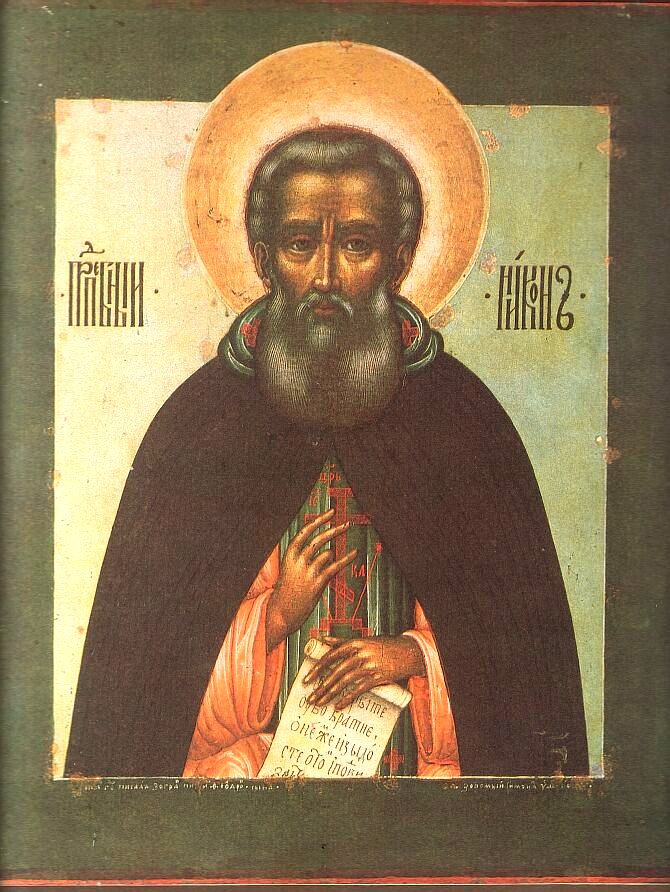
Nikon is depicted as a monk of middle age with a full, tapering brown or greying beard, in the mantle and analavos of the schema, most often holding a scroll or, in later Russian icons, gesturing toward the Trinity monastery he rebuilt. He is frequently shown paired with Sergius, the two abbots flanking the Trinity Cathedral or the image of the Holy Trinity. The stored icon is a Russian panel of the seventeenth century, a bust of the saint holding an open scroll, inscribed with his name.
Disputed questions
- Day of repose. The Russian Church keeps his commemoration on November 17 (Old Calendar civil November 30), and the tradition dates his repose to that day in 1426; the Orthodox Church in America's synaxarion text gives the date as November 27, 1426, a discrepancy of the received sources. The feast is kept on November 17 regardless.
- Not to be confused with the Greek missionary saint Nikon Metanoeite, "the Preacher of Repentance" (d. 998, commemorated November 26), nor with Nikon the Dry of the Kiev Caves (twelfth century). The three monastic Nikons are distinguished by their epithets — of Radonezh, Metanoeite, and the Dry.