
Nilus of Stolobny
Our Venerable Father Nilus of Stolobny, Wonderworker of Lake Seliger
Venerable · Wonderworker · d. 1554
Commemorated 27 May — Uncovering and translation of the relics (1667), 7 December — Repose on Stolobny Island (1554)
Nilus of Stolobny (died 1554) was one of the great hermit-ascetics of northern Russia, who spent twenty-six years in absolute solitude on a wooded island in Lake Seliger, in the Tver borderlands, and there founded — after his death — one of the most famous monasteries of the Russian Church, the Nilov Hermitage (Nilova Pustyn). Renowned for extremes of self-denial, above all his vow never to lie down but to sleep upright, leaning on two wooden hooks set into the wall of his cell, he became after his repose a wonderworker venerated across Russia, his image reproduced in countless carved wooden figures. His feast is December 7; the uncovering of his relics is kept on May 27.
.jpg)
Origins and monastic beginnings
Nilus was born into a peasant family in a village of the Novgorod diocese; the year of his birth is not recorded. In 1505 he entered the monastery of St Savva of Krypetsk near Pskov, where he was tonsured and passed some ten years in the common ascetic life of the brotherhood. Seeking a stricter solitude than the coenobium allowed, he withdrew to the wilderness along the little River Seremlya (Sereml), in the region of Ostashkov, where for thirteen years he lived as a hermit, waging — in the vivid language of his Life — an unremitting war against the demons, who appeared to him in the forms of reptiles and wild beasts.
The island of Stolobny
As his reputation for holiness spread, the people of the surrounding country began to come to him for counsel, and the solitude he had sought was broken. Praying to be shown a place of true stillness, he heard (the Life relates) a voice bidding him go to Lake Seliger, to the island of Stolobny, where he would find salvation. Learning the island's whereabouts from visitors, he went and was overwhelmed by its beauty — a wooded islet in the middle of the great lake. On a low hill he dug himself a cave for the first winter and afterwards built a small hut, and there he remained for twenty-six years until his death.
To the ordinary austerities of fasting and unceasing prayer Nilus added a singular discipline that became inseparable from his memory: he never lay down to sleep. He allowed himself only a light doze, supported upright by leaning against two wooden pegs or crutch-hooks fixed into the wall of his cell, so that even his rest was a labour. He refused all gifts brought by those whose conscience was impure, and lived by the work of his own hands.
Trials and miracles
The Life records that his holiness provoked the malice of the enemy, expressed through hostile neighbours. Once an arsonist set fire to the forest of the island to drive him out, but the flames miraculously died as they reached his hill. Another time robbers broke into his hut, demanding his treasure; Nilus told them his treasure lay in the corner — where an icon of the Mother of God stood — but when they searched there for money they were struck blind, and only recovered their sight after repenting with tears. Many other wonders were ascribed to him.
Repose
Foreseeing his end, Nilus prepared his own grave. At his death an abbot from a nearby monastery came to the island and gave him the Holy Mysteries; after a last prayer, censing the icons and his cell, Nilus surrendered his soul to God on 7 December 1554.
The Nilov Hermitage and the cultus
Some years after his death a hermit named Herman, together with a wandering pilgrim, settled on Stolobny and, about 1594, founded a monastery over the saint's grave — the Nilov Hermitage (Nilova Pustyn), which grew into one of the largest and most visited monasteries in Russia, its great cathedral rising from the island in the lake. His relics were uncovered incorrupt in 1667 and enshrined; this translation is commemorated on May 27, and his repose on December 7. Devotion to him spread far beyond the region: small carved and painted wooden figures of the saint, shown seated and bowed with his head resting on his hand or supported by his hooks, were made and venerated in enormous numbers across the Russian north, one of the few sculptural forms in Orthodox devotion. His relics, removed in the Soviet period, were later restored to the reopened monastery.
Feast and commemoration
December 7 (church date; Old Calendar civil December 20), the day of his repose, within the Nativity Fast. The uncovering and translation of his relics (1667) is kept on May 27 (Old Calendar civil June 9). His veneration is Russian rather than universal; he is not among the saints of the general Byzantine Menaion.
Hymns
Troparion — Tone 4
As a most radiant lamp thou didst shine forth on the island in Lake Seliger, O venerable father Nilus; for from thy youth thou didst take the Cross of Christ upon thy shoulders and follow after Him with fervour, and drawing near to God by purity thou wast enriched with the gift of wonders. Wherefore we also, coming to the shrine of thy relics, cry out with compunction: O venerable father, entreat Christ God that our souls be saved.
Original translation from the Slavonic
Kontakion — Tone 8
Withdrawing from thy homeland, O venerable one, thou didst settle in the wilderness, and going up onto the island in Lake Seliger thou didst show forth a life of hardship; and having astonished many by thy virtues, thou didst receive from Christ the gift of wonders. Remember us who honour thy memory, that we may cry to thee: Rejoice, O Nilus our father.
Original translation from the Slavonic
Magnification
We call thee blessed, O venerable father Nilus, and we honour thy holy memory, O instructor of monks and companion of the angels.
Original translation from the Slavonic
Iconography
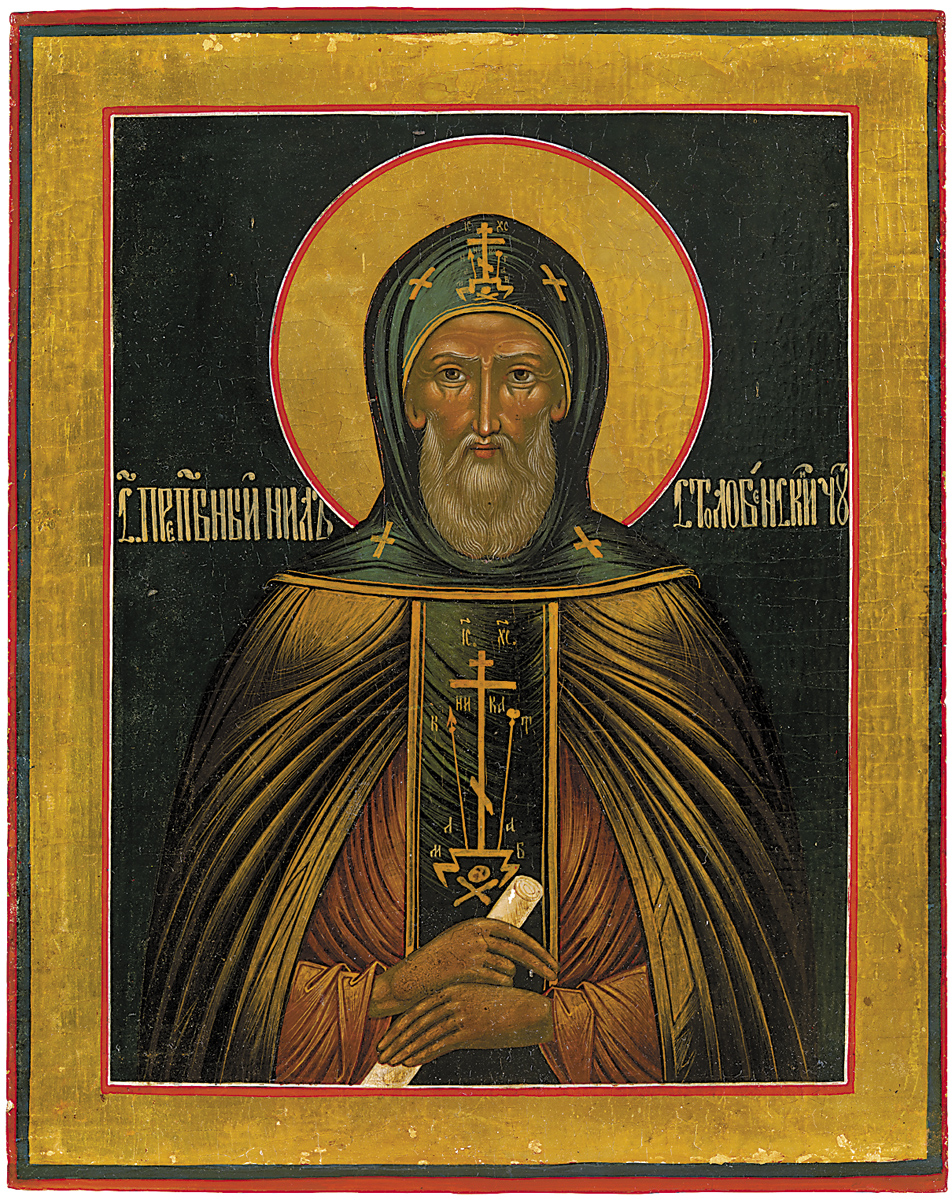
Nilus is depicted as an aged hermit in the monastic habit, with a long grey beard, thin and bowed from his austerities; his distinctive attribute is the posture of his rest, seated and stooped forward with his head bowed upon his hand or propped on the two wooden hooks by which he slept upright, so that even in his icons he never lies at ease. He is often shown against the island and lake, sometimes with the monastery he founded. Uniquely among Russian saints he is also venerated in carved wooden statuettes of this bowed, seated form. The stored icon is a nineteenth-century Russian (Old Believer) panel showing the saint at prayer.
Disputed questions
- Not to be confused with three other saints named Nilus: Nilus the Faster of Sinai/Ancyra (died c. 430, commemorated November 12); Nilus the Myrrh-gusher of Mount Athos (c. 1601–1651, also November 12); and above all Nilus of Sora (Nil Sorsky, died 1508, commemorated May 7), the great Russian hesychast and leader of the "Non-possessors." Nilus of Stolobny is frequently confused with Nil Sorsky because both are Russian ascetics of about the same period with nearly identical names, but they are entirely distinct: Sorsky was a learned skete-elder and writer of the Volga trans-forest hermitages, whereas the Stolobny hermit left no writings and is remembered for his solitude and wonders on Lake Seliger.