
Nilus the Faster
Our Venerable Father Nilus the Faster, of Sinai
Venerable · d. c. 430
Commemorated 12 November
Nilus the Faster (died c. 430), also called Nilus the Ascetic and, in the later tradition, Nilus of Sinai, is one of the most prolific ascetic writers of the early Church: a vast body of letters and monastic treatises circulates under his name. The tradition remembers him as a high official of Constantinople who forsook the world with his son to become a monk, and as a spiritual heir of John Chrysostom whose memory he defended. Modern scholarship distinguishes the historical monk-author, Nilus of Ancyra, from the legendary Sinaite of the later Life. He is commemorated on November 12.

The received tradition
The Life that entered the Byzantine synaxaria makes Nilus a native of Constantinople who, after a fine education, rose to the eminent post of eparch (prefect) of the imperial city. Married, with two children, he was drawn to the ascetic life, and by mutual agreement he and his wife separated to enter the monastic state: she withdrew with their daughter to a community in Egypt, while Nilus took their son Theodulus and settled among the monks of Mount Sinai. There, the narrative continues, a raid of desert Saracens fell upon the ascetics; some were killed, and the boy Theodulus was carried off and sold, later to be ransomed, ordained, and reunited with his father — the two ending their days together on the holy mountain. Throughout, the tradition presents Nilus as a disciple and admirer of John Chrysostom, whose cause he championed in letters to the emperor Arcadius after the saint's unjust deposition and exile.
Ascetic and literary struggle
Whatever the details of his life, Nilus is above all a teacher of the inner warfare of the monk. An immense correspondence — more than a thousand short letters — passes under his name, together with ascetic treatises of lasting influence: on the monastic life and its excellence, on voluntary poverty, on prayer, and the dialogue known as the Peristeria. His teaching on unceasing prayer, on the guarding of the mind, and on the eight thoughts that assail the soul stands close to that of Evagrius and fed the later hesychast tradition; some works long ascribed to Nilus are now assigned to Evagrius, and the disentangling of the two corpora is a continuing scholarly task. Whether written near Ancyra or on Sinai, the writings made his name a byword for sober, practical spiritual counsel.
Repose
Nilus reposed in peace, by the common reckoning around the year 430; the Byzantine calendar keeps his memory on November 12, and some sources give the date of his death as late as 451.
Relics and later cultus
Relics venerated as those of Nilus were translated to Constantinople under the emperor Justin, and enshrined in the church of the Holy Apostles. His authority as an ascetic master kept his writings in constant use in the monasteries of East and West, and excerpts pass into the standard florilegia of the spiritual life.
Feast and commemoration
November 12 (church date; Old Calendar civil November 25), kept universally in the Byzantine rite, shared with John the Almsgiver, whose service takes the lead in the day's Menaion. Nilus the Faster is not to be confused with Nilus the Myrrh-gusher, the Athonite ascetic of the seventeenth century commemorated on the same day, nor with the two Russian saints of the name: Nilus of Stolobny (†1554, the hermit of Lake Seliger, December 7) and Nilus of Sora (Nil Sorsky, †1508, May 7).
Hymns
Troparion — Tone 8
With the streams of your tears you tilled the barren desert, and with sighs from the depths you brought forth fruit a hundredfold in labours; and you became a luminary, shining upon the whole world by your wonders, O Nilus our father. Intercede with Christ our God, that our souls may be saved.
Original translation from the Greek
Iconography
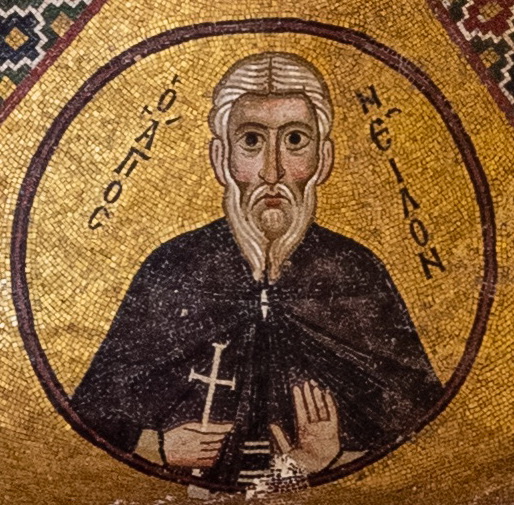
Nilus is depicted as an aged monk in the ascetic habit, with a long pointed beard, holding a scroll of his ascetic counsels or his hand raised in blessing — the type of the desert elder and writer. The stored image is an eleventh-century Byzantine mosaic from the monastery of Hosios Loukas in Greece, identifying him by inscription among the holy monastics.
Disputed questions
- Sinai or Ancyra. The figure of the Constantinopolitan eparch turned Sinaite monk, and the tale of the Saracen raid (the Narrationes / "Tales of the slaughter of the monks of Sinai"), are now widely regarded by scholars as a hagiographical romance. The historical author of the ascetic letters and treatises appears rather to have been an abbot of a monastery near Ancyra in Galatia. The tradition conflated the two, giving us "Nilus of Sinai"; the distinction is noted here without resolving the whole question.
- Discipleship of Chrysostom. The literary "discipleship" of Chrysostom is a matter of spiritual affinity and correspondence rather than of demonstrable personal formation; it is affirmed by the tradition and treated cautiously by historians.
- Authorship. A number of works transmitted under Nilus's name — most notably on prayer and the eight thoughts — are the writings of Evagrius Ponticus, circulated under the more acceptable name of Nilus after Evagrius's posthumous condemnation.