
Onesiphorus of the Seventy
The Holy Apostle Onesiphorus of the Seventy
Apostle of the Seventy · Apostle · Hieromartyr · Bishop
Commemorated 4 January — Synaxis of the Seventy Apostles, 7 September — With the Apostle Evodus of the Seventy, 8 December — With the Apostles Sosthenes, Apollos, Cephas, Tychicus, Epaphroditus and Caesar
Onesiphorus (1st century) is the disciple whom the Apostle Paul blesses by name in his last letter: "he often refreshed me, and was not ashamed of my chain, but when he was in Rome he sought me out diligently and found me" (2 Timothy 1:16–17). Counted among the Seventy Apostles, he is held by tradition to have served Paul at Ephesus, to have become bishop of Colophon in Asia Minor and afterwards of Corinth, and to have died a martyr at Parium on the Hellespont, where he had gone to preach Christ. He is commemorated on September 7 with the Apostle Evodus, on December 8 with six fellow apostles of the Seventy, and on January 4 with all the Seventy.
_-_%D0%B8%D0%BA%D0%BE%D0%BD%D0%B0_01072_%D0%9E%D0%BD%D0%B8%D1%81%D0%B8%D1%84%D0%BE%D1%80_%D0%B8_%D0%95%D0%B2%D0%BE%D0%B4.png)
The witness of Scripture
Onesiphorus (Greek Ὀνησίφορος, "profit-bringer") is one of the few of the Seventy about whom the New Testament itself speaks. Writing to Timothy from his final Roman imprisonment, Paul prays: "The Lord give mercy to the house of Onesiphorus, for he often refreshed me, and was not ashamed of my chain; but when he was in Rome, he sought me out very diligently and found me. The Lord grant to him that he may find mercy from the Lord in that Day — and in how many things he ministered to me at Ephesus you know very well" (2 Timothy 1:16–18). At the letter's close Paul greets "the household of Onesiphorus" (4:19).
The picture is concrete: a Christian of Ephesus with a household of his own, who had served Paul's ministry there, and who in Rome — at a time when association with the imprisoned apostle was dangerous and others "in Asia" had turned away (1:15) — searched the city until he found him. That Paul twice greets or blesses the household of Onesiphorus, and prays that Onesiphorus himself "find mercy in that Day," has been read since antiquity as suggesting that the man himself was already dead when Paul wrote — a passage long cited in discussion of prayer for the departed. If so, tradition has extended his life beyond what the text implies; the Church's account of his later episcopate and martyrdom rests on the synaxaria, not on the letter.
Ministry and martyrdom
The Byzantine tradition counts Onesiphorus among the Seventy and continues his story past the New Testament: he became bishop of Colophon, near Ephesus in Asia Minor, and later is said to have presided at Corinth. His end came at Parium, a city on the Hellespont not far from Cyzicus, where he had gone to preach Christ among the pagans; there he died a martyr. One strand of the tradition relates that he was tortured and dragged to death by wild horses, together with a servant of his household, Porphyrius. No year is transmitted; his death belongs to the later first century.
Feast and commemoration
September 7 (church date; Old Calendar civil September 20), together with the Apostle Evodus of the Seventy, within the forefeast of the Nativity of the Theotokos — the principal commemoration. He is commemorated again on December 8 with the Apostles Sosthenes, Apollos, Cephas, Tychicus, Epaphroditus and Caesar of the Seventy — where he is the seventh of the company, listed there but narrated in full here — and on January 4 at the Synaxis of the Seventy Apostles. All Byzantine-rite calendars keep the September memory; the Roman Martyrology commemorates Onesiphorus on September 6.
Hymns
Troparion — Tone 3
Holy Apostle Onesiphorus, intercede with the merciful God, that he grant to our souls the forgiveness of offences.
Original translation from the Greek
Iconography
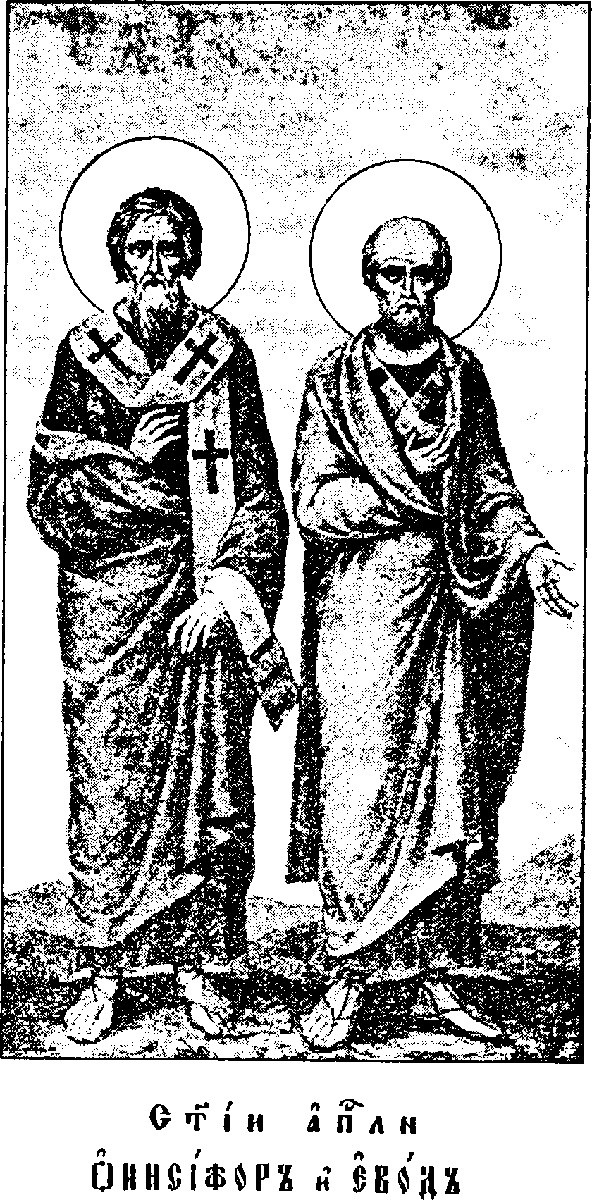
Onesiphorus is painted as an apostle-bishop: an elderly man with a pointed beard, vested in phelonion and omophorion with the Gospel book, or in the apostolic chiton and himation with a scroll. For September 7 he is commonly paired with Evodus; he also appears in synaxis icons of the Seventy. The stored image is a Russian engraved icon of the two apostles together, inscribed "the holy apostles Onesiphorus and Evodus" in Church Slavonic, from the illustrated Moscow edition of the Lives of the Saints (Zhitiya Svyatykh, 1903–1911), September volume.
Disputed questions
- Death before 2 Timothy? As noted above, the wording of 2 Timothy is most naturally read as a prayer for a man already departed, which sits awkwardly with the tradition of a later episcopate and martyrdom. The entry records both the scriptural datum and the received tradition without forcing a harmony.
- Conflation with the martyrs of November 9. The Church also commemorates, on November 9, the martyrs Onesiphorus and Porphyrius, who suffered under Diocletian (late 3rd–early 4th century) — burned, and then dragged to death by horses. The resemblance between that account and the tradition of the apostle's death at Parium with his servant Porphyrius is close enough that scholars have suspected the two commemorations of having exchanged material, and some popular retellings merge them outright. The calendars keep the persons distinct — an apostle of the first century and a martyr of the Great Persecution — and this collection follows them.
- Sees. Colophon is constant in the tradition; the Corinthian episcopate is less firmly attested and is absent from some synaxaria.