
Sosthenes, Apollos, and Companions of the Seventy
The Holy Apostles of the Seventy Sosthenes, Apollos, Cephas, Tychicus, Epaphroditus and Caesar
Apostle of the Seventy · Apostle · Bishop · d. 1st century
Commemorated 4 January — Synaxis of the Seventy Apostles, 30 March — Second commemoration of the company, 8 December — With the Apostle Onesiphorus of the Seventy
On December 8 the Church commemorates a company of apostles of the Seventy, all named in the letters of the New Testament: Sosthenes, once ruler of the synagogue at Corinth and afterwards a bishop; Apollos, the eloquent Alexandrian of the Book of Acts; Cephas of Colophon; Tychicus, Paul's trusted messenger; Epaphroditus, whom Paul called his fellow-soldier; and Caesar, bishop of Dyrrhachium — together with the Apostle Onesiphorus, who is commemorated with them but whose principal feast and full entry stand under his own name. Chosen and sent by Christ among the Seventy (Luke 10), they laboured beside the Apostle Paul and became shepherds of the young Churches. Their memory is kept also on March 30 and, with all the Seventy, on January 4.
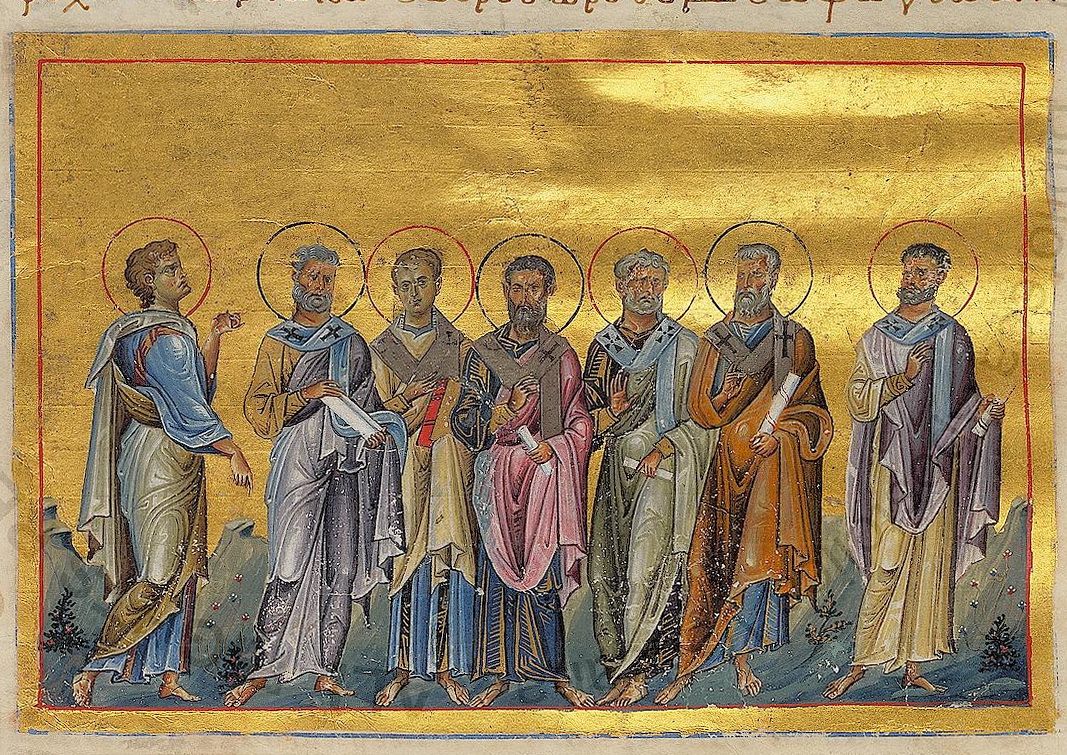
.jpg)
These are apostles of the Seventy known to the Church chiefly through the Pauline epistles, where each is named as a companion or convert of the Apostle of the Gentiles. The Greek synaxarion for December 8 honours "seven apostles" together — the six treated here and Onesiphorus — as "noble heralds of God the Word." The biographical notices that follow are those transmitted by the apostolic lists (attributed to Hippolytus and to Dorotheus of Tyre) and the synaxaria; where these go beyond the New Testament, they carry the authority of tradition rather than of Scripture.
Sosthenes
Sosthenes appears in Acts 18:17 as ruler of the synagogue at Corinth who was beaten before the judgement-seat of Gallio during the tumult raised against Paul. The tradition understands this Sosthenes to have become a Christian through Paul — and identifies him with the "Sosthenes our brother" whom Paul joins to himself in the opening greeting of the First Epistle to the Corinthians (1 Corinthians 1:1). He is remembered as having become bishop of Caesarea.
Apollos
Apollos is the best-known of the company from Scripture itself: "a certain Jew named Apollos, born at Alexandria, an eloquent man, and mighty in the Scriptures" (Acts 18:24), who, instructed more perfectly in the way of the Lord by Aquila and Priscilla, powerfully confuted the Jews at Corinth and "watered" where Paul had "planted" (1 Corinthians 3:6). The tradition has him labour long at Corinth, preach at last in Crete, and end as a bishop — the notices say of Caesarea; some Greek witnesses give him the second name Apelles. His eloquence made him so dear to a party at Corinth that Paul had to rebuke the factions that formed around his name and Paul's own.
Cephas
The Cephas commemorated here is not the Apostle Peter (whose Aramaic name was also Cephas) but a distinct member of the Seventy; the tradition makes him bishop of Colophon, near Ephesus. Some have connected him with the "Cephas" to whom the risen Christ appeared (1 Corinthians 15:5), read as separate from Peter — a reading the calendars presuppose in keeping him as a distinct saint.
Tychicus
Tychicus, a native of Asia Minor, was among Paul's most trusted companions and couriers: Paul calls him "a beloved brother and faithful minister" and sends him bearing the Epistles to the Ephesians and to the Colossians (Ephesians 6:21; Colossians 4:7), and names him again in the Pastoral Epistles (2 Timothy 4:12; Titus 3:12). The tradition holds that he succeeded Sosthenes as bishop of Caesarea.
Epaphroditus
Epaphroditus was the messenger sent by the Philippian church to minister to the imprisoned Paul, and the bearer of their gift, who fell gravely ill in Paul's service; Paul writes of him with warm affection as "my brother, and companion in labour, and fellow-soldier" (Philippians 2:25; 4:18). He is remembered as bishop of the Thracian city of Adriaca (Adriakē).
Caesar
Caesar (Kaisar) is counted among the Seventy and is remembered as having preached in and been bishop of Dyrrhachium (Durrës) on the Adriatic coast. The apostolic lists that transmit the Seventy include his name; the New Testament greeting "they of Caesar's household" (Philippians 4:22) is sometimes linked to him, though the connection is not certain.
Onesiphorus
The seventh apostle of the December 8 company is Onesiphorus, the disciple whom Paul blesses in 2 Timothy 1:16–18 for seeking him out in his Roman chains — bishop of Colophon and later of Corinth, and a martyr at Parium. His principal feast is September 7 and his full life is given under his own entry; he is listed here only as a member of the company, not re-narrated.
Feast and commemoration
December 8 (church date; Old Calendar civil December 21), within the Nativity Fast and the forefeast of the Conception of the Theotokos by Anna; the apostles are commemorated in the synaxarion notice while the day's sung service belongs to Patapius of Thebes and to the forefeast. The same company is kept again on March 30, and all the Seventy are gathered at the Synaxis of the Seventy Apostles on January 4. Several members carry additional individual memories in the calendar — Apollos, for instance, is also commemorated on September 10 — but December 8 is the day on which they are honoured together as this apostolic company.
Hymns
Troparion — Tone 3
Holy Apostles, intercede with the merciful God, that he grant to our souls the forgiveness of offences.
Original translation from the Greek
Iconography
The apostles are painted as a standing company: several in the phelonion and omophorion of bishops, holding Gospel books or scrolls, one or two in the apostolic chiton and himation — the range of dress marking those who became hierarchs. The stored image is the miniature of the seven from the Menologion of Basil II (c. 1000; Vatican, Vat. gr. 1613, fol. 253), which ranges the seven apostles in a row against a gold ground, the youthful figure at the left contrasting with the grey-bearded hierarchs beside him. It is the same folio that furnishes the December 8 commemoration; Onesiphorus, though depicted here among the seven, has his own separate icon under his entry.