
Onesiphorus and Porphyrius
The Holy Martyrs Onesiphorus and Porphyrius
Martyr · d. c. 284–305
Commemorated 9 November
Onesiphorus and Porphyrius were two martyrs who suffered together during the persecution of the emperor Diocletian (284–305). Having confessed Christ and refused to sacrifice to the idols, they were scourged and burned, and then, when neither torment shook their faith, were bound to wild horses and dragged over the stones until they died. Their relics were afterwards gathered and enshrined. They are commemorated together on November 9. In some accounts Porphyrius is named as the servant of Onesiphorus, and both are styled "of Ephesus," where their contest is placed.
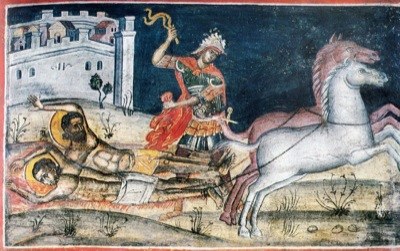

The two are known from the synaxarion notice of their common feast rather than from a full passion. They are set in the great persecution under Diocletian and his colleagues (284–305), when Christians throughout the East were required, on pain of death, to offer sacrifice to the gods of the empire. Onesiphorus and Porphyrius confessed themselves Christians and refused. They were seized and subjected to torture: beaten, and then burned — laid, in the received account, upon a heated iron grid. When these torments failed to break them, the two confessors were tied to untamed horses and dragged across rough and stony ground until their bodies were broken and they gave up their souls. Pious Christians recovered what remained of them and buried the relics with honour; a strand of the tradition carries the relics to the town of Pentele (or, in other notices, to a place by the sea in Cappadocia), where a shrine kept their memory.
Beyond this the record is thin. One tradition distinguishes the two by rank, making Porphyrius the servant or household companion of Onesiphorus who shared his confession and his death — a detail that closely echoes the older account of the apostle Onesiphorus of the Seventy and his servant Porphyrius (see below). Their martyrdom is placed by several notices at Ephesus, whence they are sometimes called "Onesiphorus and Porphyrius of Ephesus."
Feast and commemoration
November 9 (church date; Old Calendar civil November 22), kept universally in the Byzantine rite. In the Menaion their brief synaxarion notice stands among the several commemorations of the day, their liturgical service supplied from the common of martyrs.
Hymns
Troparion — Tone 4
Your holy martyrs Onesiphorus and Porphyrius, O Lord, through their sufferings have received incorruptible crowns from you, our God. For having your strength, they laid low their adversaries, and shattered the powerless boldness of demons. Through their intercessions, save our souls.
Original translation from the Greek
Iconography
The two are shown as martyrs, in the tunic and cloak of laymen, each holding the cross of martyrdom, often side by side as a pair; where their passion is depicted they are drawn behind galloping horses. The stored image is exactly this passion scene, from the fresco cycle of Zorzis Fouka at Dionysiou Monastery on Mount Athos (1547): the martyrs bound and dragged at the heels of the white horses before the city wall. The available reproduction is small; a larger scan of the same fresco is listed among the upgrade-wanted icons.
Disputed questions
- Not the apostle Onesiphorus. These martyrs of the Diocletianic persecution are to be distinguished from Onesiphorus of the Seventy, the disciple praised by Saint Paul in 2 Timothy 1:16–18, whose feast is September 7. The resemblance is unusually close — the apostle too is said in one tradition to have died dragged by horses, together with a servant named Porphyrius — and scholars have long suspected the two commemorations of having exchanged material, while some popular retellings merge them outright. The calendars, and this collection, keep them distinct: a first-century apostle and a martyred pair of the Great Persecution.
- Not the actor Porphyrius. The Porphyrius of this pair is likewise not Porphyrius the Actor, the mime-martyr of September 15, who in the Slavic tradition is himself surnamed "of Ephesus" and whose story (with its November 4 doublet, Porphyrius of Caesarea) belongs to a wholly different account of conversion in the course of a stage performance. The shared epithet "of Ephesus" is a coincidence of place-name, not of person.
- Date and place. No year is transmitted beyond the reign of Diocletian; the martyrdom is conventionally set in the great persecution of 303–305 but may fall anywhere in that emperor's reign. Ephesus is named by several notices; the tradition of the relics' enshrinement varies (Pentele; a coastal site in Cappadocia).