
Pancratius of Taormina
The Holy Hieromartyr Pancratius, Bishop of Tauromenium in Sicily
Hieromartyr · Bishop · Martyr · d. 1st century, at Tauromenium (Taormina)
Commemorated 9 February — Bishop-martyr of Tauromenium, disciple of the Apostle Peter and apostle of Sicily; kept with the leavetaking of the Meeting, 9 July — Commemoration in the Greek Menaion
Pancratius (first century) is venerated as the first bishop of Tauromenium (Taormina) in Sicily and the apostle of the island — a disciple of the Apostle Peter, who is said to have consecrated him and sent him westward to preach. Of Antiochene origin, converted (the tradition holds) with his parents in the days of the Lord's own preaching, he was set by Peter over the young church of Tauromenium, where he laboured with such success that he is remembered as the enlightener of eastern Sicily; he overthrew idols, worked wonders, and built up a Christian people, until he was set upon and stoned to death by pagans (in some accounts by a band of brigands). He is honoured in the Byzantine calendars on February 9, kept with the leavetaking of the Meeting of the Lord, and is one of the three disciples of Peter — with Marcellus of Sicily and Philagrius of Cyprus — whom the day commemorates as apostles of the West.

Origins and discipleship under Peter
The traditional Life of Pancratius — an ancient and much-elaborated Greek text attributed to one Evagrius, a disciple who claims to have accompanied him — makes him a native of the region of Antioch, born of pagan parents in the years of the Lord's earthly ministry. The story has his father take the boy to Jerusalem, where they hear the preaching and see the wonders of Christ; and it brings the family afterward into contact with the Apostle Peter, through whom they are baptised, so that Pancratius is reckoned among the first fruits of the apostolic preaching. Formed in the faith, he embraced the ascetic life — the Life places him for a time in a cave in the region of Pontus, where Peter, passing through, found him — and was judged by the Apostle fit for the episcopate.
Peter, the tradition continues, consecrated Pancratius bishop and sent him to Sicily, to the city of Tauromenium on the island's eastern coast beneath Mount Etna, to plant the Church there — one of the band of missionaries by whom, in the apostolic reckoning of the Byzantine synaxaria, the West was first evangelised. With him the same tradition associates the sending of Marcellus (Marcian) to Syracuse and of Philagrius to Cyprus, so that the three are remembered together as Peter's disciples and fellow-labourers.
Bishop and apostle of Sicily
At Tauromenium Pancratius is honoured as the protobishop and enlightener. The Life recounts his ministry in the colours of apostolic legend: he preaches Christ to a city sunk in idolatry, confounds and casts down its idols (the demon "Falconilla" or the idol of the pagan cult is overthrown at his word), heals the sick, raises the dead, and by his miracles and his teaching wins the people and their ruler to the faith, building and consecrating the first churches of the region. One tradition, carried in the Life, has the Apostle Peter direct that icons of Christ, of Peter, and of Pancratius himself be painted by an artist named Joseph for use in the mission — a detail the later Byzantine defenders of the holy images loved to cite as a witness to the antiquity of iconography. Under Pancratius, Tauromenium became a Christian city, and from it the faith spread through eastern Sicily; his labours made him, in the island's memory, the father of its Church.
Martyrdom
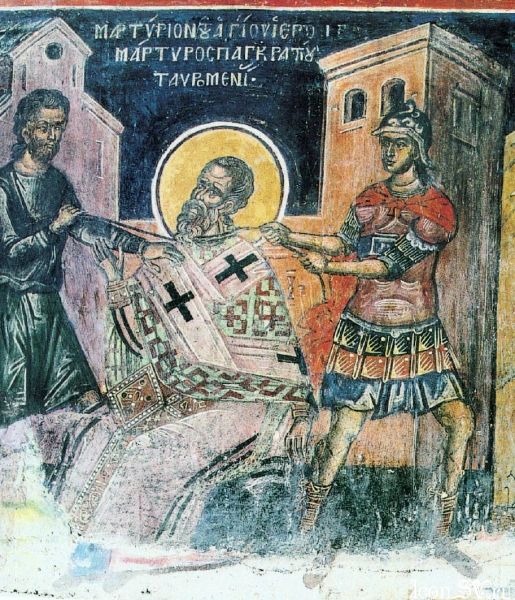
Pancratius died a martyr. The received account has him fall to the violence of those who hated his preaching — set upon and stoned to death, in some versions by pagans of the region resisting the new religion, in others by a band of Montanist heretics or of brigands who fell upon him. He is numbered accordingly among the hieromartyrs, a bishop who sealed his apostolate with his blood. His relics were kept at Tauromenium and honoured through the Byzantine centuries; a large portion is venerated at Rome, and further relics are kept on Mount Athos, so that his cult, rooted in Sicily, spread through the Greek and Latin worlds alike. He remains the patron of Taormina (and of Canicattì), where his memory has never lapsed.
The Life and its worth
The Life of Pancratius is one of the great Sicilian hagiographic romances — a long, vivid, and manifestly legendary composition, of value less as biography than as a monument of the island's apostolic self-understanding and, for historians of art and liturgy, as an early witness to the making of Christian images. Its historical core is the constant of the tradition: that Tauromenium honoured Pancratius as its first bishop, a disciple of the apostolic age, and a martyr. The precise circumstances — his Antiochene birth, the meeting with Peter, the manner of his death — belong to the legend and are given as such. What the Church keeps is the martyr-bishop, apostle of Sicily.
Feast and commemoration
Pancratius is commemorated in the Byzantine calendars on February 9 (church date; New Calendar civil February 9, Old Calendar civil February 22), kept with the leavetaking of the Meeting of the Lord and together with his fellow-disciples of Peter, Marcellus of Sicily and Philagrius of Cyprus. As an apostolic-age figure his repose is placed in the first century.
The Western calendars keep him too, but on a different day and with a divergent reckoning: the Roman tradition commemorates Pancratius of Taormina on July 8 or 9 (formerly April 3). The double dating is a genuine East–West divergence rather than two saints: the Byzantine February 9 and the Latin July date honour the one protobishop of Tauromenium. (He is a wholly distinct saint from the young Roman martyr Pancratius of Rome, "Pancras" of the Aurelian Way, kept May 12, with whom the shared name alone connects him.)
Hymns
Apolytikion — Tone 4
Sharing in the ways of the Apostles and succeeding to their throne, thou didst find in labours an ascent to divine vision, O God-inspired one; wherefore, rightly dividing the word of truth, thou didst contend for the faith even unto blood, O Hieromartyr Pancratius. Intercede with Christ our God that our souls may be saved.
Iconography
Pancratius is depicted as a bishop of the apostolic age — vested in the omophorion, holding or blessing over the Gospel-book — and, in narrative scenes, in the act of martyrdom by stoning. The stored image is a mid-sixteenth-century fresco of his martyrdom from the katholikon of the monastery of Dionysiou on Mount Athos (1547), the work of Tzortzis (Zorzis) Fuka of the Cretan school — a genuine post-Byzantine wall-painting depicting the bishop cast down and stoned, retained under the public-domain provision for pre-modern works.