
Parasceva of Iconium
The Holy Great-Martyr Parasceva of Iconium
Great Martyr · Virgin · d. 3rd century (traditionally under Diocletian; some accounts place her in the 2nd century)
Commemorated 28 October — The great-martyr's principal feast; in Slavic lands "Paraskeva Pyatnitsa"
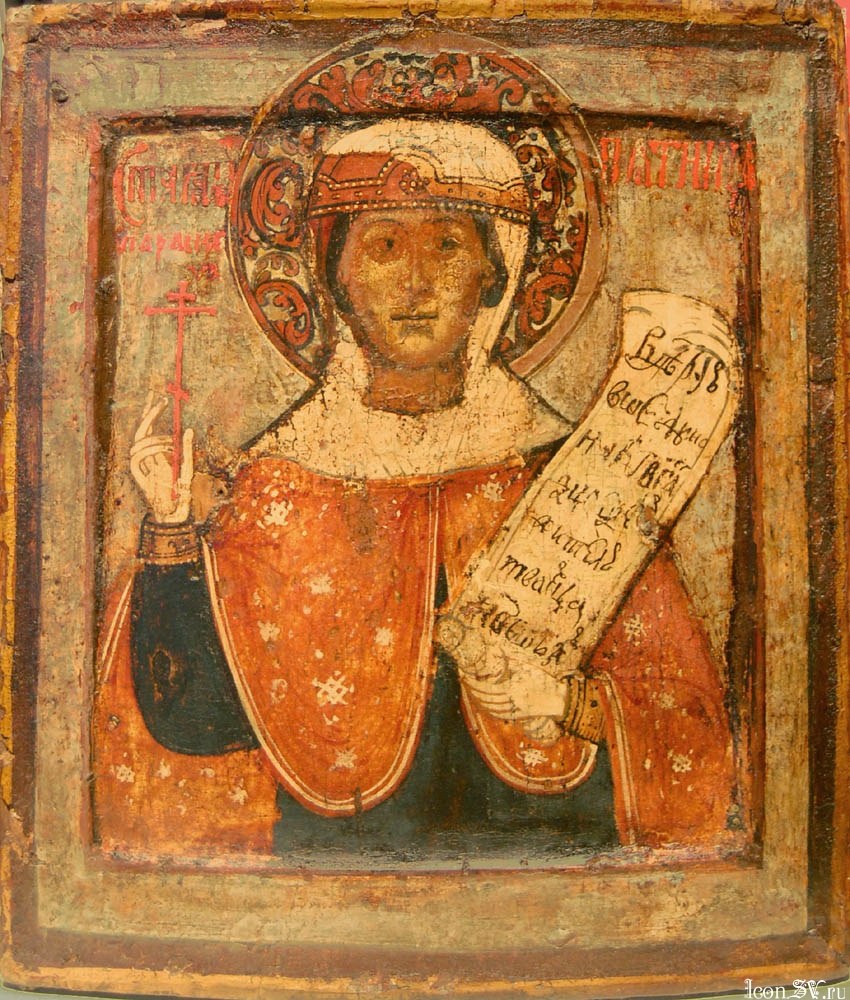
Parasceva of Iconium is a virgin great-martyr of the early Church, honoured across the whole Orthodox world on October 28 and among the most beloved of all women saints in the Slavic lands, where she is known simply as Paraskeva Pyatnitsa — "Paraskeva Friday." Born, the tradition says, of pious parents of Iconium in Lycaonia who so revered the Friday of the Lord's Passion that they named their daughter for it (Paraskeue, "Preparation," is the Greek name of Friday), she consecrated her virginity to Christ, preached him openly, and was tortured and beheaded for refusing to sacrifice to the idols, under one of the pagan persecutions of the second or third century. Venerated as a healer, especially of diseases of the eyes, and as a protectress of fields, waters and household, she is depicted as an ascetic martyr in the red robe of martyrdom, a cross in her hand and a radiant crown upon her head.

Origins and name
The received Life places Parasceva at Iconium (Konya, in Lycaonia of Asia Minor), the city of the apostle Paul's first labours, in a Christian household of wealth and piety. Her parents, the account says, honoured above all days the Friday on which Christ suffered — in Greek paraskeue, the "day of preparation" before the Sabbath — and when a daughter was born to them on a Friday they gave her that day for her name. The name would become the whole sign of her: she is Paraskeue, Friday, the martyr who bears in her very name the memory of the Passion, and Slavic devotion drew the identification tight, calling her Pyatnitsa (Friday) outright and personifying in her the holy day itself.
Left an orphan while still young and heir to her parents' estate, she gave herself wholly to Christ. She took a vow of virginity, spent her substance on the poor, and — unusually for the women martyrs of her type — went out openly to preach, teaching the pagans of Iconium to abandon their idols and turn to the living God. It was as a public confessor and teacher, not merely as a private believer denounced, that she was seized.
Martyrdom
The Acts follow the pattern of the great virgin-martyrs of the persecutions, and the hymns of her feast rehearse it. Brought before the city prefect (the tradition names him variously) and commanded to offer sacrifice, Parasceva refused with such boldness that she reproved the idols to his face. She was stripped and bound to a tree and beaten with rods; her body was raked with iron claws or combs; she was cast into prison, torn to the bone and left to die. There, the account says, God did not forsake her: an angel visited and healed her wounds, and she came forth whole, to the confusion of her torturers. Fresh torments followed — the Lives tell of a cauldron of boiling pitch and oil into which she was thrown unharmed, and of the idol-temple that fell at her prayer — until at the last the sentence was carried out and she was beheaded. The Greek synaxarion and the Slavic Menaion alike keep her memory on October 28 as a great-martyr; the exact reign under which she suffered is not fixed by the sources, the tradition ranging from the second century to the persecution of Diocletian (see Disputed questions).
Veneration and later cultus
Few women saints of the ancient Church have been so widely and warmly venerated. In the Greek world "Hagia Paraskeue" is invoked especially for the eyes and for sight — a patronage that gathered about her name early and endures in countless chapels and holy springs — and her feast is kept with full solemnity. Among the Slavs her cultus took on a whole life of its own. As Paraskeva Pyatnitsa she became one of the most popular saints of Rus': wayside chapels were called pyatnitsy after her, she was reckoned the protectress of fields, cattle and waters and the patroness of the marketplace (Friday being market-day), and on her feast the first-fruits and produce were brought to the church to be blessed and kept through the year. Folk piety wove her into the rhythm of the week and the farming year so thickly that she came near to being a personification of holy Friday itself, and her image — stern, tall, crowned — was thought to guard the home. This exuberant popular devotion is precisely what has led, for centuries, to her being confused with her venerable namesake of the Balkans (see Disputed questions).
Feast and commemoration
October 28 (church date; Old Calendar civil November 10), kept universally as the feast of the holy great-martyr Parasceva. The Greek Menaion of the day joins her memory to that of the martyrs Terence and Neonilla and, since 1952, to the Church of Greece's observance of the Holy Protection of the Theotokos transferred to this date; the Slavic Menaion and the OCA keep her among the day's chief saints. In Russian usage the day is Paraskeva Pyatnitsa, once a great popular festival of the countryside. She is not to be confused with the two other Paraskevas the calendar honours (below).
Hymns
Troparion — Tone 4
The all-wise and all-praised martyr of Christ, Parasceva, having taken to herself a manly courage and cast off the weakness of her sex, overcame the devil and put the tyrant to shame, crying aloud and saying: Come, cut my body in pieces with the sword and burn it with fire; for I, rejoicing, go to Christ my Bridegroom. By her prayers, O Christ God, save our souls.
Original translation from the Slavonic
Kontakion — Tone 3
Having offered thine all-holy and spotless martyrdom as a most precious dowry to the immortal Bridegroom Christ, thou didst gladden the choirs of angels and didst vanquish the wiles of the demons. Therefore do we honour thee with faith and reverence, O long-suffering martyr Parasceva.
Original translation from the Slavonic
Iconography
Parasceva of Iconium is painted as a martyr, not a nun: she wears the deep-red maphorion of martyrdom, holds a cross in her right hand (and often a scroll or palm), and is crowned. Russian iconographers, the older accounts say, depicted her as an austere ascetic figure, tall of stature, with a radiant crown; her images were held to guard the pious household, and were much adorned. This martyr-type is the sure way to tell her, and her fellow martyr Paraskevi of Rome, from the venerable Parasceva of the Balkans, who is shown in the dark mantle and veil of a nun — a distinction that icon collections and folk devotion have blurred for centuries (see Disputed questions). The stored image is a Russian icon of the Yaroslavl–Kostroma school, of the late seventeenth or early eighteenth century, inscribed "St Paraskeva Pyatnitsa": the great-martyr full-length in a red mantle, cross in hand and crowned.
Disputed questions
- The century of her martyrdom. The sources do not agree on the reign under which she suffered. The OCA places her "during the third century"; other transmissions of her Acts set her earlier, under the Antonines in the second century, and yet others (following the frequent hagiographic convention) name Diocletian, at the turn of the fourth. No contemporary record fixes the date; the entry keeps her in the third century with the variance noted.
- Not to be confused with two other Paraskevas. Folk devotion, hymnography and icon collections have for centuries conflated three saints of this name: (1) this Parasceva of Iconium, the virgin great-martyr of October 28, the "Pyatnitsa" of Russian veneration; (2) Parasceva of the Balkans (Petka, "the New"), an eleventh-century venerable nun of Epibatai whose relics rest at Iaşi, commemorated October 14 — a fortnight before this feast, and one day after this saint's own Old-Calendar civil date, a proximity that has fed the confusion; and (3) the venerable-martyr Parasceva of Rome, commemorated July 26 — a monastic martyr, usually shown in the habit and holding the dish of eyes, where this saint is crowned and richly robed. The two martyr Paraskevas wear the red maphorion; Petka of the Balkans is a nun. Vita icons bearing "St Paraskeva" with scenes of a passion depict one of the martyrs, not the Balkan ascetic — the test that the Kraków vita-icon, catalogued under Petka's name, in fact shows this Iconium great-martyr's passion.