
Parasceva of the Balkans
Our Venerable Mother Parasceva the New of Epibatai, called Petka, whose relics rest at Iaşi
Venerable
Commemorated 14 October — Principal feast; the great pilgrimage day at Iaşi
Parasceva of the Balkans (11th century), called Petka by the Slavs, Cuvioasa Parascheva by the Romanians, and "the New" by the Greeks, is the most beloved woman saint of the Orthodox Balkans: a young ascetic of Epibatai on the Sea of Marmara who left wealth for the Jordan desert, returned home at an angel's command, and died in obscurity — and whose incorrupt relics then made one of the great journeys of Orthodox history, from her native Thrace to Tarnovo (where she became the patroness of Bulgaria), to Belgrade, to Constantinople, and at last in 1641 to Iaşi in Moldavia, where they rest today and draw on her October 14 feast one of the largest annual pilgrimages in the Orthodox world.
.png)
Origins and early life
Parasceva was born in the village of Epibatai (Epivates, the modern Selimpaşa) on the north shore of the Sea of Marmara between Selymbria and Constantinople, to wealthy and pious parents; the conventional dating places her in the eleventh century. Her name — Paraskeue, "Friday," the day of the Lord's Passion — was borne by several earlier saints and would follow her through every language of her later veneration: Petka among the Serbs and Bulgarians, Parascheva and "Sfânta Vineri" (Holy Friday) among the Romanians.
The turning point of her childhood is told exactly as the Gospel gives it. At about ten years of age she heard read in church the words "If any man will come after me, let him deny himself" (Matthew 16:24), and took them as spoken to herself: from that day she repeatedly gave away her rich clothing to the poor, returning home in beggars' dress, for which she endured much grief from her family. Her elder brother heard the same call and left home first, becoming a monk under the name Euthymius; after some thirty years in the monastic life he was consecrated Bishop of Madytos on the Hellespont, and is himself venerated as a saint (Euthymius of Madytos, May 5).
Ascetic struggle
On the death of her parents Parasceva left Epibatai for good. She went first to Constantinople, where she was tonsured — the OCA's account places her tonsure at the age of fifteen — and then, by way of Herakleia in Pontus, where the Life of the saint has her spend five years in a convent, she made the pilgrim's journey to Jerusalem. From the Holy City she withdrew into the desert of the Jordan, taking up in a woman's measure the life of the great desert dwellers: extreme fasting, night vigil, unceasing prayer, and complete hiddenness from the world. The hagiographic tradition dwells on the severity of her regime — herbs for food, tears in place of drink, the bare ground for a bed — and on the warfare with the demons that the desert fathers before her had known in the same wilderness.
When she had lived there many years, an angel of the Lord appeared to her and commanded her to return to her homeland: "there thou must leave thy body to the earth, and pass with thy soul to the Lord." She obeyed, travelled back through Constantinople — venerating the holy places and the church of the Wisdom of God — and settled again in the region of her birth, at Epibatai and the neighbouring Kallikrateia, living her last two years in ascetic stillness attached to the church there. She died young — at twenty-seven, in the account the OCA transmits — a stranger among her own people, and was buried without honour near the sea, as an unknown woman of prayer.
The uncovering of the relics
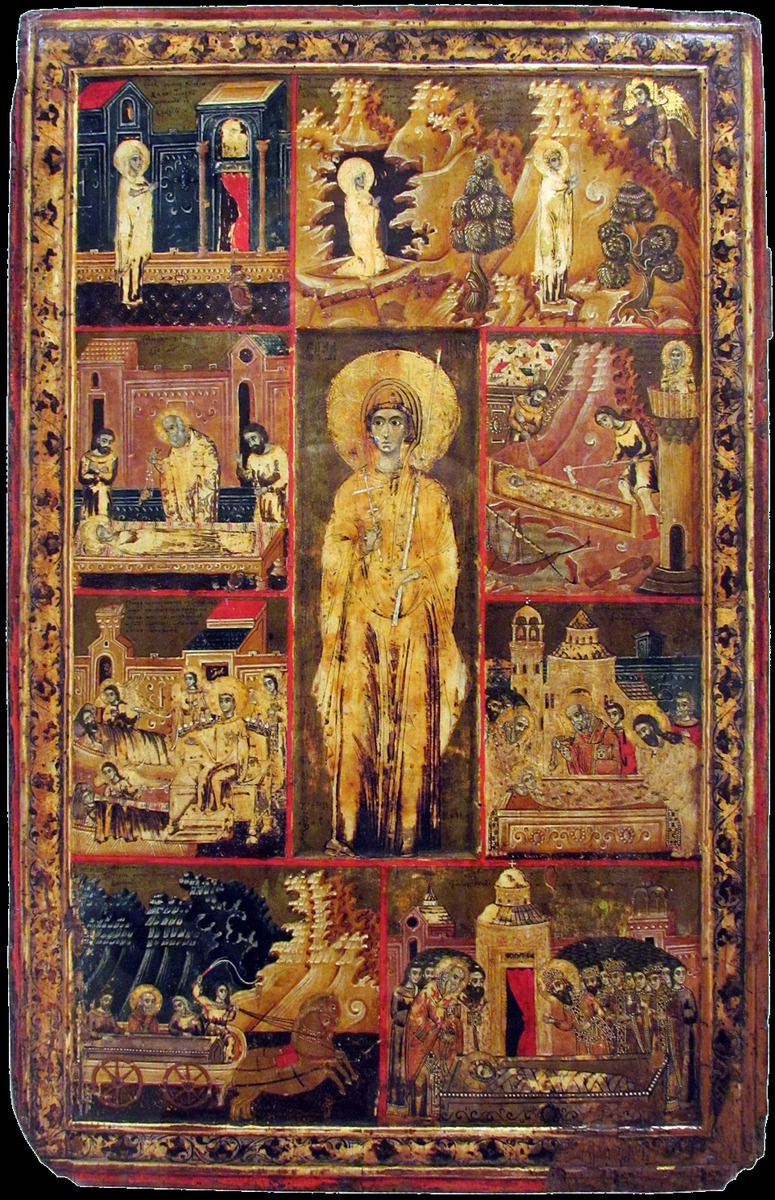
The uncovering of her body is the hinge of her whole cultus, and the Lives tell it with homely vividness. A sailor's corpse was cast up by the sea near her grave, and its stench so afflicted a nearby ascetic — a stylite in the transmitted account — that he had workmen dig a pit to bury it. Digging, they found a woman's body whole and incorrupt, and, thinking nothing of it, buried the corpse beside it and went home. That night one of them, a pious man named George, saw in a dream a queen enthroned in light amid a host of angels, who reproached the diggers for leaving her body in the mire beside a corpse and named herself: Parasceva of Epibatai. A devout woman named Euphemia saw the same vision. The village clergy and people exhumed the body, found it fragrant and entire, and translated it with candles and censing to the church of the Holy Apostles at Epibatai, where healings began at once and continued — the OCA's notice says — for about a hundred and seventy-five years, until the relics began the long journey that carried her name across the peninsula.
Relics and translations
The odyssey of Parasceva's relics is a map of Balkan history; the entry records the standard sequence and notes the divergent dates under Disputed questions.
- To Tarnovo. In the years after his victory at Klokotnitsa (1230), when his power reached the Aegean, the Bulgarian tsar John Asen II obtained the relics from the region of Kallikrateia — then under Frankish lords — and had them translated in state to his capital Tarnovo, an event usually dated 1238 (the OCA gives 1223). Met by the tsar, the patriarch Joachim, and the whole city, the relics made Parasceva the patroness of Tarnovo and of the Second Bulgarian Empire; as Petka Tarnovska she entered the heart of Bulgarian devotion, and in the fourteenth century the last great patriarch of Tarnovo, Euthymius, wrote the Life that became the classic account of her.
- To Vidin and Belgrade. When Tarnovo fell to the Ottomans (1393), the relics were carried to Vidin on the Danube, and on Vidin's fall passed into Serbian keeping — the standard account brings them to Belgrade about 1396 at the instance of the princess Milica, while the OCA transmits a variant involving Mircea the Elder of Wallachia and "Princess Angelina of Serbia" (see Disputed questions). In Serbia the veneration of Sveta Petka struck the deep root it retains today; the spring beside her chapel at Kalemegdan in Belgrade is still resorted to for healing.
- To Constantinople. When Belgrade fell to Suleiman in 1521, the relics were taken to Constantinople, and came to rest in the patriarchal church, where they remained about a hundred and twenty years.
- To Iaşi. In 1641 the Ecumenical Patriarch Parthenius I and his synod granted the relics to Basil (Vasile) Lupu, voivode of Moldavia, who had paid the crushing debts of the Patriarchate. On June 13, 1641 they were received with imperial honours at Iaşi and enshrined in Lupu's newly built church of the Three Hierarchs (Trei Ierarhi). There they survived the centuries — including a fire on December 26, 1888, from which the relics were brought out unharmed, an escape the Romanian tradition counts among her miracles — and in 1889 they were placed in the new Metropolitan Cathedral of Iaşi, where they rest to this day.
Veneration and later cultus
No woman saint is more widely loved in the Orthodox Balkans. In Romania she is Cuvioasa Parascheva, patroness of Moldavia; her October 14 feast at Iaşi draws hundreds of thousands of pilgrims annually — queues to venerate the relics run for days — making it one of the largest recurring pilgrimages in the Orthodox world. In Bulgaria she is Petka Tarnovska, a national patroness whose name marks churches from the Danube to the Rhodopes, including the famous church of Sveta Petka Samardzhiyska in Sofia. In Serbia and among the Serbs of Bosnia and Macedonia, Sveta Petka is the protectress of the home and of women, honoured with countless churches, springs, and family patronal feasts on October 27 (the civil date of the Old Calendar). In Moldova and among the Slavs generally her name is a byword for help in trouble; and the Greek synaxaria too keep her memory on October 14 as "our venerable mother Parasceva the New." Folk devotion has woven her deeply into the fabric of the week itself: as the personified holy Friday she inherited, and in places exchanged, the veneration of her earlier namesakes (see Disputed questions).
Hymnographic and literary legacy
Her hagiography is itself a monument of Balkan letters. In the twelfth century the patriarch Nicholas IV Mouzalon of Constantinople, finding in circulation a Life "written by a peasant" and unworthy of the saint, ordered it destroyed and commissioned the deacon Basilikos to write a proper one. The classic Life, however, is the Church Slavonic one composed in the fourteenth century by Euthymius, patriarch of Tarnovo, the greatest man of letters of mediaeval Bulgaria; and the translation of the relics into Serbia was recounted by Gregory Tsamblak, Euthymius's literary heir. Full services to her exist in Slavonic, Greek and Romanian, and her akathist remains among the most used in Romanian and Slavic devotion.
Feast and commemoration
October 14 (church date; Old Calendar civil October 27), kept universally: the Greek synaxarion of the day lists her among its commemorations, and in the Slavic and Romanian worlds she is the day's chief saint, celebrated with a full festal service that in Romania ranks among the greatest feasts of the year. At Iaşi the feast is the centre of a pilgrimage of national scale; in Serbia and Bulgaria the civil date October 27 (Old Calendar) is a major patronal and family feast (slava). The Antiochian and other New Calendar jurisdictions keep her on October 14 together with the martyrs Nazarius, Gervasius, Protasius and Celsius and (in Greek use) Cosmas of Maiuma.
Hymns
Troparion — Tone 2
Having loved the desert life and its stillness, and run with fervour after Christ thy Bridegroom, and taken his good yoke upon thee in thy youth, thou didst arm thyself manfully with the sign of the Cross against the spiritual foes; by ascetic struggles, by fasting, prayers and drops of tears thou didst quench the burning coals of the passions, O Parasceva worthy of all praise; and now in the heavenly bridal chamber, standing with the wise virgins before Christ, pray for us who honour thy precious memory.
Original translation from the Slavonic
Kontakion — Tone 6
Come, all ye faithful, and let us devoutly hymn the holy protectress of those in adversity, Parasceva the all-honoured; for she forsook the corruptible life and received the incorruptible unto the ages, and therefore has found glory, and the grace of wonders, at the command of God.
Original translation from the Slavonic
Magnification
We call thee blessed, O venerable mother Parasceva, and we honour thy holy memory, for thou dost pray for us to Christ our God.
Original translation from the Slavonic
Iconography
Parasceva is painted as a nun: dark monastic mantle and veil, a cross or scroll in her hand, the face young and ascetically drawn. She thus differs at a glance from her martyr-namesakes of Rome and Iconium, who wear the red maphorion of martyrdom — a distinction icon collections regularly blur (see Disputed questions). Vita icons surround her with the scenes of her legend: the hearing of the Gospel, the desert struggle, the angel's command, her burial by the sea, the uncovering of the relics beside the sailor's corpse, and the translations with tsars and hierarchs in attendance. The stored image is exactly such a witness: the vita icon of St Paraskeve of Trnovo of 1719–20 from the Patriarchate of Peć, the saint full-length in monastic dress with cross and staff, ringed by the scenes of her life, death, uncovering and translations. A second stored image (parasceva-of-the-balkans-2.jpg) is a Greek engraved icon of 1817 inscribed "the holy Parasceva," transmitted under her Greek title "the Epivatine": the venerable in full monastic mantle holding a cross.
Disputed questions
- Century and chronology of her life. The calendars conventionally place her in the eleventh century (so the OCA), but her brother Euthymius of Madytos is a historically attested bishop whose death is generally set about 990, which would pull her life back into the tenth century. The sources also divide on the shape of her asceticism: the Euthymian tradition followed by the OCA has her die young, at about twenty-seven, two years after returning home, while the account transmitted in the Prologue of Ohrid and printed by azbyka has her labour in the Jordan desert "to advanced years." Neither can be verified; both are recorded.
- Dates of the translations. The translation to Tarnovo is dated 1238 in the standard scholarship (after Klokotnitsa, under John Asen II) but 1223 in the OCA's notice; the OCA likewise dates the Ottoman capture of Tarnovo 1391 (usually 1393) and has the relics pass to Mircea the Elder of Wallachia and then in 1394 to "Princess Angelina of Serbia," who brought them to Belgrade — an account hard to reconcile with the dates of the historical Angelina (†c. 1520), where the standard account names the princess Milica and c. 1396. The disagreement is old and is recorded here, not resolved; all accounts converge again at Belgrade, at the 1521 removal to Constantinople, and at the documented translation to Iaşi in 1641.
- Not to be confused with her two chief namesakes, with both of whom folk devotion and icon collections constantly conflate her: Parasceva of Rome (second-century venerable-martyr, commemorated July 26), and Parasceva of Iconium (virgin great-martyr of the early Church, commemorated October 28 — the "Paraskeva Pyatnitsa" of Russian folk veneration, whose feast falls a fortnight after Petka's own and one day after Petka's Old Calendar civil date, a proximity that has fed the confusion for centuries). Both now have their own entries, which carry the reciprocal notes. Distinct also is the fool-for-Christ Parasceva of Diveyevo (†1915). In iconography the martyr Parascevas are shown in the red maphorion of martyrdom, often with the instruments or scenes of their passion; Petka is a nun. Vita icons bearing "St Parasceva" with passion scenes depict the martyrs, not her — a test applied to this entry's own image (see Iconography).