
Parasceva of Rome
The Holy Venerable-Martyr Parasceva of Rome
Venerable Martyr · Virgin · b. c. 118, at Rome — d. c. 140–160, beheaded near Rome
Commemorated 26 July — Beheading of the venerable-martyr; in Greece the great summer panegyri of Agia Paraskevi
Parasceva was a Roman-born Christian of the second century, the only child of Greek Christian parents, Agathon and Politia, who named her for the day of her birth — the Preparation, Friday, the day of the Cross. Left an orphan while still young, she sold her inheritance, gave it to the poor, consecrated her virginity, and then did the thing that makes her unusual among women saints of her age: she went out and preached, city by city, as the Apostles had. She was arrested under Antoninus Pius (138–161), survived a red-hot helmet and a cauldron of boiling oil and pitch, and — by the most famous episode of her passion — healed the emperor of the blindness that came upon him, so that he set her free and stayed his hand against the Christians. Taken again in another province, she was tortured and beheaded. She is the great Agia Paraskevi of the Greek world, invoked above all for diseases of the eyes. She must not be confused with two later saints of the same name (see Disputed questions).

Origins and consecration
The passion places her birth at Rome, in a household of Greek extraction that had been Christian for some time — her parents Agathon and Politia are named, and the tradition adds that they were long childless and that she was given them in answer to prayer. She was born on a Friday, and was called Παρασκευή, Paraskeuē, "Preparation", the Greek name of that day: the name is itself a small sermon, since Friday is the day of the Lord's Passion, and the hymnography plays on it constantly ("named for the day of the Cross, thou didst take up the Cross").
She was educated in the Scriptures from childhood and was reading them, the account says, by the time she was seven. Her parents died while she was still a young woman — some recensions say at about twenty. She sold the estate, distributed the proceeds to the poor, and consecrated her virginity to Christ, joining herself to a community of Christian women at Rome who lived in prayer, fasting and manual work. It is from this period that her title in Greek is ὁσιομάρτυς, venerable-martyr: a woman first professed to the ascetic life, and only afterwards martyred.
The preaching
What follows is the distinguishing feature of her Life. After some years she did not remain enclosed. Taking, the text says, the Apostles as her pattern, she left Rome and travelled, entering towns and speaking openly — to Jews, to Greeks, to whoever would listen — and by her word a considerable number of pagans were baptised. Women's preaching of this kind is rare in the hagiography of the period and is precisely what the tradition remembers of her; the same detail recurs in every recension.
It also explains her arrest. It was not a household discovered but a public teacher denounced.
Before Antoninus Pius
Brought before the emperor — the passion names Antoninus Pius, whose reign (138–161) fixes her dating — she was ordered to sacrifice and refused. The tortures follow the usual progression of the genre, but with one instrument that is hers alone: a helmet of iron, heated red-hot, was set upon her head. She was then suspended and her sides raked, and finally lowered into a cauldron of boiling oil and pitch — from which, the account says, she stood unharmed, the liquid neither scalding her nor even troubling her.
The emperor, watching from his seat, refused to believe the cauldron was hot and taunted her with it. She took some of the boiling liquid in her hands and cast it towards him; it struck his face and eyes, and he was blinded. He cried out to her for help; she prayed and touched his eyes, and his sight returned. It is from this scene — repeated in every icon, every village panegyri and every ex-voto in Greece — that she is invoked as the healer of the eyes, and it is why the standard Greek icon of Agia Paraskevi shows her holding a dish or tray bearing a pair of eyes.
Antoninus released her, and (the passion adds, and here it is claiming more than history can bear out) forbade the persecution of the Christians for a time.
The governors Asclepius and Tarasius
She resumed her preaching in the provinces. Under a governor named Asclepius she was condemned to be devoured by a great serpent kept for executions: she made the sign of the Cross over it and the beast, the account says, split and died. Asclepius and a crowd of the citizens were baptised.
In another city, under the governor Tarasius, the pattern was not broken a third time. She was scourged, her body torn, and she was beheaded — the date usually given is about the year 140, though the reign named in her own passion runs to 161, and the middle of the century is as close as the record allows. Christians took her body and buried it; her tomb became a place of healings, and the passion closes with the standard but here unusually persistent catalogue: the blind saw, the lame walked, and barren women bore children.
Cultus
No saint of her rank is more thickly present in the Greek countryside. Agia Paraskevi is among the commonest church dedications in Greece, Cyprus and the Greek diaspora; whole villages and city quarters bear her name; and July 26 is one of the great summer panegyria of the Greek year, with the eve vigil, the procession of the icon and the fair. Springs and agiasmata dedicated to her are resorted to for the eyes. She is kept with equal warmth in Romania (Sfânta Parascheva de la Roma, carefully distinguished there from Cuvioasa Parascheva of Iaşi), in the Arab-speaking Antiochian parishes, and in the Slavonic books as преподобномученица Параскева Римская.
Feast and commemoration
July 26 (church date; New Calendar civil July 26, Old Calendar civil August 8). The service is a full one with the doxastika proper to her and a canon; where a church bears her name it is kept as a patronal feast with vigil, and in Greece with the great open-air panegyri on the eve. In the Antiochian Archdiocese and other New Calendar Churches the day falls on civil July 26; Old Calendar Churches keep it on civil August 8.
The placement is significant in its own right. July 26 stands between the Dormition of St Anna (July 25) and the great-martyr Panteleimon (July 27), so the last week of July carries three of the most popular name-days of the Greek year in succession.
Hymns
Apolytikion — Tone 1
O Christ our God, thou hast granted us thy venerable-martyr Parasceva as a physician of our ills: for named for the day of thy Cross, she took up the Cross and followed thee, and by the shedding of her blood she opened the eyes of the blind. By her prayers, O merciful One, grant to our souls also the light that never sets.
Kontakion — Tone 3
Consecrating thy virginity to the Bridegroom and thy tongue to the preaching of the truth, thou wast tried in fire and in the seething cauldron, and wast not consumed, O all-praised Parasceva; wherefore, receiving thy crown by the sword, thou dost pour out healings upon them that honour thee.
Original translation from the Greek
Iconography
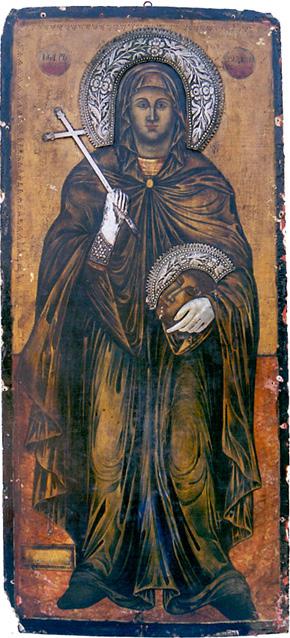
The type is fixed and unmistakable. Parasceva is shown standing, full length, a young woman in a dark or crimson maphorion over a long tunic, holding in her right hand the martyr's cross and in her left, at the level of the breast, a shallow dish or plate on which lie two eyes — the memory of the blinded and healed emperor, and the reason the sick of sight come to her. In some Greek examples she holds a martyr's crown or a small model of a church instead; in others the dish is replaced by a scroll.
Because she is a venerable-martyr she is often given the monastic habit rather than the imperial-style robes worn by the virgin great-martyrs — a useful, though not infallible, way of telling her from Parasceva of Iconium, who is normally shown crowned and richly dressed. Vita-icons surround her with the scenes of the passion: the helmet, the cauldron, the serpent, the beheading.
The stored image is the despotic icon of the church of Agia Paraskevi at Langadas in Greek Macedonia, painted in 1850 by Stefanos Pantazis (the silver revetment on the halo and the dish was added in 1918, and is visible in the photograph): the saint stands full-length in a dark mantle, the cross held obliquely across her breast in her right hand and the covered dish in her left.
Disputed questions
-
Three saints named Parasceva — the standing confusion. This entry concerns Parasceva of Rome, venerable-martyr, second century, feast July 26. She is distinct from:
- Parasceva of Iconium, the great-martyr of the third century, feast October 28, called in Slavic lands Paraskeva Pyatnitsa; and
- Parasceva of the Balkans — St Petka of Epivates, eleventh century, a venerable (not a martyr), whose relics rest at Iaşi, feast October 14.
All three are "St Paraskeva/Petka"; all three are shown as young women; the two October saints are constantly merged with each other and with this one, in popular devotion, in church dedications, and in modern lists. The safest discriminators are the date and the type: July 26 = Rome, venerable-martyr; October 28 = Iconium, great-martyr; October 14 = Epivates/Iaşi, venerable and no martyrdom at all.
-
"Prisca" in the Antiochian list. The Antiochian Archdiocese's liturgical-day feed for July 26 gives, immediately after "Paraskeve the Righteous Martyr of Rome," a second line, "Prisca the Righteous Martyr." This is not a distinct saint: Prisca (Priscilla) is the Latin name-equivalent by which some Western and Antiochian books gloss Paraskeve — the two render the same person — and no other calendar (OCA, the Greek synaxaria) carries a separate Prisca on July 26. The doubling is the one name written twice, once Greek and once Latin; it is recorded here rather than made into a second entry.
-
Historicity. No pre-Byzantine document attests her; the passion is a Byzantine composition, and the naming of Antoninus Pius is part of the passion, not independent evidence. Some scholars have argued that the Roman Paraskeve is a doublet generated by the Greek name of Friday and the Iconian great-martyr's cult travelling west. The Church's usage — three distinct commemorations, three distinct services — is what this entry records.
-
Date of death. "About 140" is the figure carried by most synaxaria, but it does not sit easily with a reign that began in 138 and a Life that gives her a long ascetic career and years of travel first. Later in the reign is likelier if the framework is taken at face value.