
Paul of Obnora
Our Venerable Father Paul of Obnora and Komel, Wonderworker
Venerable · Wonderworker · b. 1317, at Moscow — d. January 10, 1429, at the Obnora monastery
Commemorated 10 January — Repose of Paul of Obnora; kept within the afterfeast of the Theophany
Paul of Obnora (1317 – 1429) was one of the great hermit-founders of the northern Russian forests, a disciple of Saint Sergius of Radonezh and among the most severe ascetics of his age. Born at Moscow to wealthy parents, he fled a proposed marriage to become a monk, and after long years of obedience came to Sergius of Radonezh, in whose Trinity monastery he served, then withdrew fifteen years into a hermit's cell, and at last wandered north into the wilderness of Vologda. In the Komel forest, by the river Obnora, he lived three years in silence in the hollow of a great linden tree, at peace with the wild creatures, before gathering disciples and founding, in his old age, the Trinity monastery of Obnora. He reposed on January 10, 1429, at the age of one hundred and twelve, and was numbered among the saints; he is remembered for his extreme stillness, his gentleness toward the birds and beasts, and his counsel, "Flee, keep silence, and be still."
_-_%D0%B8%D0%BA%D0%BE%D0%BD%D0%B0_05104_%D0%9F%D0%B0%D0%B2%D0%B5%D0%BB_%D0%9A%D0%BE%D0%BC%D0%B5%D0%BB%D1%8C%D1%81%D0%BA%D0%B8%D0%B9.png)
From Moscow to the Trinity of Saint Sergius
Paul was born at Moscow in 1317, of rich and pious parents, and from his youth was drawn to prayer and to mercy toward the poor. When his parents prepared him for marriage and a place in the world, he secretly left home at the age of twenty-two and received the monastic tonsure at the Nativity monastery on the Volga, in the Yaroslavl diocese. Seeking a stricter and more hidden life, he came at length to the Holy Trinity monastery of Sergius of Radonezh, the great renewer of Russian monasticism, and lived several years there as Sergius's disciple, obedient in all things and setting himself the hardest labours of the community. With his elder's blessing he then withdrew, a little apart from the monastery, to a solitary cell, where he passed fifteen years as a recluse in unbroken prayer.
The wilderness of the North, and the linden tree
The longing for still deeper solitude drew Paul at last away from Radonezh and northward into the forests of Vologda. After a time with Saint Abraham of Chukhloma and a season of wandering, he came to the Komel forest, in the valley of the little river Obnora (a tributary of the Nurma), and there found the stillness he sought. For three years he dwelt, the tradition says, in the hollow of an old linden tree, in complete silence, "giving his body no rest that he might win the rest to come." The many stories of these years dwell on his communion with the wild creatures of the forest — the birds settling on him, the bears and hares and foxes coming to his hand — as to a man restored, in his innocence and peace, to something of Adam's dominion; and for this Paul is beloved in the Russian tradition as a friend and protector of birds.
The founding of the Obnora monastery, and repose
Disciples gathered, drawn by the fame of his holiness, and Paul — though he loved solitude above all — consented to shepherd them. With the blessing of Saint Sergius's memory and the agreement of the Metropolitan Photius of Moscow, he built about 1414, in his ninety-seventh year, a wooden church of the Holy Trinity on the Obnora, around which grew the monastery afterwards called the Monastery of Saint Paul of Obnora (Pavlo-Obnorsky). He gave it a rule of strict community, but for himself kept the hermit's silence to the end, coming down to the brethren chiefly on Saturdays and Sundays. He reposed on January 10, 1429, having lived, the tradition holds, one hundred and twelve years. Miracles were worked at his tomb, and he was formally glorified among the saints of the Russian Church in the sixteenth century (the council of 1547). His companion and neighbour in the wilderness, Macarius of Pisemsky, is remembered with him.
Feast and commemoration
Paul is kept on January 10 (church date; Old Calendar civil January 23), the day of his repose, within the afterfeast of the Theophany. His commemoration is principal in the Russian Church and kept by the Orthodox Church in America; he is numbered among the disciples of Saint Sergius of Radonezh and among the Vologda saints of the northern wilderness. He shares the day with Gregory of Nyssa and the other saints of January 10.
Iconography
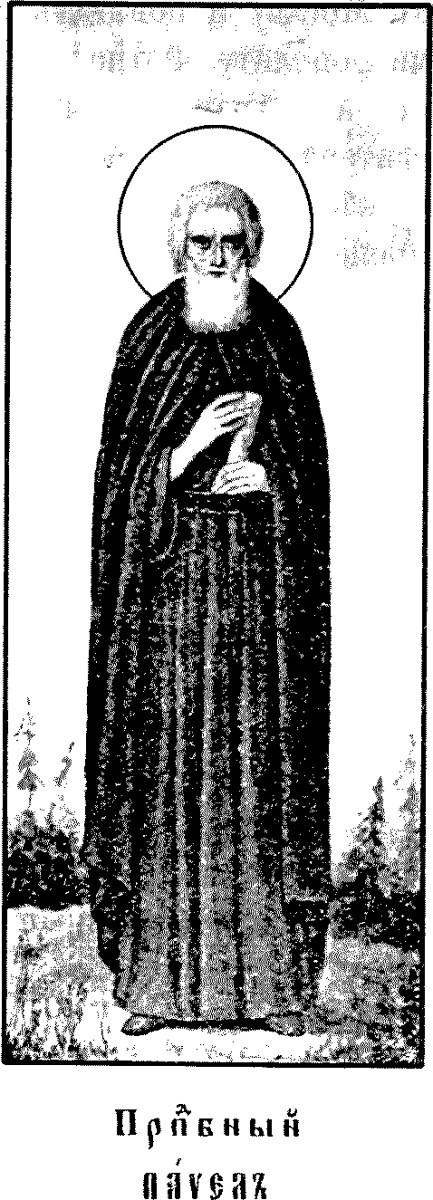
Paul is depicted as an aged hermit-monk — long grey beard, the monastic schema — often gaunt with fasting, and characteristically shown in the forest or beside a linden tree, sometimes with the birds and beasts about him that the tradition loves, or holding a scroll with his counsel to flee and be silent. As a founder he may bear a model of his monastery church.
The stored image is a Russian engraving from the illustrated Lives of the Saints (Zhitiya Svyatykh, 1903–1911), rendering the traditional iconographic type of the saint — the aged Paul in the monastic habit, after the received icon of Paul of Komel. A pre-modern painted icon has not been secured for storage; this documentary engraving stands in its place, and an older panel is wanted.