
Gregory of Nyssa
Our Father among the Saints Gregory, Bishop of Nyssa
Bishop · b. c. 335, at Caesarea or Neocaesarea in Cappadocia — d. c. 395, at Nyssa (or Constantinople)
Commemorated 10 January — Repose of Gregory of Nyssa; kept within the afterfeast of the Theophany
Gregory of Nyssa (c. 335 – c. 395) was Bishop of Nyssa in Cappadocia and the youngest of the three great Cappadocian Fathers — the brother of Basil the Great and of Macrina the Younger, the son of Emmelia, and the friend of Gregory the Theologian. The subtlest and most speculative theological mind of the three, he began as a teacher of rhetoric, was drawn by his brother Basil into the Church's service, and was consecrated bishop of the little town of Nyssa in 372 to hold it for the Nicene faith against the Arian court. Deposed and exiled under the emperor Valens, he returned in triumph after 378, and at the Second Ecumenical Council (Constantinople, 381) stood as one of the pillars of the Nicene settlement, so honoured for his orthodoxy that a later age styled him "Father of the Fathers." He left a body of writing of the first rank — On the Making of Man, the Great Catechism, the Life of Moses, the books Against Eunomius and Against Apollinarius, the dialogue On the Soul and the Resurrection set at his sister's deathbed, and the Life of Macrina — in which the doctrine of the infinite God, of the soul's endless ascent from glory to glory, and of the final restoration of all things receives its classic Greek expression. He reposed about the year 395 and is kept on January 10, within the afterfeast of the Theophany.
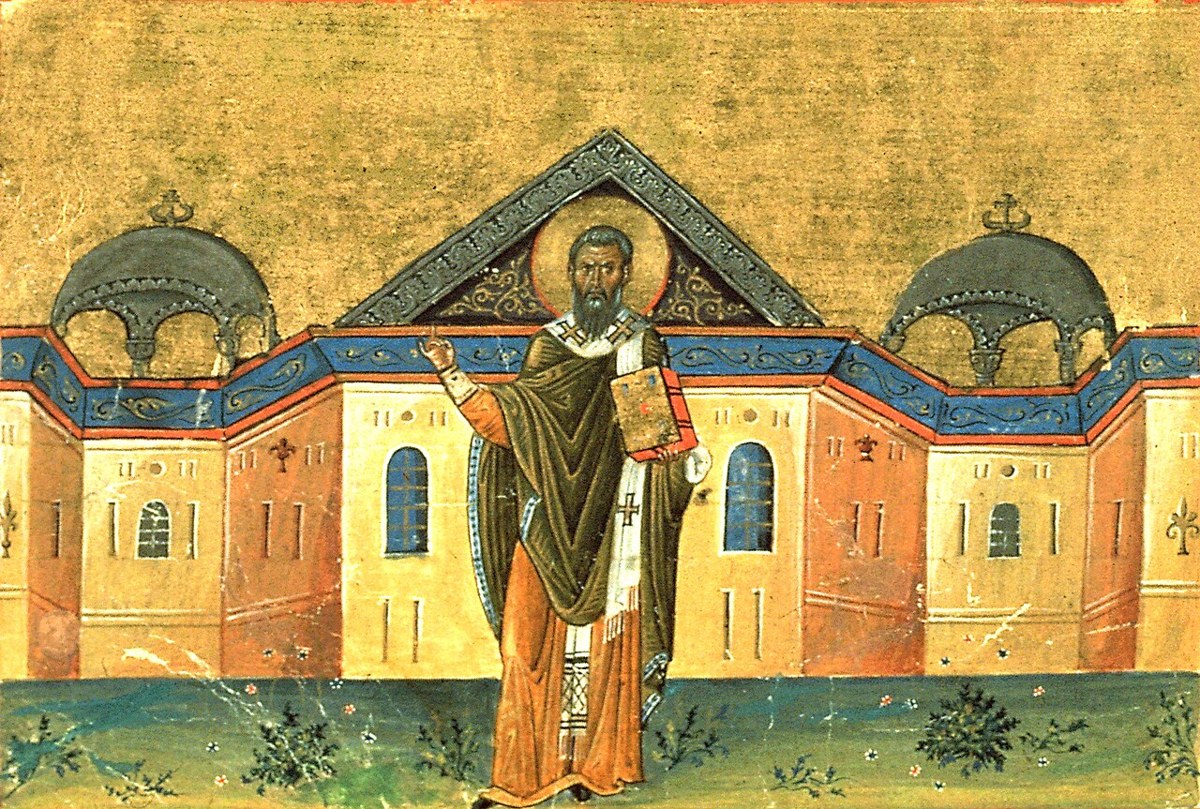
.jpg)
A family of saints
Gregory was born about the year 335, at Caesarea in Cappadocia or on the family estates in Pontus, the younger brother of Basil the Great and one of the ten children of Emmelia and Basil the Elder — that household without parallel in the calendar, which gave the Church five saints of one mother. His elder sister Macrina the Younger (commemorated July 19) was the spiritual teacher of the whole family; his brothers included Basil, the future archbishop of Caesarea; Naucratius (commemorated June 8), who died young in the ascetic life; and Peter of Sebaste (commemorated January 9), the youngest, who became bishop of Sebaste. Gregory was thus formed from birth in a family whose grandmother Macrina the Elder had been a confessor and a disciple of the followers of Gregory the Wonderworker, the apostle of Cappadocia; and it is to Gregory of Nyssa above all — in the Life of Macrina and the dialogue On the Soul and the Resurrection — that we owe the memory of that holy household.
Of the three Cappadocians he was the least robust and the most retiring, and by his own account he came to the Church's service slowly and by his elder brother's constraint. Where Basil was the organiser and man of affairs and Gregory the Theologian the orator and poet, Gregory of Nyssa was the speculative thinker, the boldest and most original mind the fourth century produced in the East, whose reach into the mystery of God and the destiny of the soul carried him further than either.
From rhetoric to the Church
Gregory received the fullest Hellenic education, though — unlike Basil — he seems not to have studied abroad, but was formed (he says) chiefly by his brother's example, calling Basil his master and reckoning himself Basil's pupil. In his early manhood he took up the profession of rhetor, a teacher of eloquence, and for a time gave himself to secular learning and the career of the schools; his friends, and Gregory the Theologian among them, reproached him for preferring the title of rhetorician to that of Christian. The tradition holds that he was recalled to the service of God partly by a vision — of the Forty Martyrs of Sebaste, at a feast in their honour, who rebuked his negligence — and partly by the reproaches of his family.
It belongs to the candour of the record that Gregory was, in these years, very probably a married man: he speaks in his treatise On Virginity with the feeling of one who has known and lost the goods he praises the celibate for forgoing, and an old tradition names his wife Theosebia — the deaconess mourned at her death by Gregory the Theologian, whom the same Gregory in his letter calls Gregory of Nyssa's "yoke-fellow." Whether Theosebia was his wife or (as the received Orthodox tradition holds) his sister is disputed and is treated below; either way, Gregory passed from the married and secular condition into the Church's ministry, and this passage — a theologian of marriage who became a bishop and an ascetic — is part of what gives his writing on virginity its peculiar depth.
Bishop of Nyssa, and the Arian storm
In 371 the emperor Valens divided Cappadocia into two provinces, weakening the metropolitan authority of Basil at Caesarea. To hold the ground for the Nicene faith, Basil filled the new sees with men he could trust, and in 372 he consecrated his brother Gregory bishop of Nyssa — a small and obscure town on the road, of which Gregory would remark ruefully that it was too mean a place for its bishop's troubles. Gregory was no politician, and the appointment strained the brothers: Basil complained of Gregory's unworldliness and want of firmness in the management of affairs, and once, exasperated, wrote that his brother had no idea how to conduct the business of a church. Yet it was precisely as bishop of Nyssa that Gregory was drawn into the front line of the Arian conflict.
The Arian party, backed by the court of Valens, moved against him. About 376 Gregory was accused — on trumped-up charges of financial maladministration and of irregularity in his consecration — deposed by a synod of Arianising bishops, and driven into exile. For some two or three years he wandered from place to place, hunted and homeless, unable to hold his see. The persecution ended only with the death of Valens at the battle of Adrianople in 378 and the accession of the Nicene emperor Gratian, whereupon Gregory returned to Nyssa amid the rejoicing of his people, who (he says) poured out to meet him as though he were restored from the dead.
The death of Basil and Macrina
The year of his return was also the year of his sorrows. Early in 379 Basil the Great died, worn out at Caesarea; and a few months later Gregory, travelling to the family lands, came to Annesi to find his sister Macrina herself dying. At her bedside he held with her the long conversation on death, the soul, and the resurrection that he afterwards wrote up as the dialogue On the Soul and the Resurrection — casting Macrina, as Plato had cast Socrates, as the "Teacher" who instructs him out of a serene certainty of the life to come — and he wrote too the tender Life of Macrina, at once a biography of his sister and the fullest portrait we possess of the ascetic household of Annesi. In the loss of his brother and his sister within a single year, Gregory the youngest was left the last surviving pillar of the family, and he stepped, in the Church's eyes, into something of Basil's place as a champion of the faith.
The Second Ecumenical Council and the years of eminence
The decade after 379 was the summit of Gregory's public life. He took a leading part in the Council of Antioch (379) and was sent by it to set in order the troubled churches of Pontus and Arabia, and even, the record says, to Jerusalem — a mission that left him with a lasting distaste for religious tourism, which he vented in a famous letter warning that a pilgrimage to the holy places is no nearer to God than a life of virtue at home, for "change of place brings no nearer to us the God who is everywhere."
Above all he was a chief actor at the Second Ecumenical Council — the Council of Constantinople in 381 — which completed the work of Nicaea, confessed the divinity of the Holy Spirit, and gave the Creed its final form. Gregory came to the Council with an authority now second to none among the Eastern fathers; the emperor Theodosius, in the edict that followed, named him among the bishops communion with whom was the very test of orthodoxy for the diocese of Pontus. In these years he preached at Constantinople before the court, delivered the funeral orations for the princess Pulcheria and the empress Flacilla, and was repeatedly employed by the Church on missions of weight. It was on the strength of this standing at the great Council that the Seventh Ecumenical Council (Nicaea, 787), four centuries later, would honour him with the title "Father of the Fathers."
Repose
Gregory's last securely dated appearance is at a synod at Constantinople in 394; he must have died soon after, and the tradition places his repose about the year 395. The place is uncertain — Nyssa or Constantinople — and no account of his death survives; he passed, as he had lived, more quietly than his brother. The Church keeps his memory on January 10.
Veneration and later cultus
Gregory's memory was honoured at once, and his authority as a father of the Church only grew: the Seventh Ecumenical Council cited him against the iconoclasts and called him "Father of the Fathers," and the later Byzantine tradition ranked him with the very greatest of the teachers. In the Christian West his influence, direct and through those he shaped, was immense. He is kept throughout the Orthodox world on January 10, his repose falling within the bright days of the afterfeast of the Theophany, so that his feast is sung together with the hymns of the Lord's Baptism.
Hymnographic and literary legacy
Gregory is, with Basil and Gregory the Theologian, one of the three Cappadocian Fathers whose settlement of the doctrine of the Trinity is the grammar of the Nicene faith; but where Basil forged the formula and Gregory the Theologian sang it, Gregory of Nyssa thought it through to its depths, and carried Christian reflection into regions no one before him had mapped. His surviving works fall into several bodies:
- Dogmatic and polemical. The Against Eunomius (in several books) takes up and completes the work Basil had begun against the neo-Arian Eunomius, who claimed a rational comprehension of the very essence of God: against him Gregory teaches with unmatched force the infinity and incomprehensibility of the divine nature — that God is without limit, and that the creature can therefore never exhaust him, but only advance into him without end. The Antirrheticus against Apollinarius defends the fullness of Christ's humanity against Apollinaris, who had denied the Lord a human mind; and a cluster of short treatises — To Ablabius, That There Are Not Three Gods, On "Not Three Gods," the letters on the Trinity once ascribed to Basil — refine the Cappadocian distinction of the one essence and the three persons.
- Catechetical and exegetical. The Great Catechism (the Oratio Catechetica Magna) is the most complete systematic exposition of the faith between Origen's On First Principles and John of Damascus — a reasoned account of the Trinity, the creation and fall of man, the Incarnation and redemption, and the sacraments, addressed to the instruction of catechists. On the Making of Man (De hominis opificio), written to complete Basil's Hexaemeron, is the classic Greek treatise on man as the image of God. His exegetical masterpieces — the Life of Moses, the Homilies on the Song of Songs, the homilies On the Beatitudes and On the Lord's Prayer, On the Inscriptions of the Psalms — read the Scriptures as a ladder of the soul's ascent to God.
- Ascetic and consoling. On Virginity, his earliest work; the Life of Macrina and the dialogue On the Soul and the Resurrection; the treatise On the Dead; and the letters, including the great letter against pilgrimage as a work of salvation in itself.
Three ideas run through the whole and are Gregory's abiding gift to Orthodox theology. The first is apophaticism — that God is infinite and therefore beyond every name and concept, known not by comprehension but by the soul's reverent unknowing, the "luminous darkness" into which Moses entered on the mountain. The second, which flows from the first, is epektasis — the teaching that because God is infinite, the blessed soul's union with him is not a static rest but an endless progress, a perpetual stretching-forward "from glory to glory" (2 Cor 3:18) in which the soul, ever satisfied, is ever more desirous, and grows into God for all eternity without ever reaching a term. The third, the most daring and the most disputed, is his hope of the restoration of all things (apokatastasis) — that in the end, the fire of judgment having purged away all evil, God will be "all in all," and every rational creature, even the fallen, brought home; a hope Gregory drew from Origen and from 1 Corinthians 15:28, held with more warmth than any other Father, and one the Church has never received as dogma (see Disputed questions).
Feast and commemoration
Gregory is kept universally on January 10 (church date; Old Calendar civil January 23), the traditional day of his repose, which falls on the fourth day of the afterfeast of the Theophany; his office in the Menaion is sung together with the afterfeast hymns of the Lord's Baptism. He shares the day with a second hierarch, Dometian of Melitene, and the two bishops are commemorated together in the day's apolytikion. The Antiochian, Greek, and Slavic calendars agree on the day. The Roman Catholic Church, which venerates Gregory as a Church Father, keeps him with a memorial on the same day, January 10.
Hymns
Troparion — Tone 4
O God of our Fathers, who dealest ever with us according to Thy forbearance: take not Thy mercy from us, but by their supplications govern our life in peace.
Original translation from the Greek
Kontakion — Tone 1
Keeping watch over the eye of thy soul, O hierarch, thou wast shown to the world a vigilant shepherd; and with the staff of thy wisdom, O all-blessed and holy one, thou didst drive away all the evil-minded as wolves, and didst keep thy flock unharmed, O all-wise Gregory.
Original translation from the Greek
Iconography
Gregory is depicted as a hierarch of the classic Cappadocian type — an aged bishop, high of forehead, with a long, rounded (rather than pointed) grey or dark beard, vested in the phelonion or the cross-figured polystavrion and the omophorion, holding the Gospel-book and raising his hand in blessing, or bearing a scroll. In the composed portraits of the Cappadocian teachers he stands beside his brother Basil — Basil marked by his narrow, tapering beard and gaunt ascetic face, Gregory of Nyssa fuller and rounder of feature — and beside Gregory the Theologian; the iconography distinguishes the two Gregorys chiefly by their setting and their inscriptions, not by face. He is often shown among the company of the great hierarchs and teachers of the Church.
The stored image is the Menologion of Basil II miniature for January 10 (Constantinople, c. 985; Vatican, Vat. gr. 1613) — Gregory of Nyssa vested as a bishop in the cross-marked omophorion, blessing and holding the Gospel, in the manner of the great teachers of the manuscript.
Disputed questions
- Theosebia — wife or sister? Gregory the Theologian, writing to Gregory of Nyssa to console him on the death of the deaconess Theosebia, calls her both his "sister" and the "true consort (σύζυγος) of a priest" — language that has been read in two ways. The received Orthodox tradition, followed by the Menaia and the modern jurisdictional calendars, makes Theosebia the sister of Gregory, Basil, and Peter, and numbers her among the children of Emmelia. Much modern scholarship, weighing the word "consort" together with Gregory's evident experience of marriage in On Virginity, holds rather that she was his wife, married before his episcopate. The question cannot be closed from the sources; this reference records both readings and adopts neither as certain. (See her own entry.)
- The universal restoration (apokatastasis). Gregory's hope that all rational creatures will at the last be restored to God, and hell itself emptied by the purifying fire, is expressed in the Great Catechism, the dialogue On the Soul and the Resurrection, and elsewhere, and is the boldest such teaching in the Greek Fathers. The Fifth Ecumenical Council (Constantinople, 553) condemned the apokatastasis in the Origenist form then in dispute; Gregory himself, however, was never condemned, and is honoured as a saint and an Ecumenical teacher without reservation, his hope treated by the tradition as the private opinion (θεολογούμενον) of a Father and not as the doctrine of the Church. Some later Byzantine writers supposed the offending passages to be heretical interpolations; the more common judgement is that they are genuinely Gregory's, and that the Church honours the saint while not receiving this teaching.
- Not to be confused with the other Gregorys of the calendar. This Gregory — of Nyssa, the Cappadocian brother of Basil, kept January 10 — is distinct from his friend Gregory the Theologian (Gregory of Nazianzus, kept January 25 and among the Three Hierarchs on January 30), with whom he shares an age, a name, a cause, and a circle, and with whom he is most often confused; from Gregory the Wonderworker of Neocaesarea (the third century, November 17), the apostle of Cappadocia whose memory his own family carried; from Gregory the Illuminator of Armenia (September 30); from Gregory Palamas of Thessalonica (the fourteenth century, November 14 and the Second Sunday of Lent); and from the several later Gregorys — of Agrigentum, of the Decapolis, of Crete, of Omirits. The two Cappadocian Gregorys are told apart in the tradition precisely by their sees: Nyssa (this Gregory, the theologian of the infinite God) and Nazianzus (the Theologian, the orator).