
Paul the Simple
Our Venerable Father Paul the Simple, Disciple of Anthony the Great
Venerable · d. c. 339
Commemorated 7 March — Slavic usage, 4 October
Paul the Simple (†c. 339) was an Egyptian farmer who at about sixty years of age, on discovering his wife's adultery, walked into the desert and asked Anthony the Great to make him a monk. Tested by the great ascetic with a harshness meant to send an old man home, he obeyed everything without a murmur, and his guileless obedience — the "simplicity" of his name — made him within a few years a wonderworker whom Anthony himself held up as the pattern of the monastic beginner, sending to Paul the demoniacs whom he could not himself cure.

The story belongs to the first generation of the Egyptian desert and is told by Palladius (who heard it in Egypt within living memory) and in the History of the Monks of Egypt. Paul was a plain farmer, mocked for his simplicity, married to a beautiful and faithless wife. Coming in from the fields he found her with another man; he laughed, said that she was no longer his concern, and walked out of the house and into the desert. After days of walking he knocked at the cell of Anthony, who told him bluntly that he was too old to become a monk and shut the door on him.
Paul sat outside without food or water. On the fourth day Anthony, fearing the old man would die on his doorstep, took him in — and set about testing him to breaking point: plaiting rope only to order it unplaited, sewing and unsewing garments, drawing water to pour it away, praying and fasting beyond measure. Paul obeyed everything, at once, without question. Anthony, astonished, declared him a true monk, gave him a cell some miles off, and in time began sending to him the possessed whom he could not heal himself, saying that Paul's simplicity accomplished what his own knowledge could not. Palladius records the case of a demoniac youth healed when Paul, with the frankness of a child, told God he would neither eat nor drink until the demon fled. The tradition of Taisia of Egypt (October 8) also names him: it was Paul, in one strand of the legend, who was granted the vision of the penitent's soul received into glory. He died in deep old age, about 339, a few years before his master.
Feast and commemoration
October 4 (church date; Old Calendar civil October 17); also March 7 in Slavic usage. No proper service is appointed; the common of a venerable is used.
Hymns
Troparion — Tone 8 (from the common of a venerable)
With the streams of thy tears thou didst make the barren desert bloom, and with sighs from the depths thou didst bring forth fruit a hundredfold in thy labours; and thou becamest a beacon to the whole world, shining with wonders. O Paul our venerable father, intercede with Christ God that our souls may be saved.
Original translation from the Greek
Iconography
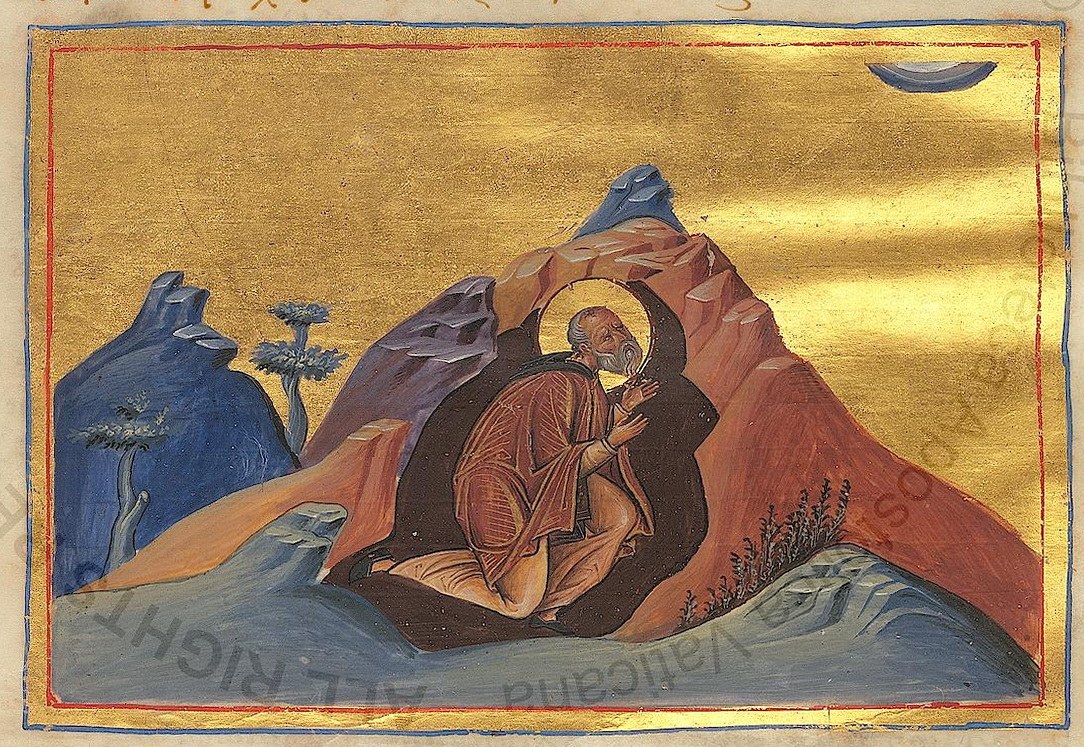
Paul is depicted as an aged monk beside or behind Anthony the Great, often in scenes of the healing of demoniacs; the composite Russian icon tradition also shows him among the venerable of the month. The stored image is the miniature of the Menologion of Basil II (Constantinople, 985): the aged monk kneels in prayer in the hollow of a desert mountain, grey-bearded and mantled — the manuscript's single-figure portrait of the hermit. The earlier search that found only composite modern menaion sheets on Commons had missed this miniature.
Disputed questions
- Calendar placement. The Greek books and the OCA keep him on October 4; the Slavic menologion also carries him on March 7. Both dates are recorded in the entry's record; the entries of the two traditions describe the same man.
- Chronology. His age at conversion (about sixty) and the year of death (c. 339) rest on Palladius's round numbers.
- Not to be confused with Paul of Thebes, the First Hermit (†c. 341, kept January 15) — a distinct and older Egyptian solitary also linked to Anthony the Great: Paul of Thebes was the hidden anchorite whom Anthony sought out and buried, whereas Paul the Simple was Anthony's disciple. The two are easily confused as "Paul, the desert monk of Anthony's circle."