
Taisia of Egypt
Our Venerable Mother Taisia (Thaïs) of Egypt, the Penitent
Venerable
Commemorated 8 October
Taisia of Egypt — Thaïs, in the Greek and Latin of her Life — was a celebrated courtesan of fourth-century Egypt, famed for a beauty that, the tradition says, ruined many, who was converted by the desert father Paphnutius. Coming to her in the guise of a client, the old ascetic found that she already knew of God and of the judgment, and his words so pierced her that she burned her wealth in the public square and followed him into the desert. Enclosed for three years in a cell, praying only "O Thou who didst fashion me, have mercy on me," she received assurance of forgiveness — Paul the Simple saw in a vision the place prepared for her in Paradise — and died within a fortnight of her release. Her feast is October 8.
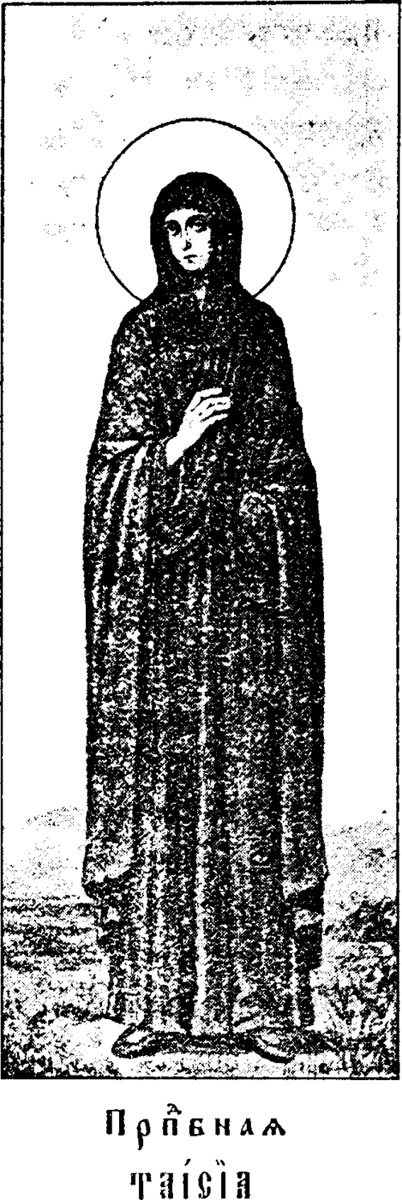
_-_икона_02082_Таисия.png)
The courtesan
The Life places Taisia in Egypt in the fourth century, in the world that adjoined the first monastic settlements. Raised by her mother — the tradition blames the mother explicitly — for the trade of her beauty, she became the most famous courtesan of her region: the Life speaks of lovers ruined, patrimonies consumed, and blood shed in rivalries at her door. Report of her reached the desert, and with it the grief of the fathers that one soul should be the ruin of so many.
Paphnutius comes to her
The ascetic Paphnutius — the desert father whom the tradition credits with the conversion (see below on his identity) — put off his habit, dressed as a man of the world, took a coin, and sought her out as a client. Admitted, he asked whether there were not some more hidden room; she answered that the chamber was private, but that if it was God he feared, no place is hidden from his eye. The old man seized on the word: she knew of God, and of the judgment to come, and yet lived so, and drew so many down with her? Taisia — the Life gives no long struggle; the word went home at once — cast herself at his feet, asked for a penance, and begged only three hours' delay. She gathered everything her trade had won her, carried it into the public square, and burned it, calling on those who had sinned with her to see: the price of sin went into the fire with the sin.
The enclosure
Paphnutius led her to a women's monastery and enclosed her in a narrow cell, sealing the door with lead and leaving only a small window through which the sisters passed her a little bread and water. When she asked him how she should pray, he answered that she was not worthy to name the name of God with lips that had been what hers had been, nor to lift her hands to heaven; she should sit facing the east and repeat only this: "O Thou who didst fashion me, have mercy on me." So she prayed for three years without leaving the cell. "From the moment I entered," she told the elder at the end, "all my sins have been before my eyes, and I have wept looking upon them"; and Paphnutius answered that it was for those tears, and not for the rigour of the enclosure, that God had granted her mercy.
The release came by revelation. Paphnutius, uncertain whether the penance had been accepted, consulted the great ascetics — the Life brings him to Anthony's community — and while the elders prayed through the night, Paul the Simple, Anthony's disciple of holy guilelessness (commemorated four days earlier, October 4), saw in a vision a couch of glory in the heavens, guarded by three virgins, and was told, when he supposed it prepared for his father Anthony, that it was prepared "for Thaïs the harlot." So assured, Paphnutius opened the cell. Taisia at first begged to remain in it with her sins; brought out, she lived fifteen days among the sisters, fell ill for three, and died in peace — "a harlot and a sinner," the tradition says with the Gospel, entering the Kingdom before the righteous (cf. Matthew 21:31).
Veneration and later fame
The synaxaria of the Byzantine rite keep "Taisia who was once a harlot" on October 8 with her own notice and verses, joined by the coincidence of the calendar to Pelagia the Penitent, the other great penitent courtesan of the tradition; the pairing has made October 8 the calendar's day of the repentant women par excellence. Her Life, translated early into Latin (and into Syriac and other languages), made her one of the most familiar of the Desert Fathers' stories in the medieval West — the tenth-century canoness Hrotsvitha of Gandersheim built a Latin drama, Pafnutius, upon it — and in modern times Anatole France's novel Thaïs (1890) and Massenet's opera (1894) carried her name, in a very free retelling, far beyond the Church.
Feast and commemoration
October 8 (church date; Old Calendar civil October 21), kept in the Greek synaxaria (notice and verses only, the Menaion service of the day being Pelagia the Penitent's) and in the Slavic and Russian calendars, which appoint her the common hymns of a venerable woman; the OCA keeps her as "Venerable Thais of Egypt." Her Western cultus, never formal, lived in the Vitae Patrum rather than the calendar; the Roman Martyrology came to note her on October 8 likewise.
Hymns
Troparion — Tone 8 (from the common of a venerable woman)
In thee, O mother, that which is according to the image was preserved with exactness; for taking up the cross, thou didst follow Christ, and by thy deeds thou didst teach us to disregard the flesh, for it passeth away, but to care for the soul, a thing immortal: wherefore thy spirit, O venerable Taisia, rejoiceth with the angels.
Original translation from the Slavonic
Kontakion — Tone 2 (from the common)
For the love of the Lord, O venerable one, thou didst hate the desire for rest, enlightening thy spirit with fasting; for mightily didst thou vanquish the beasts: but by thy prayers destroy the insolence of the adversaries.
Original translation from the Slavonic
Iconography
Taisia is painted as a penitent anchoress: a woman in a simple tunic or the monastic mantle, unveiled hair sometimes loose about her shoulders in the manner of Mary of Egypt, in prayer within or before her sealed cell — occasionally with Paphnutius at the window, or with the burning heap of her riches. She has no miniature in the Menologion of Basil II (whose October 8 images are given to the two Pelagias). The stored image is the engraving from the October volume of the illustrated Russian Lives of the Saints (1903–1911): the penitent kneeling in prayer before the window of her cell — a public domain image of documentary rather than iconographic weight, kept until a pre-modern icon or manuscript image is found (the saint is flagged for an upgraded image in the the list of icons still being sought index).
Disputed questions
- Which Paphnutius? The Life says only "abba Paphnutius," among the commonest names of Christian Egypt. The usual identification is with the great fourth-century ascetic of the Thebaid (Paphnutius "the Great"); he is not the crucified martyr Paphnutius of Egypt (September 25, †c. 303), a different man of an earlier generation — the martyr's own entry catalogues the calendar's several Paphnutii. Some versions of the story transfer the conversion to other elders (a Serapion in part of the Latin and Ethiopic tradition; later retellings vary further), a fluidity that belongs to the tale's long transmission.
- Historicity. The Life of Thaïs (BHG 1695–1697; Latin in the Vitae Patrum) is edifying desert literature of the classic penitent type, and modern hagiographical scholarship treats it, with the Pelagia legends alongside which the calendar sets it, as legend rather than document; no independent fourth-century witness attests her. The sensational claim that her body had been found — the mummies labelled "Thaïs" and "Serapion" excavated at Antinoë in 1901 and exhibited in Paris — is without foundation: the names were common, and nothing ties the burial to the saint. The Church's calendars keep her memory as the tradition delivers it, and the Life is given above on the same terms.
- Not to be confused with blessed Thais of Alexandria (commemorated May 10), the other penitent Taisia of the Egyptian tradition: a well-born young woman of Alexandria who, having beggared herself in charity toward the monks, fell into prostitution and was reclaimed by John the Dwarf, dying in the desert on the night of her return. The two stories — courtesan, desert elder, sudden repentance — invite conflation, and the pre-revolutionary Russian Lives already distinguish them explicitly ("the second Taisia, not the harlot").