
Pelagia of Tarsus
The Holy Virgin Martyr Pelagia of Tarsus in Cilicia
Martyr · Virgin · d. c. 290
Commemorated 4 May — Martyrdom in the brazen bull at Tarsus, 7 October — Secondary commemoration kept by the Slavic books and the OCA
Pelagia of Tarsus (†c. 290) was a maiden of a wealthy pagan house in Tarsus of Cilicia who came to faith in Christ from Christian companions, vowed her virginity, and refused the hand of the son and heir of the emperor Diocletian. Baptised in the mountains by the fugitive bishop Linus at a spring that sprang up for the purpose, she was denounced by her own mother, and was condemned to be roasted alive in a heated brazen bull. She entered the instrument giving thanks, and her body was consumed like melted myrrh; the bones that remained were guarded, the tradition says, by lions until the bishop could bury them, and a church rose over her relics once the persecutions ended. She is one of three early saints of the name Pelagia and must not be confused with the two of October 8.
.jpg)
Origins in Tarsus
Pelagia was born at Tarsus in Cilicia, the city of the Apostle Paul, to parents described as illustrious and rich, and — decisively for what followed — pagan. She was, the passion insists, of remarkable beauty and of a quick and serious mind, and it was among her companions and playmates, girls of the city who were already Christians, that she first heard of Christ. What she heard she believed; and believing, she resolved in her heart on two things at once: to be baptised, and to keep her virginity for the heavenly Bridegroom. Both resolutions she kept hidden from her household, for her mother was a zealous pagan and her father's house had every worldly reason to want her married.
The emperor's son
The tradition places her sufferings in the reign of Diocletian (284–305), and makes the immediate occasion of them not an edict but a courtship. The emperor's son — described in the Greek accounts as his adopted son and destined heir — saw the girl, was inflamed by her beauty, and asked for her in marriage; and the match was one that neither her family nor the city would have thought of refusing. Pelagia refused it. She answered that she was already betrothed, that her Bridegroom was Christ the immortal King, and that she had no other spouse to take.
The refusal, and the reason given for it, undid the young man. The accounts relate that when he understood both that she would not have him and that she had become a Christian, he fell into a despair from which nothing could raise him, and took his own life — some versions saying that he threw himself upon his sword. It is a detail the hagiographer does not soften: the death of the heir is what turned a private refusal into a capital matter, and it is why the emperor's anger against Pelagia is personal.
Baptism at the spring
Before her arrest Pelagia sought baptism. She had seen in a vision, the account says, the face of a bishop she did not know; and asking her mother's leave to go and visit the nurse who had reared her, she set out with a retinue, praying as she went that she might find the man she had seen. In the hills outside the city she met him: Linus (the Slavic books give the name as Klinos or Clinus), the bishop of the place, who had fled the persecution into the mountains with what remained of his flock.
There was no water for the mystery, and the accounts say that at the bishop's prayer a spring broke from the ground at their feet. Pelagia was catechised, confessed the faith, and was baptised; the tradition adds that the sign of grace was visible — a light, and angels present at the font, and the newly-illumined maiden clothed afterwards in a bright garment. She distributed her ornaments and her rich clothing to the poor of the mountain congregation and returned to the city as a Christian openly.
Betrayal and martyrdom in the brazen bull
Her mother, seeing what had been done and fearing for the household, denounced her own daughter to the emperor. Pelagia was brought before Diocletian. Here the accounts vary in a way worth recording: the more restrained version has the emperor simply demand that she sacrifice and, on her refusal, condemn her; a fuller version has him, struck like his son by her beauty, offer to take her himself, and turn to fury only when she called his idols dead things and his offer an insult to her Bridegroom.
The sentence was death by fire in a hollow bronze bull — the ancient instrument of Phalaris, heated red-hot from beneath so that the victim shut inside is roasted, and the cries carried out through the bull's throat as a bellowing. Pelagia, the account says, did not need to be forced: she signed herself, gave thanks aloud, prayed for the Church and for her own mother, and stepped into the bull of her own will. Her flesh, the synaxarion says with a phrase the hymns then took up, melted away like myrrh, and the whole place was filled with fragrance instead of the stench of burning. She was, by the common reckoning, about fifteen years old, and the year is generally given as about 290, some sources placing it a little later, within the great persecution proper.
Relics and the church over her tomb
What remained after the fire were her bones, and the executioners left them where they fell. Here the passion adds the detail that has fixed her in the memory of the Church almost as firmly as the bull: lions (or, in some versions, a single lion, or four beasts) came out of the wilderness and stood over the relics, driving off birds and wild animals but harming no one, and kept watch until the bishop Linus came down from the mountain by night and gathered the bones honourably away. When the persecutions ceased under Constantine (306–337), a church was built over the place where the relics lay, and the site was venerated at Tarsus.
Feast and commemoration
May 4 (church date; New Calendar civil May 4, Old Calendar civil May 17) is her principal and universal feast: it is kept by the Greek synaxaria, the Slavic Menaion, the Antiochian and OCA calendars alike, and she stands first among the day's commemorations in all of them. The Slavic books and the OCA additionally list her on October 7, where the entry serves as a cross-reference within the October cluster of Pelagias rather than as a second proper feast; the fuller service belongs to May 4. In her city of Tarsus her memory was joined to the site of her burial, and her name is kept with particular honour in Cilicia and Cyprus.
No proper apolytikion is transmitted for the day: the Menaion appoints the common of a virgin martyr, sung with her name.
Hymns
Troparion — Tone 4 (from the common of a virgin martyr)
Thy ewe-lamb Pelagia crieth out to Thee with a great voice, O Jesus: I love Thee, my Bridegroom, and seeking Thee I contend; I am crucified and buried together with Thee in Thy baptism, and I suffer for Thy sake that I may reign with Thee, and I die for Thee that I may live in Thee. Receive me as a spotless sacrifice, offered unto Thee in love. By her intercessions, O Merciful One, save our souls.
Original translation from the Greek
Kontakion — Tone 2
Thou didst spurn the bed of an earthly prince, O maiden, and having put on Christ in the water that sprang up for thee, thou didst enter the fiery bull rejoicing; and as sweet myrrh poured out thy body was consumed, filling the earth with fragrance, O Pelagia, boast of Tarsus and bride of the Immortal King.
Original translation from the Greek
Iconography
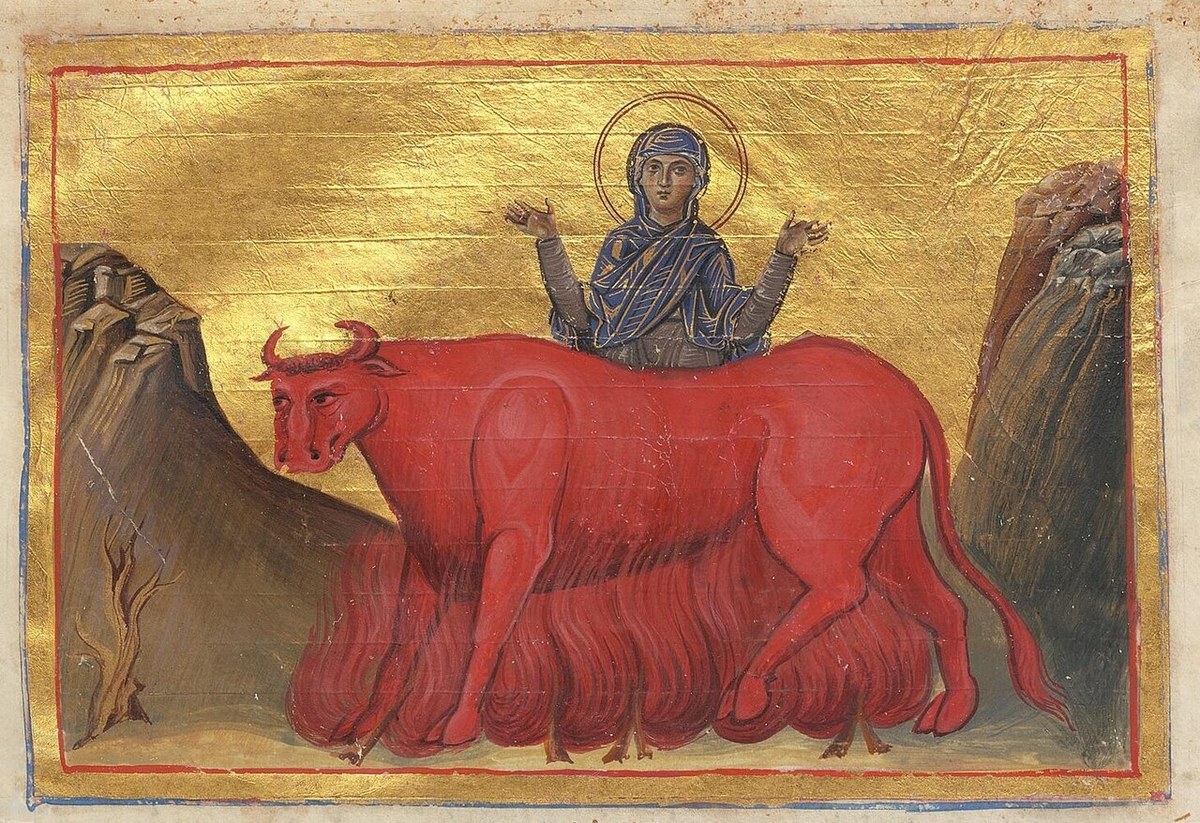
Pelagia of Tarsus is painted as a young maiden, beardless-faced and small in stature beside her instrument, in the maphorion and tunic of a woman-martyr, most often with the hands raised in the orans attitude of prayer; the martyr's cross belongs to her as to all of her rank. What identifies her infallibly, and separates her at a glance from the two Pelagias of October 8, is the brazen bull: she is shown standing inside it, the animal's body enclosing her to the waist, sometimes with flames licking beneath its belly, sometimes — as in the Byzantine menologia — with the bull painted a uniform glowing red to signify that it has been heated white-hot. Scenes of the fuller cycle show her baptism at the miraculous spring, and the lions couched over her bones.
The stored image is the Menologion of Basil II miniature (Constantinople, c. 985, Vat. gr. 1613), painted for her October commemoration and therefore properly within that manuscript's September-to-February compass: the haloed maiden in a blue maphorion stands with both palms lifted in prayer within a great glowing-red bull, between two rocky hills, against a gold ground. It is the earliest surviving image of the saint of any weight, and the visual source of the later type.
Disputed questions
- Three Pelagias, not one. The name gathered three distinct saints in the early
calendar, and the confusion among them is old and persistent:
- Pelagia of Tarsus, this saint — a virgin-martyr of Cilicia, †c. 290, burnt in the brazen bull, kept May 4 (with a secondary May-cycle commemoration on October 7 in the Slavic books);
- Pelagia the Virgin of Antioch — a virgin-martyr of Syria, †c. 303, who threw herself from the roof of her house rather than be taken by the soldiers, kept October 8;
- Pelagia the Penitent — the repentant courtesan of Antioch, †c. 457, who lived out her life as the monk "Pelagius" on the Mount of Olives, also kept October 8. The three are certainly distinct persons, of three different centuries and two different classes of sanctity. The October 7 listing of this Pelagia in Slavic calendars sits immediately beside the October 8 pair, which is precisely where the confusion enters; the distinguishing mark of the Tarsian is always the brazen bull, which belongs to neither of the others.
- Date of the martyrdom. The Greek synaxaria and the Slavic books commonly give c. 290, under Diocletian but before the edicts of 303; OrthodoxWiki and some Russian lives give 287; others place her within the great persecution itself. The narrative frame — a son and heir of Diocletian old enough to seek a wife — is difficult to reconcile with what is known of the imperial family, and the "emperor's son" is best read as the passion's own dramatic figure rather than a datable prince. The bare facts the tradition preserves without variation are the place (Tarsus), the refusal of marriage, the bull, and the burial by the bishop.
- The bishop's name. Greek accounts give Λῖνος / Linus; the Slavic tradition Клинон / Clinus (Klinos). The variation is almost certainly scribal, the initial kappa having attached itself to the name in transmission.
- The number of the lions. The guardians of the relics are one lion in some recensions, two or four in others, and simply "wild beasts" in the barest notices. The motif is a topos of martyr-passions, and the hagiographers themselves treat it as a sign rather than a count.