
Pelagia the Penitent
Our Venerable Mother Pelagia the Penitent, formerly a Courtesan of Antioch
Venerable · d. c. 457
Commemorated 8 October — Repose on the Mount of Olives
Pelagia the Penitent (†c. 457) is the most celebrated of the penitent courtesans of the Orthodox calendar: the foremost actress and courtesan of Antioch, called Margarita — "Pearl" — for the jewels she wore, who was brought to compunction by the preaching and the tears of the holy bishop Nonnus, was baptised by him, gave all her wealth to the poor, and vanished from the city in a man's clothing. As the monk "Pelagius" she lived in a walled cell on the Mount of Olives in Jerusalem in extreme asceticism, her sex discovered only when her body was prepared for burial. Her feast, on October 8, she shares with a wholly different Antiochene saint of the same name, the virgin-martyr Pelagia.
.jpg)
The actress of Antioch
The Life — told in the first person by "James (Jacob) the Deacon," who presents himself as an eyewitness — opens at Antioch, where the archbishop had summoned a synod of eight bishops. Among them was Nonnus, a monk of great sanctity raised to the episcopate (the received tradition identifies him with Nonnus, bishop of Edessa, in the middle of the fifth century). As the bishops sat at the doors of the church of the martyr Julian, there passed before them the first actress of Antioch, the leader of its dancing troupe, riding in splendour: bareheaded, hung with gold, pearls and precious stones, perfumed, laughing, with a train of servants. The city called her Margarita, "the Pearl," for her adornment; her baptismal name, the sequel reveals, was Pelagia. The bishops groaned and turned their faces away; but Nonnus gazed after her long and intently, and then asked his fellow bishops: "Did not her great beauty delight you?" They were silent. "It delighted me exceedingly," he said, "for God shall set her before us at the Judgment: she has spent hours adorning her perishable body for the eyes of men, while we take no such pains to adorn our wretched souls for the eyes of God." And returning to his lodging he prostrated himself and wept, asking that the harlot's diligence be not found greater than his own.
Conversion and baptism
The next day — a Sunday — Nonnus preached in the great church on the dread Last Judgment and the good things prepared for the righteous. Pelagia, who had never before troubled herself about her soul, was moved by some providence to enter; the sermon struck her with such fear of God that she wept without ceasing, and sent the bishop a letter begging to be received: if he was truly Christ's disciple, let him not spurn a sinner. Nonnus answered that God knew her heart, but that she must appear before the assembled bishops, for he would not see her alone. She came, cast herself at his feet before them all, washed them with her tears, and would not rise until she was promised baptism. The hesitation of the clergy — a public sinner was normally kept long in the catechumenate — was overcome by her vehemence; the archbishop was consulted, and the deaconess Romana was sent to stand as her sponsor. Pelagia was baptised, Romana receiving her from the font as her mother in God.
By night the devil appeared to her, reproaching her — as he had appeared, the Life says, wailing at what he had lost in her — and urging her back to her former life; she signed herself with the Cross, breathed on him, and he vanished. On the third day after her baptism she gathered everything she possessed — the immense wealth of her profession — and brought it to Nonnus, who ordered it distributed to the poor of the city, "so that riches ill gotten might become a treasury of righteousness." Her slaves she freed with her own hand, giving them gold.
The monk Pelagius
On the eighth day, when the newly baptised laid aside their white garments, Pelagia rose in the night, put off the baptismal robe, and dressed herself in a hair shirt and in the tunic and mantle of bishop Nonnus — a detail the Life insists on: she fled in the clothing of the man whose tears had won her — and disappeared from Antioch. No one knew where she had gone; Nonnus, who knew, kept silence. She travelled to Jerusalem and built (or occupied) a walled cell on the Mount of Olives, and there lived as a recluse under the name Pelagius, passing as a beardless monk — a eunuch, her neighbours assumed. Her window admitted only the exchange of a few words; her fame as "Pelagius, the monk of the Mount of Olives" spread through the monasteries of the Holy City for the extremity of the fasting and vigil practised in that cell.
Recognition at death
Some three or four years later James the Deacon, the narrator, came from Antioch on pilgrimage, sent by Nonnus with the charge to seek out "a certain monk Pelagius" and profit by the encounter. He found the recluse at the window of the cell — wasted beyond recognition, the eyes sunk deep; she knew him, he says, though he did not know her, and asked his prayers. Returning some days later to seek a second word, he found the window unanswered; the recluse was dead. The monks of the surrounding communities and the clergy of Jerusalem gathered to bury the famous ascetic with honour, and as the body was prepared for burial it was discovered that the monk Pelagius was a woman. "Glory to Thee, O Lord," those present cried, "for Thou hast hidden many treasures upon the earth, and not men only, but women also." The holy myrrh was brought, and the crowds of monks and nuns — and, the Life says, of the people of Jericho and the Jordan valley — bore her to her grave with lamps and hymns. Her tomb on the Mount of Olives was venerated for centuries; medieval pilgrims of several communions were shown the cell and grave of "Saint Pelagia" on the mount.
Veneration and later cultus
The commemoration of "our venerable mother Pelagia" on October 8 stands in the Synaxarion of Constantinople and the Menologion of Basil II, and she has a full proper service in the Menaion, including a canon in Tone 4 whose acrostic reads "With longing I honour the wise Pelagia." The Vespers doxastikon of her service, "Where sin abounded, grace did much more abound…," attributed to John the Monk, is among the best-loved pieces of the Menaion's penitential hymnography, and her name became, with Mary of Egypt's, a byword for the repentance that outstrips the righteous. The Roman Martyrology likewise keeps "Saint Pelagia, called the Penitent" on October 8.
Feast and commemoration
October 8 (church date; Old Calendar civil October 21), kept universally in the Byzantine rite; she is the principal saint of the day, and the Menaion service is hers. The same day commemorates the virgin-martyr Pelagia of Antioch and Taisia (Thaïs) of Egypt — the synaxarion thus joining, by coincidence of the calendar, two penitent courtesans and a virgin-martyr. The Slavic and Russian calendars add their own saints of the day (Tryphon of Vyatka, Dositheus of Pskov). In the West she stands in the Roman Martyrology on the same date.
Hymns
Troparion — Tone 8 (from the common of a venerable woman)
In thee, O mother, that which is according to the image was preserved with exactness; for taking up the cross, thou didst follow Christ, and by thy deeds thou didst teach us to disregard the flesh, for it passeth away, but to care for the soul, a thing immortal: wherefore thy spirit, O venerable Pelagia, rejoiceth with the angels.
Original translation from the Greek
Kontakion — Tone 2
Wearing out thy body with fastings and with unsleeping prayers, thou didst implore the Creator concerning thy deeds, that thou mightest receive perfect forgiveness of them; which indeed thou didst receive, O mother, having shown forth the way of repentance.
Original translation from the Greek
Sticheron
Where sin abounded, grace did much more abound, as the Apostle teacheth; for in prayers and tears, O Pelagia, thou didst dry up the sea of thy many offences, and by repentance didst bring unto the Lord an end well-pleasing to him; and now thou dost intercede with him for our souls.
Iconography
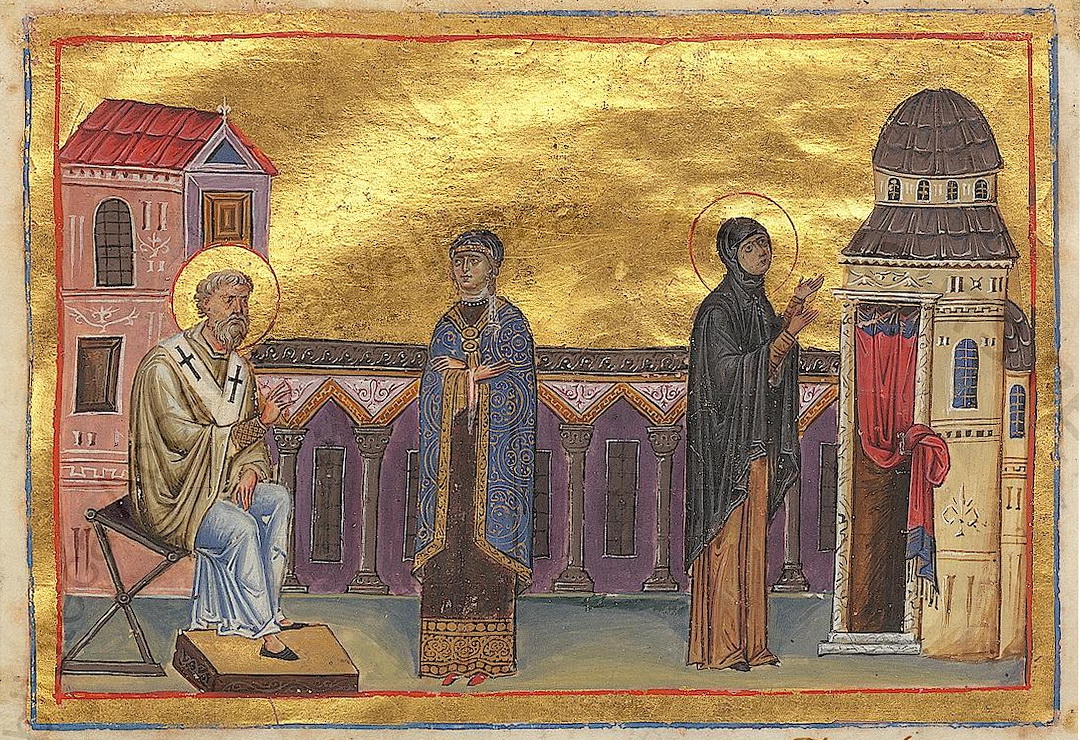
Pelagia is painted as a nun of the Egyptian-Palestinian type: in the dark monastic mantle and veil, the face gaunt with fasting, often with a scroll or with hands crossed in penitence; narrative icons show her conversion before Nonnus or her burial on the Mount of Olives. The stored image is the miniature of the Menologion of Basil II (Constantinople, c. 985, Vatican Library, Vat. gr. 1613, p. 98), a narrative composition of her whole story in one field: the enthroned bishop Nonnus preaches at the left; before him stands Pelagia the courtesan in the gold-figured blue robes and diadem of her worldly splendour; and at the right the same Pelagia, now in the black habit of a nun, turns away into the doorway of a tower-like cell — the world renounced between one figure and the next.
Disputed questions
- The sources and their history. The Life of Pelagia "by James the Deacon" (BHG 1478 and its versions) is a hagiographic masterpiece transmitted in Greek, Latin, Syriac, Armenian, Arabic and other languages, but it is not a documentary biography. Its acknowledged kernel is a passage of John Chrysostom (Homily 67 on Matthew), preached at Antioch in the late fourth century, which tells of a famous actress of that city — Chrysostom names no name — who in his own day abandoned the stage, was converted, and finished her life in extreme asceticism. Hippolyte Delehaye's classic analysis of the "Pelagia family" of legends (The Legends of the Saints, ch. VI) argued that from this anonymous actress and from the genuine cult of the virgin-martyr Pelagia of Antioch the hagiographers spun the romance of the penitent Pelagia, and that the same narrative material radiated into the whole cycle of penitent-and-disguised-women legends (Marina/Marinos, Euphrosyne, Theodora of Alexandria, Apollinaria, and the rest). Hermann Usener had earlier pressed a more radical thesis — that "Pelagia" is a baptised survival of Aphrodite Pelagia, the sea-born goddess — which Delehaye examined and rejected as outrunning the evidence. The Church's calendars have kept her without hesitation since at least the tenth century; the Life is given above as the tradition tells it, and its source-critical status is recorded here.
- Nonnus. The Life calls the bishop simply Nonnus; the identification with Nonnus of Edessa (fl. 449–470), found in the received tradition and in the OCA's notice, fixes the story in the mid-fifth century and yields the conventional death-date c. 457. The chronological seam between this setting and the fourth-century kernel in Chrysostom is part of the legend's history, not resolvable from the sources.
- Not to be confused with the virgin-martyr Pelagia of Antioch (†c. 303), commemorated the same day: the fifteen-year-old who threw herself from the housetop to escape violation by Diocletian's soldiers, praised by Ambrose and Chrysostom. The identity of city, name and feast has confused readers since the Middle Ages, and Delehaye made the pair the type-case of legend growing beside history; the two are distinct entries in the synaxaria, each with her own verses. Distinguish also Pelagia of Tarsus (May 4), a third early virgin-martyr of the name.