
Peter of Athos
Our Venerable and God-bearing Father Peter the Athonite, First Hermit of the Holy Mountain
Venerable · d. 734 (as the synaxaria transmit; the ninth century on the critical reckoning)
Commemorated 12 June — Repose in his cave on the Holy Mountain
Peter the Athonite is honoured as the first hermit of the Holy Mountain and, with the Theotokos herself, as the founder of its vocation. A Byzantine officer taken prisoner by the Arabs and shut up in the fortress of Samara on the Euphrates, he was delivered — the Life says — by Nicholas of Myra and Symeon the Righteous, the God-receiver, who melted his chains; tonsured at Rome over the tomb of the Apostle Peter at the bidding of a vision given to the Pope himself, he was then directed by the Mother of God to Athos, which she claimed as her own inheritance and portion. There he lived some fifty-three years in the caves without seeing a man, clothed at last only in his own hair and a girdle of leaves, fed after forty-day fasts by an angel with heavenly bread, and assailed by the demons in every shape. A hunter chasing a stag found him, and a year later found him dead. From him the Holy Mountain dates its life as the Garden of the Theotokos, and the hesychast fathers — Gregory Palamas above all — took him as the pattern of the solitary life.

The soldier and the vow unkept
Peter was a Greek by birth and a soldier of the empire, holding — the Life says — the rank of a scholarios in the imperial guard. He had once resolved to become a monk and had not done it; the whole of what follows he understood, and the Life presents, as God's way of holding him to his word.
Captivity at Samara
In a campaign against the Arabs he was taken prisoner, carried east, and imprisoned in the fortress of Samara on the Euphrates. In the iron and the dark he searched himself and found the broken vow, and confessed that his captivity was just; and he began to fast and to pray with tears to St Nicholas, whom he had honoured from his childhood.
Deliverance by Nicholas and Symeon the God-receiver
Nicholas appeared to him in sleep and bade him call also upon Symeon the God-receiver, who had held the Lord in his arms in the Temple and to whom, therefore, nothing is refused. Peter did so; and the two saints came together, and Symeon touched his chains with his staff and they melted like wax. Peter walked out through the gates and past the guards unseen, and Nicholas went with him until he was in Greek country again.
Tonsure at Rome
Faithful now to his vow, Peter went to Rome, to be tonsured at the tomb of the Apostle whose name he bore. The Life tells the story with a fine stroke: while he was still unknown in the crowd, Nicholas appeared to the Pope in a dream and told him of the prisoner of Samara; and next day, at the Liturgy, the Pope called out over the congregation, "Peter, you who come from the Greek lands, whom Saint Nicholas has loosed from the prison of Samara — come here to me." So he was clothed in the monastic habit by the Pope's own hand at the Apostle's tomb, and dismissed with a blessing.
The Mother of God and the Holy Mountain
Sailing eastward, he healed by his prayer the sick of a household that had received him, and his gift became known. Then, as he slept, the Theotokos appeared to him, with St Nicholas interceding, and gave him his place: she named Athos, saying that she had chosen that mountain out of all the earth and had received it from her Son and God as her portion and inheritance, that those who would flee the cares of the world might dwell there; that she would be their helper and their unconquerable ally, invisibly guiding and guarding them, and their advocate before God. The ship, when it came off the promontory, stopped of itself and could not be moved until Peter went ashore. The Life dates the landing to the reign in which it places him; the Slavic notice gives the year as 681.
This is the charter-text of the Holy Mountain. Everything the Athonite tradition says of itself — that Athos is the Garden of the Theotokos, that the Mother of God is its true Abbess, that no other woman enters it — is drawn from, or read back into, the promise given to Peter.
Fifty-three years in the caves
Peter settled in a cave near the ruined chapel of a place afterwards called by the name of St Clement, on the eastern flank of the mountain, in ground later occupied by the Monastery of the Iberians (Iviron). There he lived fifty-three years entirely alone. His clothes rotted away; his hair and beard grew until they covered his body, and he bound leaves about his loins — the same figure as Onuphrius, with whom the Church keeps him on one day and paints him in one image. He ate at first what the wilderness gave; afterwards, at the word of the Theotokos in a vision, he fasted forty days and an angel brought him bread from heaven, which sustained him forty days more, and so the pattern of his sustenance was set.
The temptations
The Life is unusually full on the demonic assaults, and this is one reason the hesychasts prized it. The demons came against him as armed soldiers storming the cave, as wild beasts and serpents; then, changing their tactic, as a kinsman or a beautiful youth urging him to come home and be useful to his people — and Peter answered that he would not leave without the permission of the Mother of God who had set him there. After seven years one came as a radiant angel with a commission to go out and preach; Peter, requiring again the Theotokos' word, refused, and the apparition vanished, and from that time he was left in peace. The discernment on which the story turns — that a vision is to be tested by obedience and not by its brightness — is exactly the lesson later Athonite writers drew from him.
The hunter, and the repose
A hunter from Bolos, in pursuit of a stag, came on the naked hair-covered figure among the rocks and fled in terror, until Peter called him back and told him who he was. The hunter begged to stay; Peter sent him away for one year, to prove himself in silence and self-examination, and to return then with any who wished to see him. A year later the hunter came back with his demon-possessed brother and companions, and found the saint already reposed; the brother was healed at the mere touch of the body. They took up the relics with reverence. The date transmitted in the synaxaria is 734.
Relics
The relics were kept first at the monastery of St Clement on Athos; hidden away during the iconoclast troubles; and afterwards — the account gives 969 — carried off to the Thracian village of Photokamo (Photokomi), whose people are said to have obtained them by stealth. The Athonite tradition of their removal is one of the small pieces of evidence by which the chronology of the Life is judged.
The first hermit of Athos, and his literary legacy
Two texts carry his memory. The older is the Life by Nicholas the monk of Athos (BHG 1505), written in the later tenth or early eleventh century — that is, at the moment when the Mountain was being organised into the great houses, and when a founding hermit was precisely what it needed. The second is the encomium and Life composed by Gregory Palamas, written on Athos in the earlier fourteenth century and among the earliest of his surviving works: Palamas takes Peter as the archetype of the hesychast — the man who by solitude, unceasing prayer and obedience to the Mother of God was made a partaker of the divine light — and the choice of subject shows how the hesychast controversy's principal theologian understood his own tradition's origins. A further hagiography was made by Gennadios the Athonite at Hilandar. Peter is reckoned the patron of the Holy Mountain, and his cave and the site of St Clement are shown to pilgrims in the ground of Iviron.
Feast and commemoration
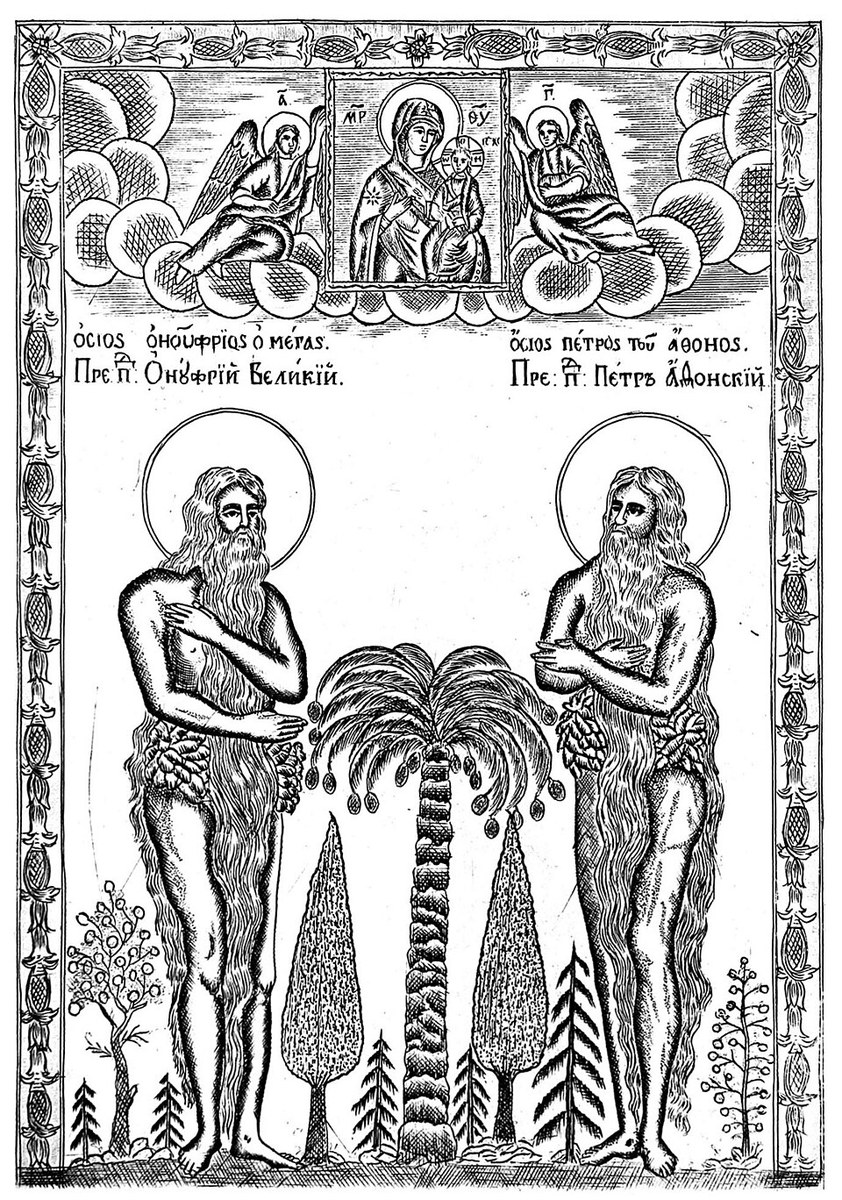
June 12 (church date; Old Calendar civil June 25), together with Onuphrius the Great. The pairing is ancient and deliberate: one hermit of the Egyptian desert and one of the Holy Mountain, both stripped to the hair of their own bodies, both communicated by angels — and in the printed Athonite devotional engravings of the eighteenth and nineteenth centuries the two are almost always shown together under the Theotokos. The Menaion service of the day is principally Onuphrius'; Peter is hymned in the canon and stichera of the day and, in Athonite usage, with a fuller observance. He is honoured on the Holy Mountain as its first inhabitant and, in the Georgian and Greek traditions of Iviron, as the saint of the ground on which that monastery came to stand. June 12 falls after Pentecost, so that in some years it lies inside the Apostles' Fast and in others after it; local practice governs.
Hymns
Apolytikion — Tone 8 (common of a venerable father)
In thee, O father, was that which is according to the image kept surely; for taking up the cross thou didst follow after Christ, and by thy deeds thou didst teach us to despise the flesh, for it passeth away, but to have care for the soul, a thing immortal. Therefore doth thy spirit rejoice with the angels, O venerable Peter.
Iconography
Peter is painted exactly as Onuphrius is, and the two are told apart by their inscriptions and, when the painter is careful, by their beards: Peter's hair and beard are long but less patriarchal, and he is often shown a little the younger of the two. He is naked, covered by his own hair, with a girdle of leaves; his hands are crossed on his breast or raised in prayer; the setting is the rock and scrub of Athos rather than the sand of Egypt, and a stag — the hunter's quarry — or the cave may be indicated. In Athonite compositions the Theotokos appears above him, sometimes handing him the mountain, sometimes flanked by angels; in narrative cycles the melting of the chains at Samara, the Pope's summons, and the ship halting off the promontory are shown.
The stored image is an Athonite engraving of 1860, from the Mount Athos print collection of the National Library of Serbia, inscribed in both Greek and Slavonic: at the left ὅσιος Ὀνούφριος ὁ μέγας / Прп. Онуфрій Великій, at the right ὅσιος Πέτρος τοῦ Ἄθωνος / Прп. Петръ Аѳонскій. The two hermits stand hair-clothed and leaf-girdled on either side of a date-palm, with the Theotokos and Child in a framed icon between two angels above — the classic pairing of the day in a single sheet, and a direct witness to how the two saints were presented to nineteenth-century pilgrims by the Holy Mountain itself.
Disputed questions
- When did he live? The synaxaria transmit a coherent set of dates — capture in 667, landing on Athos in 681, repose in 734 — which put him in the seventh and eighth centuries. Historians of Athos generally find these too early: the Life is a tenth- or eleventh-century composition, the earliest documented eremitical settlement on Athos belongs to the eighth to ninth centuries, and several details (the removal of the relics in 969, the shape of the Roman episode) sit better with a ninth-century Peter. Wikidata and much modern reference literature accordingly place him in the ninth century. This entry keeps the transmitted 734 in died and the eighth century in century, because that is what the liturgical books say, and records the objection here; the disagreement is real and unresolved.
- How much is history? The captivity, the vow, the Roman tonsure and the long solitude are the sort of thing that happened; the vision that fixes Athos as the Theotokos' inheritance is a theological charter, and it is impossible to say how much of it stood in whatever tradition Nicholas the monk received. That the Athonites believed it by the tenth century is itself a hard historical fact.
- Not to be confused with the many other monastic Peters — in particular Peter of Atroa, Peter of Damascus, Peter the Hermit of Galatia, Peter of Monembasia and Peter of Korisha, none of whom is the Athonite.