
Onuphrius the Great
Our Venerable and God-bearing Father Onuphrius the Great, Anchorite of the Egyptian Desert
Venerable · d. c. 400 (traditional)
Commemorated 12 June — Repose in the inner Egyptian desert
Onuphrius the Great is the most famous of the naked anchorites of the deep Egyptian desert: a monk of the coenobium of Eratus near Hermopolis in the Thebaid who fled by night into the wilderness and lived there sixty years without seeing a human face, until his hair and beard had grown down over him for clothing and a girdle of leaves was all his garment. A date-palm whose twelve boughs bore in turn month by month, and a spring beside his cave, were his food and drink; an angel brought him the Holy Mysteries each Saturday and Sunday. At the very end of that hidden life God sent the monk Paphnutius to him, that the Church might not lose him: the two spoke for a day and a night, Onuphrius reposed the next morning, and Paphnutius buried him, saw the cave fall in and the palm wither, and carried the story back to Egypt. His feast is June 12, and few saints are so instantly recognisable in an icon.

The name, and the one source
Everything the Church knows of Onuphrius comes from a single document: the narrative of the monk Paphnutius, who tells in the first person how he went into the inner desert to see whether there were servants of God hidden there, and what he found. The account circulated very early in Greek, Coptic, Syriac, Arabic, Ethiopic and Latin, and it is the parent text both of the June 12 synaxarion notice and of the separate entry for the four young hermits whom Paphnutius met on his way home. It is a hagiographical narrative rather than a chronicle, and it names no consul and no emperor; the fourth-century setting rests on the kind of monasticism it describes rather than on any date given in the text.
The saint's name is Egyptian, not Greek. Behind Ὀνούφριος lies the Coptic Apa Nofer (ⲁⲡⲁ ⲛⲟⲩⲫⲉⲣ), from the old Egyptian epithet wnn-nfr, "he who abides in good" — the same word that gives Wennefer, an appellation of Osiris. In Arabic Christian usage he is Abu Nofer; in Latin Onuphrius or Onofrio; in Slavonic Onufry. The name's un-Hellenised shape is itself a small argument for an authentically Egyptian figure at the root of the story.
The monastery of Eratus and the flight into the desert
Onuphrius was reared, the account says, in the monastery of Eratus near the city of Hermopolis in the Upper Thebaid, a great community of about a hundred brethren living the common life. There he heard the elders speak of Elias and of John the Forerunner, and of the anchorites who had gone out from every roof and rule to live alone with God in the waste, fed by His providence; and the desire of that life took hold of him. He said nothing to the brethren. Taking a little bread, he went out by night from the monastery gate.
He had not gone far when fear came on him in the dark, and a column of light stood before him and went with him; and when he asked what it was, he was answered that it was the angel appointed over him from his birth, sent to lead him to the place God had chosen. After several days' journey he came upon a cave and an aged hermit in it, who received him, questioned him, and kept him with him — teaching him, in the manner of the desert, the warfare of the thoughts, the measure of food and sleep, and the unceasing prayer. When the elder judged him ready, he led him further into the wilderness to the cell that was to be his, stayed with him some days, and then returned to his own place, coming back once a year to visit him until he died.
Sixty years in the inner desert
There Onuphrius remained. The narrative is careful about what sustained him, because that is the point of the story: beside the cave grew a date-palm with twelve branches, and each branch in its month ripened its fruit, so that he had dates the whole year round; and a spring of sweet water rose there. His clothing wore away and was not replaced: the hair of his head and his beard grew until they covered him, and for modesty he bound about his loins a girdle of leaves. In the beginning, he told Paphnutius, the struggle had been bitter — hunger, thirst, the burning of the day and the cold of the night, and the assaults of the demons and of his own thoughts; but afterwards the Lord sent His angel, who brought him bread, and on Saturday and the Lord's Day communicated him with the Holy Mysteries. So he passed sixty years in the inner desert, seeing no human being.
The coming of Paphnutius
Paphnutius, walking for many days into the waste, saw at last what seemed a man made all of hair, standing among the rocks; and he fled from it as from a beast, until a voice called him back — "Come to me, man of God; I too am a man, and I dwell here for the love of God." Onuphrius told him his name and his story, and led him to his cave; and at evening bread and water were found set there for the two of them, though there had never been more than one portion before. They spoke through the night of the desert and of the mercy of God, and Onuphrius said that God had brought him there for this: that his body might be buried by human hands and his life made known.
Repose and burial
In the morning Onuphrius said, "Today I finish my course in this world and depart to my Christ." He asked Paphnutius to remember him, blessed him, prostrated himself, and reposed with the words "Into Thy hands, my God, I commend my spirit." Paphnutius wept, tore his own outer garment — the melote he wore — and wrapped the body in half of it, keeping half for himself as a blessing, and laid the saint in a cleft of the rock, closing it with stones. He would have stayed on in the cell, but as he prayed the cave fell in, the palm was uprooted and withered, and the spring dried up: he understood that the place was not appointed for him, and set out on the road back.
The four hermits, and the writing down of the Life
On his way out of the desert Paphnutius came to an oasis of fruit trees where four young men lived — John, Heraclemon, Andrew and Theophilus, schoolfellows from Oxyrhynchus who had gone out together into the wilderness in their boyhood. With them, too, he was granted to receive the Mysteries from the hand of an angel; and when he begged to remain, he was told that his work was to go back and make the desert fathers known. Reaching the edge of the wilderness he came to a small monastic settlement, told the brethren everything, and they wrote it down and laid the book up in the church, so that whoever wished might read it. The four hermits are commemorated with Onuphrius on this day, and again on December 2.
Veneration East and West
The cultus is old and extraordinarily wide. In the Byzantine books Onuphrius stands on June 12 with a full service; in the Coptic Church his departure is kept on 16 Paoni and the consecration of his church on 16 Hathor, and he is among the best-loved of the desert fathers of Egypt; the Ethiopian and Syriac traditions know him; and in the Latin West he became a considerable figure in his own right. Rome has the church and former monastery of Sant'Onofrio on the Janiculum; the whole order of the Fratres Sancti Onuphrii took his name; he is a patron of weavers and of the dyers' craft, and Munich's civic seal-lore and much of the folk art of Central Europe made of him a "wild man of the woods," so that his image drifted into the medieval iconography of the homo silvestris. In the Slavonic lands he is one of the standard "desert" saints painted beside Macarius the Great, Mark of Thrace and Mary of Egypt.
Feast and commemoration
June 12 (church date; Old Calendar civil June 25). The Greek Menaion appoints a full service, with the apolytikion of the desert-dwellers and a proper kontakion in the Plagal Fourth Tone, and joins to him on the same day Peter of Athos — the two great hair-clothed hermits, of the Egyptian desert and of the Holy Mountain, kept together in text and in image — and the four Egyptian hermits of his Life. The Slavic calendars keep the day identically. In Coptic usage his departure falls on 16 Paoni, which is the same June commemoration in the Alexandrian reckoning. Because June 12 always lies after Pentecost, the day is kept in the Apostles' Fast in years when that fast is long, and outside it in years when it is short; local practice governs.
Hymns
Apolytikion — Tone 1
A citizen of the wilderness and an angel in the body and a wonderworker wast thou shown to be, O God-bearing father Onuphrius: by fasting and vigil and prayer thou didst receive heavenly gifts, and thou healest the sick and the souls of them that run to thee with faith. Glory to Him that gave thee strength; glory to Him that crowned thee; glory to Him that worketh through thee healings for all.
Kontakion — Tone 8 (Plagal Fourth)
Having received within thy heart the light that is noetic and heavenly, thou wast shown forth, O Onuphrius, a vessel of the undefiled Trinity…
Original translation from the Greek
Iconography
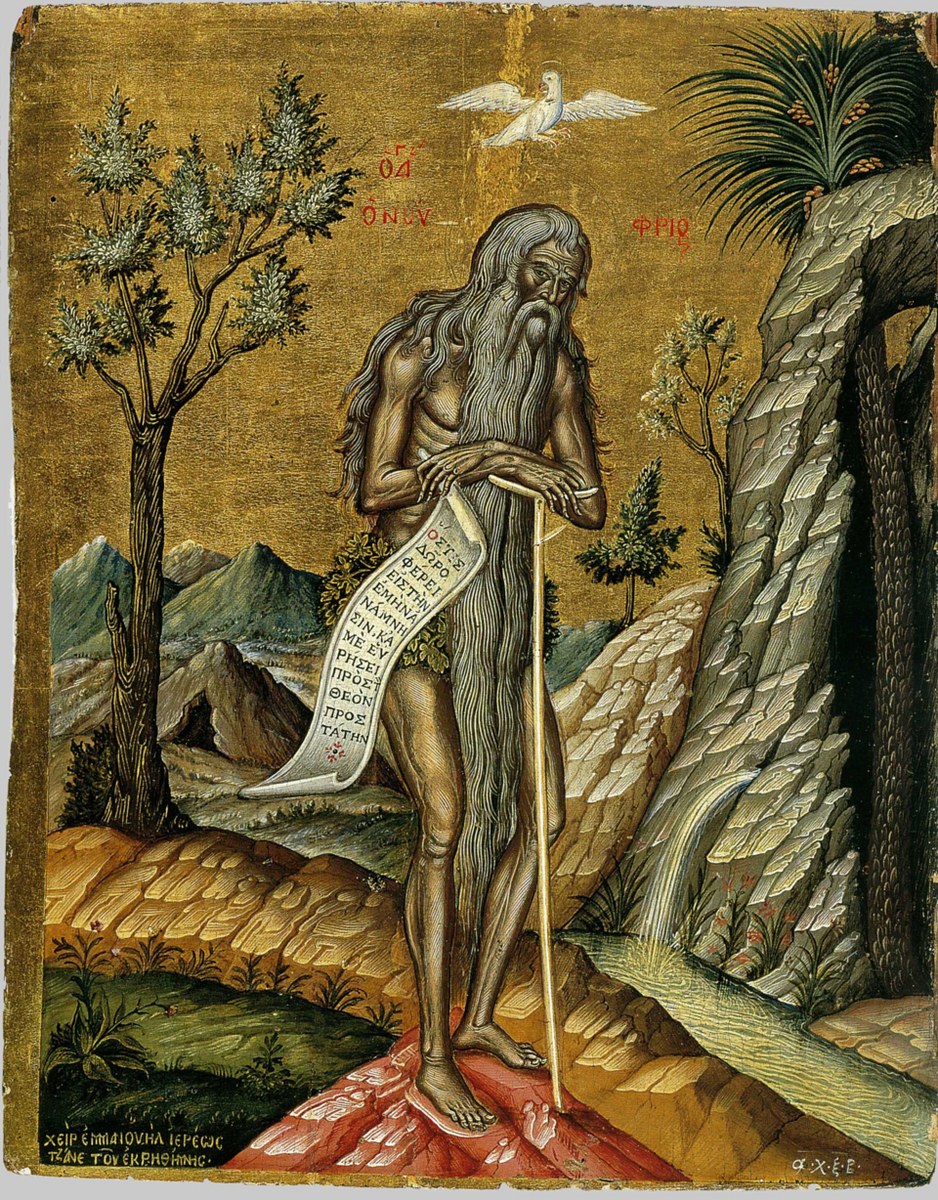
Onuphrius is one of the two or three most immediately identifiable saints in the whole Orthodox repertoire. He is painted as a very old man, naked, the flesh dried to the bone, with enormously long white hair and a beard reaching to his feet — the hair itself functioning as his garment — and a girdle of green leaves about his loins. He leans on a staff or a T-crutch; behind or beside him rise the date-palm and the spring; a scroll in his hand bears an ascetic sentence; sometimes a dove or an angel with the chalice appears above, for the communion brought him from heaven, and occasionally two angels hold a crown over his head. He is regularly paired with other naked anchorites — Macarius the Great, Mark of Thrace, Peter of Athos — and appears in the June leaf of menologion icons. In the Latin West the same figure, detached from its desert setting, fed the "wild man" imagery of late-medieval prints.
The stored image is the panel signed ΧΕΙΡ ΕΜΜΑΝΟΥΗΛ ΙΕΡΕΩΣ ΤΖΑΝΕ ΤΟΥ ΚΡΗΘΗΝΟΣ — "by the hand of Emmanuel Tzanes, priest, the Cretan" — with a date in Greek numerals at lower right, now in the Petit Palais collections at Paris and catalogued to 1662. It is inscribed Ὁ ἅγιος ΟΝΟΥΦΡΙΟΣ and shows every element of the type: the hair-clothed hermit with the leaf girdle leaning on his staff, the inscribed scroll, the palm and the spring in the rock at the right, and the dove above.
A pre-1900 Athonite engraving showing Onuphrius side by side with Peter of Athos, both inscribed in Greek and Slavonic, is stored with the entry for Peter of Athos.
Disputed questions
- Date and historicity. The narrative gives no chronology. The common reckoning puts the repose about 400, with the sixty desert years falling in the second half of the fourth century, which agrees with the kind of monasticism described (an established coenobium at Hermopolis, and anchorites deep beyond it). Some Latin calendars and a few modern handbooks push him into the fifth century. The honest position is that his century is inferred from the text's monastic setting, not transmitted.
- Which Paphnutius? The narrator is simply "Paphnutius the monk"; the name was among the commonest in Christian Egypt, and the account cannot be securely tied to any of the Paphnutii who have entries of their own — Paphnutius of Egypt and his companions (September 25), Paphnutius the Hieromartyr (April 19), or the confessor-bishop Paphnutius of the Thebaid known from the Council of Nicaea. Older scholarship sometimes identified the narrator with the latter; the identification is not demonstrable, and no separate entry is made for him here.
- The "hind" and other accretions. Latin and late Western retellings added details absent from the Greek — a hind that instructed him in the rites, royal (sometimes Persian) parentage, a childhood miracle over a false accusation of illegitimacy. These belong to the Western afterlife of the legend and not to the desert narrative.
- Not to be confused with the later namesakes who take their name from him: Onuphrius, abbot of Malsk near Pskov (†1592) and Onouphrios of Vologda (late 15th c.), both also commemorated on June 12; Onuphrius of Vorona in Moldavia (†1789); and the Onuphrius of Gareji distinguished in the entry for Shio the New and the martyrs of Gareji. The elder Onuphrius who hid his priesthood under a beggar's rags in the story of Galacteon and Episteme is likewise another man, as is Onuphrius the Silent of the Kiev Caves (July 21), the twelfth-century monk of the Near Caves.