
Philogonius of Antioch
Our Father among the Saints Philogonius, Bishop of Antioch
Bishop · Confessor · d. c. 324, Antioch
Commemorated 20 December — With Ignatius the God-bearer, within the forefeast of the Nativity
Philogonius (†c. 324) was bishop of Antioch from about 319 to 324, a defender of the Nicene faith at the very outset of the Arian controversy and a confessor who had stood firm through the last of the pagan persecutions. A lawyer before his episcopate — famed, the tradition says, for defending the poor, the widow, and the orphan — he was raised to the See of Antioch after the death of his wife, and governed it in the difficult years when Arius's teaching first divided the East, opposing the heresy before the Council of Nicaea had met. He is remembered above all because John Chrysostom, preaching at Antioch some sixty years later, delivered a celebrated homily in his praise. He is commemorated on December 20, together with Ignatius the God-bearer.

Advocate and bishop
Philogonius belonged to the church of Antioch, the great see of the Christian East, and came to its episcopate from the world rather than the cloister. Before his ordination he was a lawyer — an advocate of high reputation, distinguished (the tradition records) less for eloquence in the service of the powerful than for the defence of those who had no one to defend them: the poor, the widowed, and the orphaned. He was a married man, and it was only after the death of his wife that the church of Antioch, needing a shepherd, chose him — a layman raised directly to the episcopate, as the early centuries not infrequently raised proven men of the world. He succeeded to the See of Antioch about the year 319, in the line of its hierarchs, and held it until his death some five years later.
Confessor and defender of the faith
Philogonius's episcopate fell at a hinge of Christian history. He had lived through the last great persecution — that of Diocletian and his colleagues, and of Maximinus and Licinius in the East — and had confessed the faith under it without dying of it, so that the Church honours him as a confessor. He then lived to see, at the very end of his life, a new and subtler danger arise from within: the teaching of Arius, the Alexandrian presbyter who denied the full divinity of the Son. Antioch was one of the first sees drawn into the dispute, and Philogonius ranged himself firmly with the defenders of the Son's true Godhead — so that Athanasius, listing the bishops who upheld the faith before the Council of Nicaea, names Philogonius among them. He died about the year 324, in peace, shortly before the Council of Nicaea (325) at which the faith he had defended was vindicated; his successor at Antioch, Eustathius, would be one of the council's leading figures.
The homily of John Chrysostom
Philogonius owes the vividness of his memory to a single, dazzling source. In 386, in his first years as a priest of Antioch, John Chrysostom preached a homily on Philogonius — delivered five days before the Nativity, on the saint's feast — which survives among his works and which is the fullest ancient witness to the bishop. In it Chrysostom praises Philogonius's advocacy for the oppressed, his elevation from the courts to the sanctuary, his steadfastness in the faith, and joins his memory to the approaching feast of Christ's birth. The homily is at once a panegyric of the saint and one of Chrysostom's meditations on the Nativity, and it is the reason Philogonius's name has never been lost — the great preacher of Antioch gave the earlier bishop of Antioch a monument more lasting than any tomb.
Feast and commemoration
December 20 (church date; Old Calendar civil January 2), kept with Ignatius the God-bearer within the forefeast of the Nativity. Philogonius is the secondary commemoration of the day, honoured across the Byzantine-rite calendars; for the church of Antioch he is one of her own hierarchs, a confessor-bishop of the see. His feast falls, fittingly, in the last days before the Nativity that Chrysostom's homily on him celebrates.
Hymns
Troparion — Tone 4
O God of our fathers, who dealest ever with us according to thy gentleness, take not thy mercy from us, but through the prayers of Philogonius the hierarch guide our lives in peace.
Original translation from the Greek
Iconography
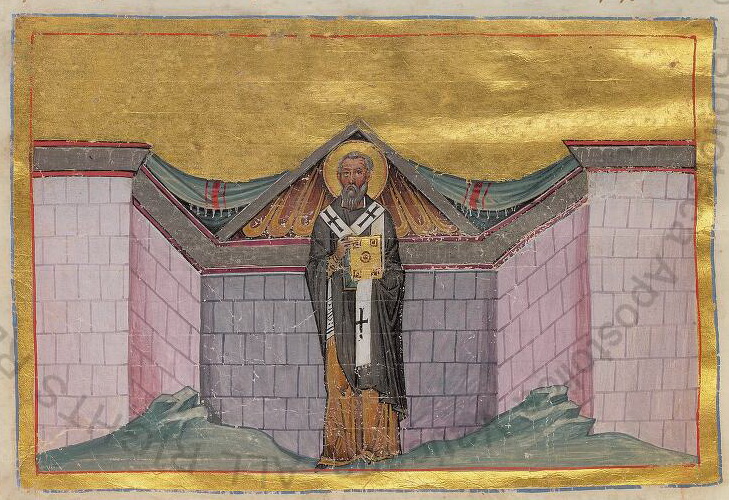
Philogonius is depicted as a bishop of the early type — an elderly, bearded hierarch in the phelonion and omophorion, holding the Gospel-book, the hand raised in blessing. The stored image is the miniature for December 20 from the Menologion of Basil II (Constantinople, c. 985; Vatican Library, Vat. gr. 1613): Philogonius stands vested as a bishop within a walled sanctuary, haloed, the jewelled Gospel in his veiled hands and the cross-marked omophorion upon his shoulders.