
Phineas the High Priest
The Holy and Righteous Phineas, Grandson of Aaron
Righteous · b. c. 1570 BC (traditional reckoning) — d. c. 15th century BC (traditional reckoning)
Commemorated 12 March — Commemoration of the Righteous Phineas
Phineas (Hebrew Pinchas) was the son of Eleazar and grandson of Aaron, and the third high priest of Israel, remembered in Scripture for the burning zeal by which he turned away the wrath of God from his people. When Israel, encamped at Shittim, was drawn into the idolatry and licence of Baal-Peor and a plague broke out among them, Phineas rose up and struck through an Israelite man and the Midianite woman with him, and the plague was stayed. For this the Lord granted him and his descendants a covenant of peace and an everlasting priesthood (Numbers 25). He led Israel in later crises, kept the priesthood after Eleazar, and his name became in the tradition of Israel and the Church a byword for righteous zeal for God. The Orthodox Church commemorates him among the holy righteous of the Old Covenant on March 12.
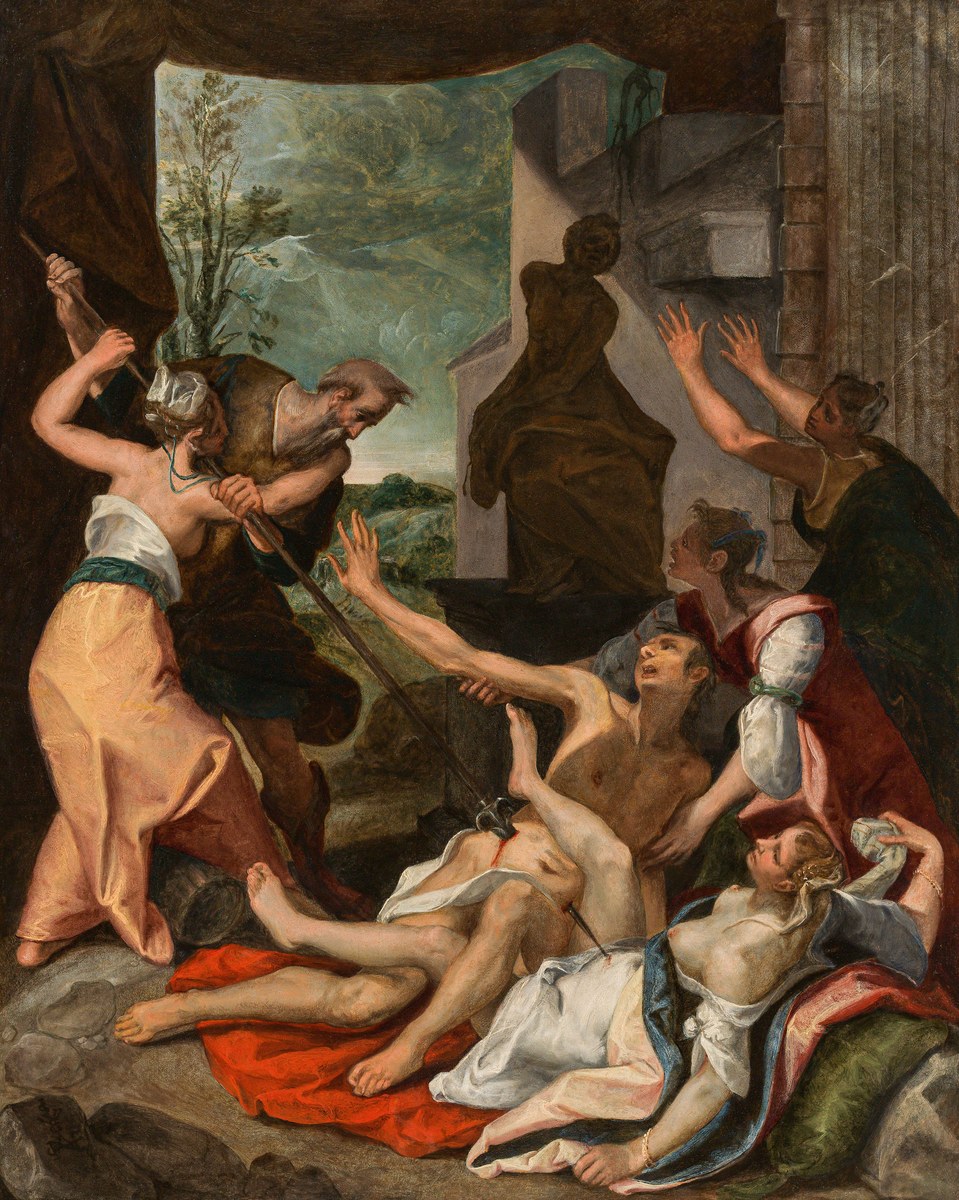

The zeal at Baal-Peor
Phineas belongs to the first generation of the Aaronic priesthood: Aaron the first high priest, his son Eleazar the second, and Eleazar's son Phineas the third. The Scriptures bring him forward at a dark moment of the wilderness years. As Israel lay encamped in the plains of Moab at Shittim, on the very threshold of the Promised Land, the people "began to commit whoredom with the daughters of Moab" and were led into the worship of Baal-Peor; the anger of God was kindled, and a plague fell upon the camp. While Moses and the congregation wept at the door of the Tabernacle, an Israelite brought a Midianite woman openly into the camp in the sight of all. Then Phineas, the account says, "rose up from among the congregation, and took a javelin in his hand… and thrust both of them through" (Numbers 25:7–8), and so the plague was stayed — but not before twenty-four thousand had died.
The act is understood in the tradition not as private violence but as a priestly and prophetic zeal for the holiness of God against a public apostasy that was destroying the people; and it is so rewarded. The Lord says to Moses: "Phineas… hath turned my wrath away from the children of Israel, while he was zealous for my sake among them… Behold, I give unto him my covenant of peace: and he shall have it, and his seed after him, even the covenant of an everlasting priesthood; because he was zealous for his God, and made an atonement for the children of Israel" (Numbers 25:11–13). The high-priestly line of Israel would descend through Phineas.
Later service
Phineas appears again through the books of the conquest and the Judges as a leader and guardian of Israel's covenant. He was sent with the army against the Midianites (Numbers 31), and later, when the tribes east of the Jordan built a great altar and the rest of Israel feared an apostasy, it was Phineas who was sent at the head of the princes to inquire, and whose peaceful settlement of the matter averted civil war (Joshua 22). He is named among those who apportioned the land (Joshua 22:13, 24:33), and at the end of the Book of Judges he stands "before the ark of the covenant" ministering as high priest in the affair of Gibeah (Judges 20:28) — a notice which, taken with the chronology, gives him a very long life spanning the wilderness, the conquest, and the early Judges. He was buried, the Scripture says, at Gibeah, the town of his son Eleazar, in the hill country of Ephraim (Joshua 24:33).
Memory in Scripture and the Church
The memory of Phineas is honoured throughout the later Scriptures. The Psalmist sings that "then stood up Phineas, and executed judgment: and so the plague was stayed. And that was counted unto him for righteousness unto all generations for evermore" (Psalm 106:30–31) — the very language of righteousness "reckoned" that the Apostle Paul uses of Abraham's faith. The priestly zeal of Phineas is recalled again in the praise of the fathers in Sirach 45:23–24 and in 1 Maccabees 2:54, where the dying Mattathias holds him up to his sons as the pattern of zeal that "obtained the covenant of an everlasting priesthood." From the Scriptures the Church received him among the righteous of the Old Covenant, the forefathers and holy ones who lived by faith before the Incarnation, and keeps his memory on March 12.
Feast and commemoration
Phineas is commemorated on March 12 (church date; Old Calendar civil March 25), among the holy righteous of the Old Testament, and the day falls within Great Lent. He shares the day with the confessor Theophanes of Sigriane and with Gregory the Dialogist, Pope of Rome; the Greek Menaion and the Slavic and OCA calendars all keep his memory, giving him a synaxarion notice among the saints of the day.
Iconography
Phineas is rarely depicted alone. Where he appears in the illustrated Bibles and Octateuchs of the Christian East, it is in the narrative scene of Baal-Peor — the priest with the javelin staying the plague — or standing as an aged high priest in the vesture of the Aaronic priesthood, bearded and robed, among the righteous forefathers. The stored image is a Western work per §34: van Winghe's painting of the zeal of Phinehas (Numbers 25), the spear-thrust that stayed the plague. An Eastern image remains wanted and is listed among the upgrade-wanted icons.
Disputed questions
- Chronology. As with all the figures of the Exodus and conquest, the dates of Phineas depend on the traditional reckoning followed for Moses and Aaron; the years given here (a floruit in the fifteenth century BC on that reckoning) are approximate, and the Church transmits no exact dates. The long span implied by his appearance from Numbers through Judges is noted in the sources rather than resolved.
- "High priest." Phineas succeeded to the high priesthood after his father Eleazar and is reckoned the third high priest of Israel; his office is that of the Aaronic (Levitical) high priesthood of the Old Covenant, not the presbyteral office of the Church, and the calendars style him simply "the Righteous Phineas."
- Not to be confused with Phineas (Phinehas) the son of Eli, the wicked priest of Shiloh who with his brother Hophni profaned the sanctuary and fell in battle when the Ark was taken (1 Samuel 2–4) — a later and very different man of the same name.