
Gregory the Dialogist
Our Father among the Saints Gregory the Dialogist, Pope of Rome
Bishop · b. c. 540, Rome — d. 12 March 604, at Rome
Commemorated 12 March — Repose at Rome
Gregory the Dialogist (c. 540 – 604), known in the West as Gregory the Great, was Pope of Rome from 590 to 604 and is honoured by East and West alike as a Father of the whole undivided Church and one of the four great Latin Doctors. Born to a Roman senatorial family, he rose to be Prefect of the City, then renounced the world, turned his houses into monasteries, and became a monk; drawn back into service as papal legate at Constantinople and then, against his will, as pope, he governed Rome through plague and Lombard war with wisdom and charity. He is remembered for the Dialogues — from which the East names him "the Dialogist" — for the Pastoral Rule, the classic manual of the shepherd's office, and the Moralia on Job; for sending the mission of Augustine to convert the Anglo-Saxons; for the reform of the Roman chant that bears his name; and, in Orthodox tradition, as the compiler to whom the Liturgy of the Presanctified Gifts of Great Lent is ascribed. He reposed at Rome on March 12, a day kept in Lent, and is one of the few Western fathers venerated without interruption in the Orthodox East.

Origins and early life
Gregory was born about 540 at Rome, into a wealthy and devout patrician family of the old senatorial aristocracy — a house that had already given the Church a pope, his ancestor Felix III. His father, Gordianus, held office in the Roman Church; his mother, Silvia, and two of his father's sisters, Tarsilla and Aemiliana, are themselves venerated as saints. He was educated in the best learning still to be had in the ruined Rome of the sixth century — grammar, rhetoric, and law — and entered public life with distinction, rising while still young to the highest civil dignity of the city, that of Prefect of Rome (praefectus urbi), about the year 573.
Conversion to the monastic life
At the height of this worldly success Gregory turned from it. On his father's death he inherited great estates, and he used them to found seven monasteries — six on the family lands in Sicily, and one in his own house on the Caelian Hill in Rome, dedicated to the Apostle Andrew, which he entered as a simple monk. The years of hidden monastic life he afterward remembered as the happiest and most fruitful of his life, and his whole later teaching is stamped by the ideal of contemplation he found there. His ascetic rigour in these years permanently injured his health, leaving him subject to the fevers and stomach ailments that dogged his pontificate.
Deacon and apocrisiarius at Constantinople
Gregory's gifts could not stay hidden. Ordained one of the seven deacons of Rome, he was sent by Pope Pelagius II about 579 as apocrisiarius — the pope's resident legate — to the imperial court at Constantinople, where he remained some six years. There, though he never learned Greek well, he moved in the highest circles of the Eastern Church and empire, and there he disputed publicly with the patriarch Eutychius of Constantinople, who had taught that the risen body would be impalpable, "more subtle than air"; Gregory maintained the true palpability of the Lord's risen and glorified flesh, and the emperor ruled in his favour. At Constantinople too, at the urging of his friend Leander of Seville, he began his vast commentary on Job.
Pope of Rome
Recalled to Rome, Gregory served as counsellor and secretary to the pope and as abbot of St Andrew's. When Pelagius II died of the plague that was ravaging the city, the clergy, senate, and people of Rome chose Gregory pope by acclamation (590). He resisted with all his strength — writing to beg the emperor to refuse confirmation, and, the tradition says, attempting to flee the city hidden in a basket — but was consecrated, and governed the Roman Church for fourteen years. In his humility he took a title no pope had used and every pope has kept since: "servant of the servants of God" (servus servorum Dei).
His pontificate fell in a time of calamity — plague, flood, famine, and the advance of the pagan and Arian Lombards on a Rome the distant emperor could no longer defend. Gregory rose to all of it: he reorganised the vast estates of the Roman Church (the patrimonium Petri) to feed the poor of the city with an almost governmental care, ransomed captives, tended the sick in the plague, and — when the imperial officers failed — himself negotiated with the Lombard king Agilulf to spare Rome, so becoming in effect the temporal protector of the city. His letters, some 850 of which survive in the Registrum, show him governing churches from Britain to Africa to the East with untiring pastoral attention.
The mission to the Anglo-Saxons
The act for which the northern churches love him most was the sending of the mission to the English. The tradition — told of his monastic days — has Gregory see fair-haired Anglo-Saxon youths for sale in the Roman market and, told they were Angli, answer that they were rightly named, for they had the faces of angels (non Angli, sed Angeli), and were made to be co-heirs with the angels in heaven. As pope he made the vision real: in 596 he sent a band of forty monks from his own monastery of St Andrew, under the prior Augustine of Canterbury (May 26), to preach to the pagan English. They converted Æthelberht, king of Kent, and his people, and founded the see of Canterbury — the beginning of the English Church, which has never forgotten that it owes its faith to Gregory, calling him its Apostle.
Writings
Gregory ranks with Ambrose, Jerome, and Augustine as one of the four great Doctors of the Latin Church, and his works were read through the whole Middle Ages:
- The Pastoral Rule (Regula Pastoralis, or Liber Regulae Pastoralis) — his treatise on the office of the shepherd of souls, how a man should come to it, live in it, teach and rule and examine himself: the classic manual of the bishop's and priest's life, translated at once into Greek in his own lifetime, and made basic reading for bishops for a thousand years.
- The Moralia in Job (the Magna Moralia) — a vast moral and allegorical commentary on the Book of Job, a summa of the spiritual life.
- The Dialogues (Dialogi) — four books, cast as a conversation with his deacon Peter, on the lives, virtues, and miracles of the holy fathers of Italy; Book II is the earliest and principal Life of Saint Benedict of Nursia, and Book IV treats of the soul after death. It is from this work — read and loved in the Greek translation of Pope Zacharias — that the Byzantine East gave Gregory the surname by which it knows him, ὁ Διάλογος, the Dialogist (in Slavonic, Dvoeslov).
- Homilies on the Gospels and on the prophet Ezekiel, and the great collection of his Letters (Registrum Epistolarum).
Chant, liturgy, and the Presanctified Gifts
Gregory's name is bound to the Church's worship in two lasting ways. In the West, tradition credits him with the ordering and codification of the Roman ecclesiastical chant and the strengthening of the Schola Cantorum, whence the plainsong of the Latin Church is called "Gregorian"; he also revised and fixed portions of the Roman Mass. In the East, a firm and ancient tradition honours him as the compiler — or at least the great arranger and transmitter — of the Liturgy of the Presanctified Gifts, the Communion service of the Lenten weekdays at which the Gifts consecrated the previous Sunday are received without a new consecration. It is chiefly for this that Orthodox Christians remember him with such warmth, and that his feast in Lent is kept with love: the pope of Rome who is met at every Presanctified Liturgy of the Fast. (On the scholarly caution owed to both attributions, see Disputed questions.)
Repose
Worn out by disease and the labours of his office, Gregory died at Rome on 12 March 604, and was buried in the portico of Saint Peter's. He was acclaimed a saint at once, and "the Great" was joined to his name; the East and the West have kept his memory unbroken ever since.
Feast and commemoration
Gregory is commemorated on March 12 (church date; Old Calendar civil March 25), the day of his repose at Rome, and the day is kept in the Antiochian, Greek, and Slavic calendars alike; because it falls within Great Lent his office is joined to the Triodion. The Roman Church long kept him on this same March 12; in the calendar reform of 1969 it moved his feast to September 3 (the day of his consecration as pope), precisely because March 12 falls in Lent — the Anglican and older Western calendars retain March 12. Both East and West thus honour him, and his feast in the Fast keeps company with the confessor Theophanes of Sigriane and, in Slavic and OCA usage, with Symeon the New Theologian.
Hymns
Troparion — Tone 4
Receiving divine grace from God on high, O glorious Gregory, and strengthened by its power, thou didst choose to walk according to the Gospel. Wherefore thou hast received from Christ the reward of thy labours, O all-blessed one. Entreat him that our souls may be saved.
Original translation from the Greek
Kontakion — Tone 3
Thou wast likened to the great Shepherd, O Gregory, leading the ranks of monks to the heavenly sheepfold; and from thence thou didst teach to all men the way. Wherefore now thou dost rejoice and art glad together with them in the dwelling-places of heaven.
Original translation from the Greek
Iconography
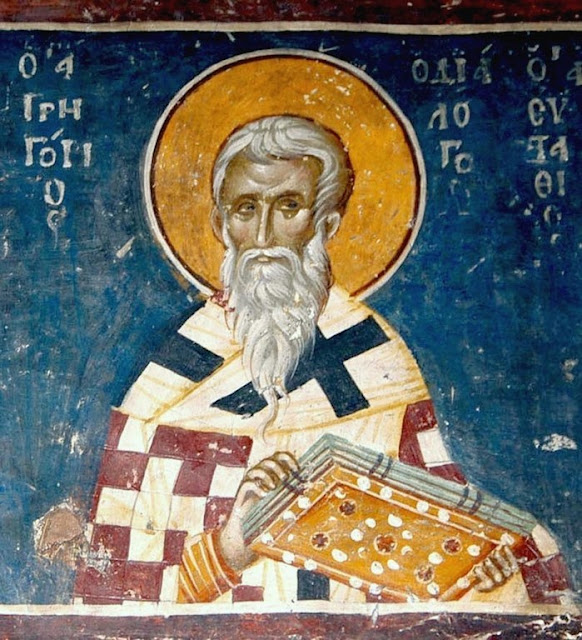
Gregory is depicted in the East as a bishop in the settled type of a hierarch: vested in the cross-figured phelonion or sakkos and the omophorion, holding or blessing over a jewelled Gospel-book, grey-haired and with a rounded beard. A distinctively Western and widely-known motif — passing also into the East — shows the dove of the Holy Spirit at his ear, the tradition that the Spirit dictated to him as he wrote or as he ordered the sacred chant.
The stored image is a 14th–15th-century Byzantine fresco, inscribed "Ὁ ἅγιος Γρηγόριος ὁ Διάλογος" — Saint Gregory the Dialogist — showing him vested as a bishop in the crossed omophorion and holding a jewelled Gospel-book, the identity fixed by the inscription (source, public domain, pd-old-work).
Disputed questions
- The Presanctified Liturgy and its attribution to Gregory. The rite of the Presanctified is far older than any one author and is Eastern in origin — the practice of communing on Lenten weekdays from Gifts consecrated beforehand is attested in the Christian East (Jerusalem, Antioch, Constantinople) from the early centuries, and the developed Byzantine service took shape in the East, not in Rome. The ascription of its compilation to Gregory is a later Byzantine tradition, honouring the one Western father whom the East kept as its own and who had lived at Constantinople; it is best understood as a mark of veneration and of the rite's antiquity rather than a claim of sole composition. The Church keeps the ascription in its liturgical books while scholarship rightly distinguishes the man from the rite. The same caution applies to "Gregorian" chant, whose fixing in the form later known is the work of generations after him, though his impulse and reforms stand behind the name.
- On the doctrine of the state after death. The fourth book of the Dialogues speaks of a purifying fire for lighter faults after death and commends prayer and the Eucharist for the departed. Later Latin theology built on such passages its developed doctrine of Purgatory, with its juridical reckoning of satisfaction, which the Orthodox Church does not receive. Gregory himself teaches within the older and shared patristic frame — the value of prayer for the dead and a cleansing that is not the Latin scholastic construction — and it is as a father of the undivided Church, before that development, that the East venerates him. The distinction is recorded, not resolved by anachronism.
- The Roman see. Gregory upheld the honour and primacy of the see of Rome, yet in a manner the Orthodox tradition can wholly own: he strenuously rejected the title "Ecumenical (Universal) Patriarch" claimed by John IV the Faster of Constantinople, judging that no bishop should set himself as universal head over his brethren, and calling any who would do so a forerunner of pride; his own chosen style was "servant of the servants of God." He honoured the five patriarchal sees and governed collegially. His ecclesiology is that of the first millennium, and belongs to no later polemic.
- Not to be confused with the other Gregories of the calendar — Gregory the Theologian of Nazianzus (†c. 390, kept January 25), Gregory of Nyssa (†c. 395), Gregory the Illuminator of Armenia (†c. 331), and Gregory of Agrigentum: "the Dialogist" and "Pope of Rome" belong to this Gregory alone.