
Theophanes the Confessor
Our Venerable Father Theophanes the Confessor, Abbot of the Great Field
Venerable · Confessor · b. c. 759/760, Constantinople — d. 12 March 817 or 818, in exile on Samothrace
Commemorated 12 March — Repose in exile on Samothrace
Theophanes the Confessor (c. 759/760 – 817/818) was a wealthy Byzantine noble of Constantinople who renounced rank and riches to become a monk, and who is remembered on three counts above all: as founder and abbot of the great monastery of the Great Field (Megas Agros) on the peninsula of Sigriane by the Sea of Marmara; as author of the Chronographia, the annalistic chronicle of the years 284–813 that is one of the primary sources for Byzantine, Persian, and early Islamic history; and as a confessor of the holy icons in the second iconoclasm. Married in youth but living with his wife in continence until both took the monastic habit, he distributed his fortune, built monasteries, and signed the decrees of the Seventh Ecumenical Council (787). When Leo V the Armenian revived iconoclasm, Theophanes, already broken by a painful illness, refused to condemn the icons, was imprisoned some two years, and was exiled to the island of Samothrace, where he died of his sufferings a few days after arrival, on March 12. His relics were returned to Megas Agros, and he is venerated throughout the Orthodox world.

Origins and early life
Theophanes was born about the year 759 or 760 in Constantinople, into the higher nobility of the empire. His father, Isaac, was a man of rank and wealth — the sources make him governor (strategos) of the maritime theme of the Aegean Sea and connect the family to the imperial house — but he died when the boy was only about three years old, leaving Theophanes to be raised, on one account, under the care of the emperor Constantine V himself, in whose service the family stood. The child inherited a great estate and grew up amid the splendour of the capital in the middle iconoclast period, when the veneration of icons was proscribed and the young were formed in the imperial ideology. That Theophanes, so reared, became the age's most celebrated chronicler of the iconoclast persecution and one of its confessors is the first surprise of his history.
By the wish of his guardians — and, the tradition says, by the arrangement of the emperor Leo IV — he was married while still young to a noblewoman named Megalo (Megalis). But Theophanes had already conceived a longing for the monastic life, and he persuaded his bride that they should live together in continence, as brother and sister rather than as husband and wife. When after some years the way opened — his father-in-law's death releasing him from worldly obligation — the two parted by mutual consent to take up the monastic habit: Megalo entered a convent, and Theophanes gave himself to the ascetic life he had desired from the first.
The renunciation and the monasteries of Sigriane
Theophanes now did what his whole after-life would be measured by: he scattered his immense fortune — freeing his slaves, giving to the poor, and turning his lands into houses of prayer. On the peninsula of Sigriane, on the southern shore of the Sea of Marmara in the region of Cyzicus (Mysia), he first established himself in a small monastery, and on the nearby island of Kalonymos he founded another. But his great and enduring foundation was the monastery of the Great Field — Megas Agros — built on the slopes of Sigriane, which he governed as abbot and which became a centre of monastic life and of learning. It is from this house that he takes his surest title in the calendars: Theophanes of Sigriane, or of the Great Field.
He was, by every account, a monk of rigorous asceticism and gentle rule, esteemed for his humility and his gift of spiritual discernment; the hymnography credits him with the working of wonders and with foreknowledge of things to come. Throughout these years he was afflicted by a painful and chronic disease — a stone and kidney complaint that the sources describe as a torment he bore for the rest of his life, and which would make the hardships of his last imprisonment and exile the more cruel.
The Seventh Ecumenical Council
When the empress Irene and the patriarch Tarasius convoked the Seventh Ecumenical Council at Nicaea in 787 to restore the veneration of the holy icons, Theophanes, then abbot of Megas Agros, was among the fathers. Ill though he was — the tradition has him carried to the council or riding worn with disease — he took his place among the monastic superiors, subscribed to the Council's definition, and set his hand to the restoration of the icons. His presence at Nicaea binds him to the central dogmatic act of his age and gives his later confession its full weight: he did not merely suffer for the images at the end of his life, he had helped to vindicate them in council.
The Chronographia
The work that carried his name farthest was written in his last years, and almost by inheritance. His friend George the Synkellos — a learned monk and sometime secretary (synkellos) to the patriarch — had compiled a great chronicle of the world from the Creation, but died before he could bring it down to his own day. On his deathbed George entrusted to Theophanes his materials and notes, and charged him to complete the work. Theophanes, reluctant and pleading his lack of learning and his ill health, undertook it out of love for his friend, and so composed the Chronographia — an annalistic chronicle covering the years from the accession of Diocletian in 284 to the fall of Michael I Rhangabe and the accession of Leo V in 813, the point at which George's narrative had broken off and Theophanes's own memory could carry it.
Arranged year by year, dated by the year of the world, of the Incarnation, and by the regnal years of emperors, popes, patriarchs, and caliphs set in parallel columns, the Chronographia is written in a plain, unliterary Greek close to the speech of its day. Its value is out of all proportion to its modest style: for the seventh and eighth centuries — the "dark age" of Byzantium, from which little else survives — it is a primary source of the first rank, our chief connected narrative of the Arab conquests and the rise of Islam, the Persian wars of Heraclius, the sieges of Constantinople, the reigns of the iconoclast emperors, and the affairs of the Bulgars and the West. It was translated into Latin within two generations by Anastasius Bibliothecarius, and through that version, and its Greek continuators, it shaped the whole medieval memory of these centuries. The historian's craft and the confessor's crown belong to the same man.
Confession under Leo V and exile
On the death of Michael I, Leo V the Armenian (813–820) came to the throne, and in 815 revived the iconoclast policy that Nicaea II had condemned, deposing the patriarch Nikephoros and convening a council to renew the ban on images. The old confessors of the icons were sought out and pressed to conform. Leo summoned Theophanes — by now aged, famous, and gravely ill — to Constantinople, hoping that the submission of so revered an abbot would carry weight. He tried first flattery and then threats; Theophanes, unmoved, openly professed the veneration of the icons and refused to subscribe to the heresy, rebuking the emperor for overturning the faith of the Council. He was thrown into prison, where for about two years he lay in harsh confinement, his disease unrelieved, enduring, the sources say, both bodily torment and the emperor's continued attempts to break him.
At last, his constancy unshaken, Theophanes was sent into exile on the island of Samothrace in the northern Aegean. Worn out by imprisonment, illness, and the hardship of the journey, he survived only a short time there — the tradition counts some seventeen (some say twenty-three) days — and reposed on 12 March, in the year 817 or 818, a confessor who had not been slain outright but had died of his sufferings for the icons, which is the very definition of his rank.
Relics and later cultus
After the death of Leo V and, more fully, after the final Triumph of Orthodoxy under the empress Theodora in 843, the memory of the iconodule confessors was honoured throughout the empire. Theophanes's relics were carried back from Samothrace to his own monastery of the Great Field, where they were enshrined and where miracles and a flow of healing myrrh were reported at his tomb. His feast entered the Synaxarion of Constantinople and the Menaia, and his memory was kept the more warmly because his Chronographia was read and copied in every generation. His widow Megalo, who had shared his renunciation, is herself remembered in some synaxaria among the holy women.
Feast and commemoration
Theophanes is commemorated on March 12 (church date; Old Calendar civil March 25), the day of his repose in exile, and the day is kept universally — in the Antiochian, Greek, and Slavic calendars alike. Because March 12 falls within Great Lent, his office is sung on a Lenten weekday, joined to the services of the Triodion; where the date meets a Saturday or Sunday, a fuller celebration is possible. The day he shares, in the wider tradition, with Gregory the Dialogist, Pope of Rome, and (in the Slavic and OCA usage, transferred here from the fast-conflict on his October feast) with Symeon the New Theologian.
Hymns
Troparion — Tone 8
O guide of Orthodoxy, teacher of piety and holiness, luminary of the world, God-inspired adornment of monastics, O wise Theophanes: by thy teachings thou hast enlightened all, thou lyre of the Spirit. Intercede with Christ our God that our souls may be saved.
Original translation from the Greek
Kontakion — Tone 2
Having received revelation from on high, thou didst hasten forth from the midst of the world's tumults; and taking up the monastic life, O righteous one, thou wast granted the working of wonders and the gift of foretelling things to come. For having scattered thy riches and thy possessions and thy wedded life, thou wast made a kinsman of Christ, O Theophanes.
Original translation from the Greek
Iconography
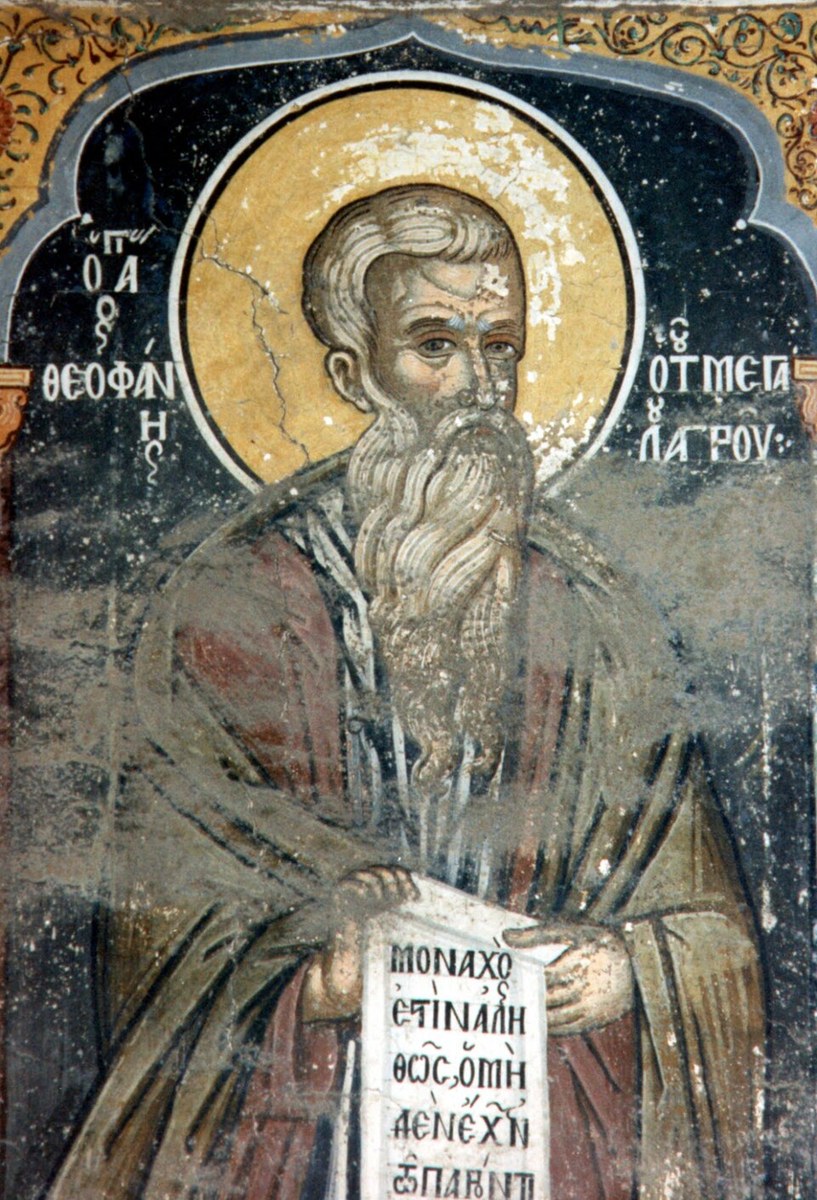
Theophanes is depicted as a monk and abbot: an aged ascetic of middle height, with a long, full grey beard and high forehead, in the dark monastic mandyas or schema, often holding a scroll of monastic counsel. As a confessor rather than a martyr he bears no instrument of death; his dignity is that of the ascetic and the wise elder. Because he was also a hierarch's peer at the Seventh Council and an abbot, some images give him the bearing of a superior of monks.
The stored image is a 14th–15th-century fresco from Mount Athos, inscribed "Ὁ ἅγιος Θεοφάνης ὁ τοῦ Μεγάλου Ἀγροῦ" — Saint Theophanes of the Great Field — showing him as a grey-bearded monk holding an open scroll with a monastic text, the identity fixed beyond doubt by the inscription (source, public domain, pd-old-work).
Disputed questions
- The year of his death — 817 or 818. The chronology of Leo V's persecution allows both reckonings, according to whether the two years of imprisonment are counted from 815 or 816; the older Byzantine tradition and the OCA give 818, much modern scholarship 817. The day, March 12, is fixed and certain.
- How much of the Chronographia is Theophanes's own. Because the work grew out of the papers of George the Synkellos, scholars have long debated how far Theophanes was author and how far editor — some crediting him chiefly with the arrangement and completion of George's collected sources, others with a substantial share of the composition, especially for the years after George's narrative failed. The debate touches the history of the text, not the sanctity of the man, and the Church honours him as the chronicler the tradition has always named.
- Not to be confused with his several namesakes: Theophanes the Branded (Graptos), the hymnographer and confessor-bishop of Nicaea (†c. 845, kept October 11), who with his brother Theodore was branded on the face for the icons in this same second iconoclasm — a distinct and later confessor; Theophan the Recluse of Vysha (†1894, kept January 10), the Russian bishop and spiritual writer; and Theophanes of Mount Diabenos, the much earlier ascetic. "The Confessor of Sigriane" and "chronicler" belong to this Theophanes.