
Porphyrius of Gaza
Our Father among the Saints Porphyrius, Bishop of Gaza
Bishop · b. c. 347, at Thessalonica — d. February 26, 420, at Gaza
Commemorated 26 February — Repose at Gaza
Porphyrius (c. 347 – 420) was bishop of Gaza from 395 to his death, and the man who broke the last great stronghold of organized paganism in Palestine. Born to wealth at Thessalonica, he gave up the world at twenty-five for the monks of the Egyptian desert of Scetis and then a cave above the Jordan; healed of a wasting illness by a vision of Christ at Golgotha, he was made keeper of the Wood of the Cross at Jerusalem, and against his will was consecrated bishop of Gaza — a city where a mere handful of Christians lived surrounded by the temples of Marnas, Aphrodite, Apollo, and the rest. There he waged a long and dangerous struggle against the pagan majority, and at length secured from the Empress Eudoxia and the Emperor Arcadius the imperial order that in 402 razed the eight public temples of Gaza — above all the Marneion, the vast shrine of Marnas — and raised in its place the cruciform church called the Eudoxiana. His deeds are known in extraordinary detail from the Life written by his deacon and companion Mark, one of the most vivid biographies to survive from the Christian antiquity. He reposed on February 26, 420.

The life of Porphyrius is unusually well documented, for it comes to us in the Life of Porphyrius, Bishop of Gaza (the Vita Porphyrii) ascribed to Mark the Deacon — his disciple, secretary, envoy, and eyewitness of most of what it records. Whatever the precise history of the text (see Disputed questions), it preserves a portrait of a late-antique bishop and his city — the councils, the journeys, the imperial audiences, the very weather of the days it narrates — of a fullness almost without parallel among the saints' lives, and the account that follows draws throughout upon it.
Origins and the flight to the desert
Porphyrius was born about the year 347 at Thessalonica, the Macedonian metropolis, into a family of substance; his upbringing gave him property, a good education, and every prospect of a comfortable life in the world. About the age of twenty-five, moved by the desire for the monastic life, he left his native city and went to Egypt, to the great monastic settlement of Scetis in the Nitrian desert, then at the height of its fame as the school of the Fathers of the desert. There, among the anchorites, he learned the ascetic discipline. After some years he turned toward the Holy Land, drawn to the places of the Lord's life and passion, and withdrew to a cave in the wilderness of the Jordan, where he lived for about five years in prayer, fasting, and vigil.
Illness, the vision at Golgotha, and the Wood of the Cross
The severity of the Jordan desert broke his health: he fell ill of a wasting disease — the Life describes a swelling and drying of the body, a liver and dropsical affliction — that left him unable to keep the harsh regime of his cave. He went up to Jerusalem, and, sick as he was, would drag himself daily around the holy places to venerate them. It was here, the Life relates, that he formed his lifelong bond with the young Mark, a native of Asia who had come to Jerusalem and now attached himself to the ailing ascetic, running his errands, tending him, and — since Porphyrius supported himself by copying and by the shoemaker's trade — carrying his work to sell.
Wishing to be free of the last claim of the world, Porphyrius sent Mark to Thessalonica to sell the property he had inherited; the proceeds he gave away to the poor and to the monasteries, keeping nothing. And in the same season came the turning-point of his life. Praying at Golgotha, worn by his sickness, he saw in a vision the crucified Christ and the thief crucified beside him; the Lord bade the thief help Porphyrius, who was raised up, and Christ, coming down from the Cross, said to him, "Take this Wood, and keep it." He awoke healed — his strength and health wholly restored — and the vision was read as a charge laid on him. The Patriarch of Jerusalem, John II, ordained him priest about the year 393 and appointed him keeper of the venerable Wood of the Life-giving Cross (the staurophylax), the guardian of the relic of the True Cross preserved at Jerusalem — an office he held for some three years, still living frugally and giving his substance to the needy.
Consecration as bishop of Gaza
In 395 the see of Gaza fell vacant by the death of its bishop Aeneas. Gaza was among the most stubbornly pagan cities of the empire — an ancient Philistine and Hellenistic town whose civic life still turned upon its temples, where Christians were a small and harried minority. The Metropolitan John of Caesarea (Caesarea Maritima, the metropolis of Palestine), seeking a man equal to so hard a charge, fixed upon Porphyrius. Knowing the ascetic would refuse the burden, John sent for him under the pretext of needing his counsel on a question of Scripture; when Porphyrius came to Caesarea he was seized and, over his protests, consecrated bishop of Gaza. He is said to have wept at his ordination, foreseeing the trials of the place; and to the end of his life he kept the plainness of the monk.
He entered Gaza to find, by Mark's account, a Christian community of only a few hundred souls and but a small number of churches, set against a city bristling with temples — the shrines of Aphrodite, Apollo, Kore, Hecate, the Sun, the Heroön, the Tychaion (the temple of the city's Fortune), and, towering over all, the Marneion, the great round temple of Marnas ("Our Lord"), the Cretan-Zeus of Gaza, reckoned among the most splendid sanctuaries of the East. The pagan majority held the civic offices, controlled the water and the courts, and met the new bishop with contempt and, at times, violence.
The drought and the first conversions
The Life opens Porphyrius's episcopate with a sign. A drought had gripped the region; the pagans, according to their custom, made supplication to Marnas, "the lord of rains," in vain. Then Porphyrius led the Christians in fasting, vigil, and a procession through the city with the Cross and the singing of psalms; and the rain came in abundance. The wonder, and the bishop's charity in the ensuing plenty, brought a first harvest of converts — the Life numbers them in the scores and then hundreds (giving, at one point, a figure of some 127, and in all through these years a few hundred souls). But the mass of the city held to its gods, and the hostility deepened. Christians were beaten and their houses attacked; the pagans obstructed them at law and barred them from the wells; and the imperial officials, drawing rich revenues from a prosperous pagan city, were disinclined to enforce the laws already on the books against the temples.
The appeal to Constantinople
Convinced that Gaza could not be won while the temples stood open, Porphyrius resolved to seek the closing of the temples from the imperial power at Constantinople. About 398 he sent his deacon Mark to the capital, where — the Life says — through the good offices of John Chrysostom, then archbishop of Constantinople, the petition reached the court of the Emperor Arcadius. A rescript was granted, but it fell short: the official sent to enforce it, Hilarius, closed the temples in form only, and the greatest of them, the Marneion, was kept in use by bribery and evasion. The harassment of the Christians resumed.
So in the winter of 401–402 Porphyrius went to Constantinople himself, together with the aged Metropolitan John of Caesarea, to press the cause in person. Chrysostom received and counselled them, and directed them to the chamberlain Amantius and, through him, to the Empress Aelia Eudoxia, the formidable wife of Arcadius, who was then with child. The Life gives the audiences in vivid scene: the bishops' petition met at first by the emperor's reluctance — for the pagans of Gaza paid heavy taxes and the treasury was unwilling to lose them — and carried at last by the empress. Porphyrius, the account says, promised Eudoxia that if she obtained the destruction of the temples she would bear a son who would live and reign; when she was delivered of the future Theodosius II, she held the emperor to his word. An imperial edict was issued for the destruction of the temples of Gaza and the restoration of the Christians' rights, and the empress undertook besides to build a great church in the city at her own expense, sending the bishop away with funds and, it is said, a cruciform plan of her own devising.
The destruction of the temples and the fall of the Marneion
In the spring of 402 the imperial commissioner Cynegius reached Gaza with a body of soldiers to execute the decree. Over some days the eight public temples of the city were thrown down and burned; the idols were shattered and the sacred precincts profaned. The hardest to fall was the Marneion itself. The pagans had barricaded themselves and their god within it; the great temple was at last set alight and burned, and its ruin was thorough. The Life records a telling humiliation devised by the Christians: the polished marble slabs of the Marneion were taken up and laid down to pave the forecourt and the street before the new church, so that the stone once trodden only by the god's initiates should thereafter be trodden underfoot by every passer-by, women and beasts alike — a deliberate desacralizing that the pagans of Gaza felt as a lasting wound.
The Eudoxiana
Upon the very ground of the Marneion, Porphyrius raised the church the empress had endowed: a great cruciform basilica, built to the plan Eudoxia had sent, and named for her the Eudoxiana. Its foundations were laid in 402 and the work went forward over the following years; the church was dedicated at Easter, on April 14, 407 (some reckon 406), with great solemnity, and stood thereafter as the cathedral of a now-Christian Gaza — the monument of Porphyrius's long struggle, set upon the grave of the city's dead god.
Later episcopate and repose
The rest of Porphyrius's twenty-five years at Gaza were given to the building-up of the Church he had won: the instruction of converts, the care of the poor, the suppression of the lingering paganism and of heresy (the Life records his contest with a Manichaean woman named Julia, who came to Gaza to spread her doctrine and against whom he prayed and prevailed). He governed his see to a great age, honoured as the apostle of his city. He reposed on February 26, 420, some seventy-three years old, and was buried in the church of his labours; the faithful of Gaza kept his memory as that of the shepherd who had given them their Christian city.
Feast and commemoration
Porphyrius is commemorated on February 26 (church date; Old Calendar civil March 11), the day of his repose, universally in East and West. The Greek Menaion gives him a proper office with synaxarion notice; the Antiochian, Greek, and Slavic calendars agree on the day, as does the Roman Martyrology. On the same February 26 the Church keeps the memory of Photini the Samaritan Woman and her companions, the new-martyr John Kalfa of Constantinople, and, in the Russian calendar, the venerable Sebastian of Poshekhonye.
Hymns
Troparion — Tone 4
A rule of faith and an image of meekness, a teacher of temperance, the truth of things itself revealed thee to thy flock. Therefore by lowliness thou didst gain the things that are exalted, and by poverty the things that are rich. O Father and Hierarch Porphyrius, intercede with Christ our God that our souls may be saved.
Original translation from the Greek
Kontakion — Tone 2
Adorned with thy most sacred ways of life, thou wast made resplendent in the vestments of the priesthood, O all-blessed and God-minded Porphyrius; thou art radiant in the heights of healings, interceding without ceasing on behalf of us all.
Original translation from the Greek
Iconography
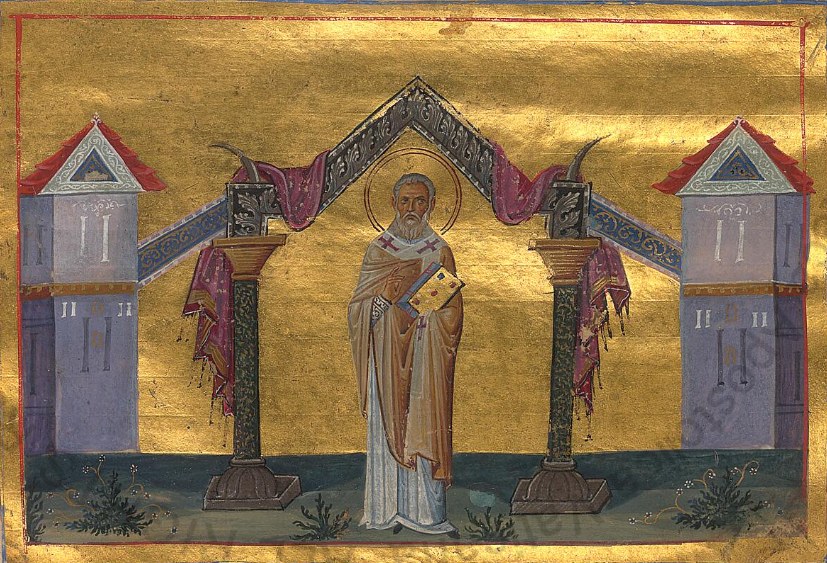
Porphyrius is depicted in the settled type of a bishop and confessor of the faith: an elderly hierarch, balding with a rounded or tapering grey beard, vested in the phelonion or the cross-figured polystavrion, wearing the omophorion and holding or blessing over the Gospel-book. Where his story is told in narrative, the scenes are the vision at Golgotha (Christ upon the Cross raising the sick ascetic) and the destruction of the Marneion (the great temple in flames, its idol toppling, the bishop and his people looking on) — the two turning-points of his Life.
The stored image is the miniature for February 26 from the Menologion of Basil II (Constantinople, c. 985; Vatican, Vat. gr. 1613): Porphyrius standing beneath a draped arch between two columns, vested as a bishop in the cross-marked omophorion and holding the Gospel-book — the received portrait of the hierarch of Gaza (source, public domain, pd-old-work).
Disputed questions
- The date and authorship of the Life. The Vita Porphyrii presents itself as the work of Mark the Deacon, Porphyrius's own companion, written soon after the bishop's death — and its intimate knowledge of Gaza, its topography, and the machinery of a late-antique episcopate has persuaded many that a genuine eyewitness core underlies it. But the text as it survives (in Greek, with a Georgian version) carries chronological difficulties that have made it a celebrated problem of scholarship. Its account entangles the reigns and persons of Arcadius, Eudoxia, and John Chrysostom in ways not easily squared with the known dates — Eudoxia died in 404, the birth of Theodosius II fell in 401, and Chrysostom's own troubles were mounting in just these years — and some details (names of officials, the sequence of the embassies) resist verification. Scholars from Grégoire and Kugener onward have accordingly judged the received Life a later reworking (fifth- or even sixth-century) of an original memoir, its framework embellished and its chronology confused in the retelling; others defend a substantially authentic Mark. The prudent position, followed here, is that the Life preserves a true and vivid memory of Porphyrius and the Christianization of Gaza, told with hagiographic freedom and with a chronology to be used cautiously — historians differ on how much of the imperial drama is exact.
- The number and identity of the temples. Mark names eight public temples of Gaza and a number of household idols; the identifications (Marnas as a form of the Cretan Zeus; the Aphrodite of the city; the Tychaion) rest largely on his account and on the archaeology of the region, and the topography of the Marneion and the Eudoxiana above it is reconstructed from the Life.
- Not to be confused with the several other Porphyrii of the calendar — none of them this bishop: Porphyrius the Actor (the mime martyred at Ephesus, kept September 15) and Porphyrius of Caesarea (the mime-actor of November 4), both converted upon the stage; the soldier-martyr Porphyrius of the company of Onesiphorus (November 9); the martyr Porphyrius, companion of Baptus (February 10); and, in the modern age, the wonderworker Porphyrios of Kavsokalyvia (†1991). "Bishop of Gaza" belongs to this Porphyrius alone.