
Photius of Kiev
Our Father among the Saints Photius, Metropolitan of Kiev, Moscow and All Rus', Wonderworker
Bishop · Wonderworker · b. c. 1370s, at Monemvasia in the Peloponnese — d. July 2, 1431, at Moscow
Commemorated 27 May — Translation of the relics of Cyprian, Photius and Jonah, Metropolitans of Moscow, in the Dormition cathedral of the Kremlin, 1472, 2 July — Repose at Moscow, 1431
Photius (c. 1370s–1431) was a Greek monk of the Peloponnese who was sent from Constantinople in 1408 to be Metropolitan of Kiev and All Rus' and governed the Russian Church for twenty-two years from Moscow. He came to a metropolitanate half-ruined by the wars of Edigu and the Lithuanian pressure on its southern dioceses, and left it richer, better ordered, and canonically one: he recovered the alienated properties of the see, put down the Strigolnik heresy at Pskov and Novgorod, and after ten years of struggle obtained in 1420 the suppression of the rival Lithuanian metropolitanate set up under Gregory Tsamblak. A learned writer of epistles and instructions, he stood as regent-guardian of the boy grand prince Vasily II in the opening of the great Muscovite civil war. He reposed on July 2, 1431, having foreseen his end, and his incorrupt relics were uncovered in the Dormition cathedral of the Kremlin in 1471. He is not the ninth-century patriarch of Constantinople of the same name.

A Greek of Monemvasia
Photius was born in the last decades of the fourteenth century at Monemvasia, the rock-fortress city of the Peloponnese, in the Byzantine despotate of the Morea. While still a boy he left the world for the monastic life under an elder named Acacius, an ascetic of the neighbouring mountains who afterwards became metropolitan of Monemvasia; and under him Photius was formed in the hesychast piety and the Greek learning of the late Palaiologan age, both of which stayed with him. He was in Constantinople on an embassy from his despot when the affairs of the distant Russian metropolitanate had to be settled.
Sent to Rus'
The metropolitan see of Kiev and All Rus' had fallen vacant in 1406 with the death of Cyprian (September 16, not yet authored here), the hierarch who had governed it for thirty years, and both the grand prince of Moscow and the grand duke of Lithuania pressed candidates upon Constantinople. The patriarch Matthew I would have neither, and in 1408 consecrated Photius. He reached Kiev in September 1409 and stayed there half a year, visiting the southern dioceses that lay in Lithuanian territory, and came up to Moscow on the feast of the Annunciation, 1410.
He had seen enough in Kiev to make the decision that shaped the rest of his life and much of Russian history: that the spiritual centre of the Russian Church could not remain in the south, where every diocese was falling under the political and confessional pressure of Catholic Poland-Lithuania, and that the metropolitan of All Rus' must reside in Moscow. He kept the ancient title of Kiev — the see was, and remained on paper, the see of Kiev — but he governed from the north.
Devastation, recovery, and the raid of 1410
What he found at Moscow was a wreck. The invasion of the emir Edigu in 1408 had burned the towns of the north-east, and the metropolitan household and lands had been plundered and given away during the vacancy. Photius set himself first to recover the alienated estates and revenues of the see — a business that made him enemies among the boyars and at times strained his relations with the grand prince Vasily I — and then to the restoration of order in the dioceses.
In 1410 the Tatars fell upon Vladimir while Photius was there. He escaped by a hair: leaving the city ahead of them, he hid in a remote settlement among the marshes on the river Senega, and the raiders who followed his track lost him in the swamps. Vladimir was sacked, the Dormition cathedral stripped, and the sacristan Patrikey tortured to death for refusing to give up the treasures — a martyrdom the Russian Church remembers. Photius went back and began to rebuild.
The Lithuanian schism and its healing
The hardest of his labours was the unity of the metropolitanate. Vitovt (Vytautas), grand duke of Lithuania, wanted a metropolitan of his own for the Orthodox of his dominions, and when Constantinople refused him he had a council of Lithuanian and west-Russian bishops elect and consecrate — uncanonically, in 1415 — Gregory Tsamblak, a learned Bulgarian and a kinsman of Cyprian. Photius answered with a stream of encyclical letters to the southern dioceses, denouncing the consecration and calling the flock back; Constantinople excommunicated Tsamblak; and Tsamblak went, in 1418, to the Latin Council of Constance to treat of union, which did his cause no good among the Orthodox. On his death, about 1419–20, Vitovt did not replace him, and in 1420 Photius was received again in Lithuania and Kiev as the one metropolitan of All Rus'. Thereafter he travelled the southern dioceses repeatedly and kept the peace with Vitovt to the end — he was even named among the guardians of Vasily II in the grand prince's will, alongside the boy's Lithuanian grandfather.
The Strigolniki
At Pskov and Novgorod a rigorist movement called the Strigolniki — "the shearers," so named for reasons the sources no longer explain — had been troubling the Church since the 1370s. They rejected the ordained priesthood as simoniacal, refused the sacraments and the offerings for the dead, and confessed their sins to the earth instead of to a priest. Photius wrote at least three great epistles to the Pskovians against them — patient, argued letters that are among the more substantial pieces of Russian churchmanship of the century, insisting on the priesthood and the sacraments and forbidding violence against the sectaries — and by 1427 the movement had ceased to be a force.
Churchman, writer, and regent
Photius' surviving works run to sermons, encyclicals, epistles of instruction, a will, and a canonical Order for the election and installation of bishops (1423). He is credited with directing the compilation of the great All-Russian Chronicle in the 1420s, the redaction that first gathered the local chronicle-traditions into one narrative of the whole Russian land — an undertaking that matched his ecclesiastical policy exactly.
On the death of Vasily I in 1425 the metropolitan became the chief support of the ten-year-old Vasily II against his uncle Yuri of Zvenigorod, who claimed the throne by the old lateral succession. Photius went himself to Galich to reason with Yuri; the chronicles tell how, refused and departing in anger, he left the town without giving his blessing, and how a pestilence at once broke out there, so that Yuri rode after him to beg him to return — and the prince submitted to a truce. It was a postponement rather than a peace; the Muscovite civil war broke out in earnest after Photius' death.
Repose
The tradition, illustrated in the sixteenth-century Illuminated Chronicle, relates that on the Friday of Bright Week in the year 6938 (1430), while Photius was at his morning rule in his cell, an angel of the Lord appeared to him and told him that he had one year yet to order his flock and prepare himself. He wrote his testament, set his house in order, and reposed on July 2, 1431. He was buried in the Dormition cathedral of the Kremlin, near the tomb of the metropolitan Cyprian.
In 1471, in the course of the works that preceded the rebuilding of the Dormition cathedral, his relics were uncovered and found incorrupt — the vestments whole, the body untouched — and on 27 May 1472 they were translated with those of the metropolitans Cyprian and Jonah and laid in the new cathedral, which is the commemoration the Russian books keep on that day. (The OCA's notice gives the uncovering as 1471; the Slavonic calendar dates the translation 1472; the two are stages of one event.) He was numbered thereafter among the wonderworking hierarchs whose relics rest in the Dormition cathedral — though not among the five (Peter, Alexis, Jonah, Philip and Hermogenes) of the October 5 Synaxis of the Hierarchs of Moscow. Two of his vestments survive in the Kremlin Armoury: the Great Sakkos of Photius, one of the masterpieces of late Byzantine embroidery, worked with hundreds of figures in gold and silver thread and bearing portraits of the grand prince Vasily I and his wife Sophia and of the Byzantine emperor John VIII and empress Anna — and, among the saints, the metropolitan himself.
Feast and commemoration
July 2 (church date; New Calendar civil July 2, Old Calendar civil July 15), the day of his repose, kept in the Russian, Ukrainian and American (OCA) calendars and joined to the great commemoration of the Deposition of the Robe of the Theotokos, which governs the day. He is commemorated a second time on May 27, the translation of the relics of the metropolitans Cyprian, Photius and Jonah in the Dormition cathedral of the Kremlin (1472); that day's commemoration is already listed as pending at 27 May and should now be linked to this entry. He does not appear in the Greek or Antiochian calendars, being a saint of the Russian Church, though he was a Greek by birth and by formation.
Hymns
Troparion — Tone 4
O hearer of the words of the Gospel and lover of the divine teachings, most wise instructor, ever meditating upon the fear of the Lord and reaching out to God in prayer; thou didst stop the mouths of them that wrest the word of the right faith, O sharer in the lot of the Apostles, confirmer of the faith of Christ, utterer of prophecy: O holy father Photius, entreat Christ God to give peace to the world and to save our souls.
Original translation from the Slavonic
Kontakion — Tone 8
By thy life thou wast shown to be a precious vessel of the Trinity, O holy father Photius; and ever beholding the Holy Trinity before whom thou standest, pray without ceasing for us all.
Original translation from the Slavonic
Iconography
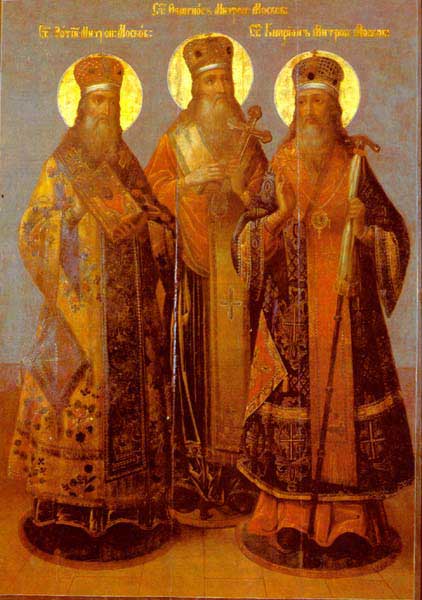
Photius is painted as a Greek hierarch of the late Byzantine type: dark, greying hair and a long tapering beard, the sakkos and the crossed omophorion and the white klobuk of a Russian metropolitan, blessing and holding the Gospel. He is seldom shown alone. Most often he stands in the ranks of the Hierarchs of Moscow, or in the particular grouping of the three Greek and South-Slav metropolitans of Kiev and All Rus' — Theognostus, Cyprian and Photius — which Russian iconography developed to honour the foreign hierarchs of the Muscovite period together. In the narrative cycles he appears twice: escaping the Tatars into the marshes of the Senega, and receiving the angel who foretold his death.
The stored image is a nineteenth-century Russian icon of the three metropolitans, inscribed above each figure; Photius stands on the left, in a jewelled sakkos and white klobuk, with Ст. Фотій Митроп. Москов. written beside his head, between Theognostus at the centre and Cyprian on the right.
A second stored image is the miniature from the Illuminated Chronicle (the Litsevoy letopisny svod, Moscow, later sixteenth century), whose caption reads "the tale of Photius, metropolitan of Kiev and All Rus', who saw an angel of the Lord showing him the end of his life": the metropolitan lies in his cell within the towers of Moscow while the winged angel in imperial dress stands over him and his attendant kneels below (source: Commons, public domain, pd-old-work).
Disputed questions
- Not to be confused with Photius the Great, Patriarch of Constantinople (c. 810–891, feast February 6), the scholar-hierarch of the Bibliotheca and the Mystagogy, whose name this metropolitan shares and with whom he is regularly confused in English writing — both being Greeks named Photius and both hierarchs of the first rank. They are separated by five centuries and by everything else: the patriarch never left the Byzantine world, while this Photius spent his whole episcopate in Rus'. See also Photius the Monk, a distinct saint again.
- His origins. The sources give Monemvasia and the elder Acacius; the year of his birth is not transmitted and is placed by convention in the 1370s.
- Photius and the Union. He died in 1431, seven years before Ferrara-Florence, and took no part in the union negotiations; his successor Isidore did, with consequences that ended the Greek line of metropolitans in Rus' altogether. Photius is therefore the last but one of the Greek metropolitans of Kiev, and the last remembered as a saint.