
Porphyrius the Actor
The Holy Martyr Porphyrius, of the Mimes
Martyr · d. 361
Commemorated 15 September
Porphyrius the Actor (†361) was a mime of the reign of Julian the Apostate who, performing at the celebrations of the emperor's birthday, was to mock the mystery of holy Baptism on stage. Immersing himself in the water, he pronounced the baptismal words in earnest — "The servant of God Porphyrius is baptised in the name of the Father, and of the Son, and of the Holy Spirit" — and rose from the water confessing himself a Christian before the whole theatre. Grace had made the jest true. Tortured on Julian's orders, he was beheaded; the Slavic tradition places his martyrdom at Ephesus. He is commemorated on September 15.
.jpg)
The synaxaria remember Porphyrius as one "of the mimes" (ὁ ἀπὸ Μίμων) — an actor of the popular comic stage, on which the mockery of Christian rites, and of baptism above all, was a stock entertainment of the pagan revival under Julian the Apostate (361–363). At the festivities for the emperor's birthday Porphyrius took the role of the catechumen in a burlesque of the sacrament. Entering the water, he spoke the baptismal formula over himself in full: "The servant of God, Porphyrius, is baptised in the name of the Father, and of the Son, and of the Holy Spirit." What was scripted as parody was answered from heaven: the grace of the sacrament came upon him in the water, and he emerged transformed, declaring before the audience that he was a Christian in truth and would die one. Julian ordered him tortured, and after the tortures he was beheaded, in the year 361. The Greek verses fix the paradox: "Bidden to make sport of Baptism, thou madest sport of error; thou art washed clean, O Porphyrius, and art cut down by the sword."
The account belongs to a small, cherished family of "converted actor" passions — with Gelasinus of Heliopolis, Ardalion, and the Porphyrius commemorated on November 4 — in which the mocker of the mysteries becomes their martyr mid-performance: the ancient Church's testimony that the sacraments are not play-acting, and that grace is free to seize even the scoffer.
Feast and commemoration
September 15 (church date; Old Calendar civil September 28), within the afterfeast of the Elevation of the Cross; a synaxarion commemoration without proper hymns, kept universally.
Hymns
Troparion — Tone 4 (from the common of a martyr)
Thy Martyr, O Lord, Porphyrius, in his contest received an incorruptible crown from Thee our God; for possessing Thy strength he cast down the tormentors and broke the feeble insolence of the demons: at his intercessions save our souls.
Original translation from the Greek
Iconography
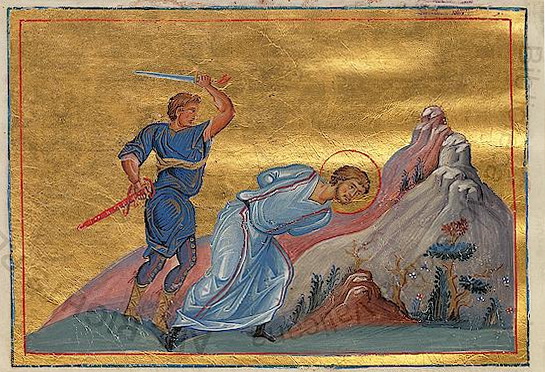
The Menologion of Basil II (c. 985) contains miniatures for both actor- martyrs named Porphyrius: for September 15 the martyr beheaded in a rocky landscape, bowed beneath the executioner's raised sword, and for November 4 a beheading before a domed building. The September miniature is stored here; its assignment was verified directly against the Vatican digitisation of the manuscript (Vat. gr. 1613, p. 41, under the heading "the contest of the holy martyr Porphyrius" among the September 15 notices). Reproductions of the November miniature (p. 159) circulate mislabelled as the September saint — including on the hosting platform — so the identification is recorded here explicitly.
Disputed questions
- Place of martyrdom. The OCA and the Russian calendar place the martyrdom at Ephesus ("Порфирий Ефесский"); the Greek synaxarion notice names no city, and the association of the story with Julian's birthday festivities has led some accounts to locate it where the court then was. Ephesus is recorded here as the received Slavic tradition.
- The two Porphyrii of the stage. The calendars keep a second actor- martyr Porphyrius on November 4, martyred under Aurelian (270–275) — at Caesarea in the received accounts — after an almost identical conversion in mid-parody of baptism. The OCA prints both and expressly distinguishes them; hagiographic scholarship has long suspected the two notices of being doublets of a single tradition, but the liturgical books commemorate two martyrs, and this collection follows the books. The November 4 saint is authored under a distinguishing slug as porphyrius-of-caesarea, where the doublet question is set out; note that the Greek Menaion keeps him but neither the OCA nor the Moscow Patriarchate calendar commemorates a Porphyrius on November 4. The confusion extends to the iconography: see below.
- Not to be confused with Porphyrius the martyr, companion of Onesiphorus (November 9) — the pair sometimes likewise surnamed "of Ephesus" — nor with the bishop Porphyrius of Gaza (February 26).