
Praxedes of Rome
The Holy Virgin Praxedes of Rome
Virgin · Righteous · d. traditionally c. 165, at Rome (the era is in fact unknown)
Commemorated 21 July — Commemoration of the virgin of Rome; deposition at the cemetery of Priscilla
Praxedes was a Christian woman of second-century Rome, honoured with her sister Pudentiana as one of the earliest of the Roman virgins: daughters, by the received tradition, of the senator Pudens of the Seventy in whose house the Apostle Peter had lodged. In the persecutions they spent their inheritance on the Christians, sheltered the hunted in their own house, ministered to the imprisoned, and gathered up and buried the bodies of the martyrs — the office from which comes the image that fixed Praxedes in Roman art, of a woman wringing out a sponge of the martyrs' blood into a well. The great basilica of Santa Prassede, rebuilt by Pope Paschal I in 817–824 over the site of the family house, keeps her name and her relics. The era of her death is unknown; the veneration is certainly ancient, going back to the fourth century.

The house of Pudens
The Roman tradition, as it is transmitted in the acta of Pudentiana and Praxedes and in the medieval guidebooks to the city, makes the two sisters daughters of the senator Pudens whom St Paul names in his last letter — "Eubulus greeteth thee, and Pudens, and Linus, and Claudia" (2 Tim. 4:21) — and who is counted in the East among the Seventy and commemorated on April 15. Their brothers are given as Novatus and Timothy. The family house on the Viminal, so the tradition runs, had received the Apostle Peter and had been one of the earliest places of the Christian assembly in Rome; it is the titulus Pudentis of the ancient Roman lists.
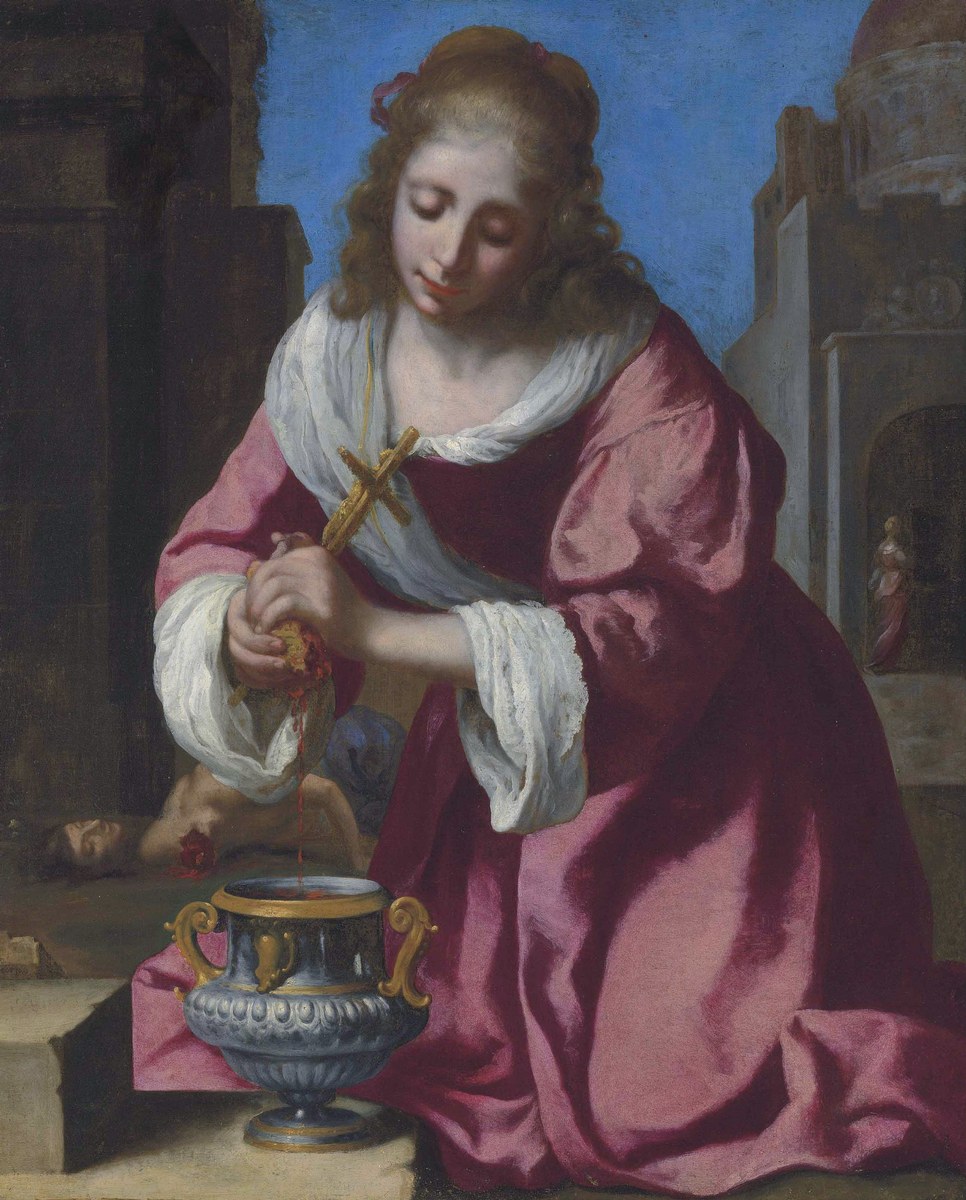
The sisters are described as unmarried and consecrated. When their father died they turned the whole inheritance to the service of the persecuted Church: they sold what they had and distributed it to the poor, they hid Christians in the house, they carried food and comfort to those in prison, and — the work most insisted upon — they took up the bodies of the martyrs and buried them, at a time when to be seen doing so was itself a capital matter. Praxedes is said to have gathered the blood of the slain with a sponge and poured it into a well within the house, so that it should rest in a holy place with the bodies. Whether or not the detail is historical, it is very old, and it is the reason the painters never show her without a sponge or a vessel.
Pudentiana died first, and Praxedes buried her beside their father in the cemetery of Priscilla on the Via Salaria. Praxedes lived on, sheltering Christians, until — by one strand of the tradition — a company of them was taken from her house and put to death, and she prayed to be released from a world in which she could no longer save anyone; she died soon after and was laid in the same cemetery. Another strand makes her herself a martyr. The acta give the year 165, the reign of Marcus Aurelius or of Antoninus Pius.
The basilica
Whatever the history, the cult is early and it is topographically anchored. A titulus Praxedis is attested at Rome from the late fourth or early fifth century, and its priests signed the Roman council of 499. About 817–824 Pope Paschal I rebuilt the church on a new site nearby — the present Santa Prassede, one of the most complete Carolingian monuments in Rome — and translated into it, from the catacombs then being emptied for fear of the Saracen raids, the relics of the two sisters together with the bones of some two thousand three hundred martyrs, an act recorded on a marble slab still in the church. The chapel of San Zenone which Paschal built there as a mausoleum for his mother Theodora is entirely lined with ninth-century mosaic; in it Praxedes and Pudentiana stand beside the Theotokos, and Theodora is shown with the square nimbus of the living.
Feast and commemoration
July 21 (church date; New Calendar civil July 21, Old Calendar civil August 3), the day kept for her in the Roman calendar and carried on that day in the Orthodox listings, shared with the Prophet Ezekiel and Symeon the Fool-for-Christ of Emesa. Her sister Pudentiana is kept on May 19. Praxedes is a Western pre-schism saint: the Greek synaxaria do not carry her, and her presence on Orthodox calendars comes by way of the Latin martyrologies and of Orthodox Western-rite usage.
Hymns
Apolytikion — Tone 4 (common of a holy woman)
The lamb of Christ, Praxedes, was found worthy to be numbered with the wise virgins; for she spent her substance upon the poor, and buried the bodies of the martyrs, and kept her lamp burning; wherefore, entering with the Bridegroom into the marriage feast, she prayeth for our souls.
Iconography
Praxedes is painted as a Roman matron or consecrated virgin: veiled, in a long tunic and mantle, the head covered — in the Roman mosaics in the gold-and-jewelled dress of a Byzantine court lady, since the ninth-century mosaicists of Paschal I dressed the female saints in the fashion of the eastern empire. Her constant attribute is the sponge, and with it a bowl, basin or well: she is shown squeezing the blood of the martyrs from the sponge into a vessel, and this is how the visitor to Santa Prassede is taught to recognise her. She frequently carries a crown offered to Christ or the Theotokos — again a mosaic convention rather than a martyr's palm — and she is almost never shown alone but paired with her sister Pudentiana, the two standing on either side of the Theotokos or of Christ.
The two great ninth-century mosaic ensembles of Santa Prassede — the apse and triumphal arch, and the chapel of San Zenone — are the classic images. In the East she has no developed iconography, and the Byzantine painters did not take her up.
No image has been stored for this collection. The candidates found on Wikimedia Commons are photographs of the Santa Prassede mosaics taken in situ: the underlying work is ninth-century and long out of copyright, but the available shots are wide, angled architectural views of the chapel vault in which the saint's own figure is small and her inscription illegible, so that identity cannot be verified from the image itself, and one otherwise good candidate has the lower register obscured by altar flowers. Both were rejected on those grounds rather than on licence grounds, and a clean frontal reproduction of the San Zenone panel remains wanted.
The stored image is a Western work per §34: the painting of Saint Praxedis wringing the martyr's blood from a sponge (1655), signed as an early Vermeer copy after Ficherelli — the attribution is debated, the subject is not. An Eastern image remains wanted and is listed among the upgrade-wanted icons.
Disputed questions
- Martyr or confessor? The Roman tradition is not consistent. Some notices call her a martyr; the Catholic Encyclopedia and the modern Roman calendar treat the sisters as martyrs "of an unknown era," which is a way of saying that neither the fact nor the date can be established. Because the death is nowhere described, this entry classes her among the virgins and the righteous rather than the martyrs, and records the alternative.
- The historicity of the family. The connection with the senator Pudens of 2 Timothy, and through him with the Apostle Peter, rests on the acta, which are late and legendary in form, and on the coincidence of the name of the titulus Pudentis. Historians generally hold that the churches came first and the family history was constructed to explain them — that "Pudentiana" was originally an adjective describing the ecclesia Pudentiana, the church of Pudens, and was afterwards read as a woman's name. Praxedes' own name, by contrast, appears independently in the ancient list of Roman tituli. The entry reports the tradition as tradition.
- The date of death. The traditional 165 has no independent support.
- Name-forms. She appears in the Orthodox calendar listings as Paxedes as well as Praxedes, and in Italian as Prassede.