
Reginos of Skopelos
The Holy Hieromartyr Reginos, Bishop of Skopelos
Hieromartyr · Bishop · b. late 3rd century, at Livadeia in Boeotia — d. 25 February 362, at Skopelos
Commemorated 25 February — Martyrdom under Julian the Apostate
Reginos (late 3rd century – 362) was Bishop of Skopelos, the island of the Northern Sporades in the Aegean, and a hieromartyr of the reign of Julian the Apostate. Born at Livadeia in Boeotia of Christian parents, he was a defender of the Nicene faith who, the tradition holds, distinguished himself at the Council of Sardica (343) by his skill in refuting the Arians, and was afterwards acclaimed bishop of Skopelos by its people. When the emperor Julian set out to restore paganism and turned against the confessors of Christ, Reginos was arrested and, on 25 February 362, beheaded — with, the synaxarion adds, some forty others. He is the patron saint of Skopelos, where a monastery bears his name and guards his relics, and where his feast is kept as the island's own holiday; a portion of his relics is venerated at the church of the Archangel Michael Trypiotis in Nicosia, Cyprus.

Origins and the defence of Orthodoxy
Reginos was born toward the end of the third century at Livadeia (Livadia), a town of Boeotia in central Greece, to Christian parents who raised him in the faith and in learning. He came to manhood in the years of the Church's great struggle against Arianism — the heresy that denied the full divinity of the Son — in the generation after the First Ecumenical Council of Nicaea (325). The tradition of the island he would serve remembers him as present at the Council of Sardica (modern Sofia) about the year 343, the great synod summoned by the emperors Constans and Constantius to vindicate the Nicene faith and the cause of Athanasius of Alexandria against the Arian party; there, it is said, the young Reginos distinguished himself among the fathers by the force and clarity with which he confuted the heretics. Whether he sat as a bishop already or was present in a lesser capacity the sources do not make plain, but the memory binds him from the first to the Nicene confession he would seal with his blood.
Bishop of Skopelos
On the repose of the bishop of Skopelos — one of the islands of the Northern Sporades, off the coast of Thessaly — Reginos was, the tradition relates, chosen and acclaimed by the whole people as their shepherd, and consecrated to the see. Of his episcopate the record is brief: he governed the island church in peace and taught his flock the Orthodox faith through the middle years of the fourth century, when the Arian controversy still troubled the East and the old paganism, though failing, had not yet died.
Martyrdom under Julian
The peace of the Church was broken by the accession of the emperor Julian, called by the Church the Apostate — Constantine's nephew, who had been reared a Christian and turned back to the worship of the old gods, and who in his brief reign (361–363) set himself to revive paganism and to strip the Church of its standing, dismissing Christians from office and stirring up their persecution. When the storm reached the islands, Reginos was seized for his open confession of Christ and his refusal to sacrifice to the idols. After imprisonment he was condemned, and on 25 February 362 was led out and beheaded; the synaxarion tradition remembers that he was not alone, but suffered together with some forty fellow-confessors. So the bishop who had withstood the Arians in the council-hall gave his life under the last of the pagan emperors, and Skopelos received a martyr for its patron.
Veneration and relics
Reginos has been from ancient times the patron saint of Skopelos. A monastery dedicated to him stands on the island and preserves his holy relics, to which the faithful of the Sporades resort in great numbers on his feast, and where healings and other miracles are attributed to his intercession; his name is a favourite among the island's children. A portion of his relics is kept and venerated far to the south, at the church of the Archangel Michael Trypiotis in Nicosia, Cyprus. His feast on February 25 is observed as a local holiday on Skopelos, where he is honoured as the island's founding hierarch and protector.
Feast and commemoration
Reginos is commemorated on 25 February (church date; Old Calendar civil March 10), the day of his martyrdom, together with Tarasius of Constantinople and the other saints of the day. The Greek Menaion styles him "the holy hieromartyr Reginos, bishop of Skopelos"; on Skopelos itself the day is kept as the patronal feast of the island. The Skopelos of which Reginos was bishop is the island of the Northern Sporades, and is not to be confused with the crag called Skopelos near Rhosus in Syria, the site of the ascetic labours of Theodosius of Antioch.
Hymns
Troparion — Tone 4
O God of our fathers, who ever dealest with us according to thy gentleness: take not thy mercy from us, but by the prayers of the Hieromartyr Reginos direct our lives in peace.
Original translation from the Greek
Iconography
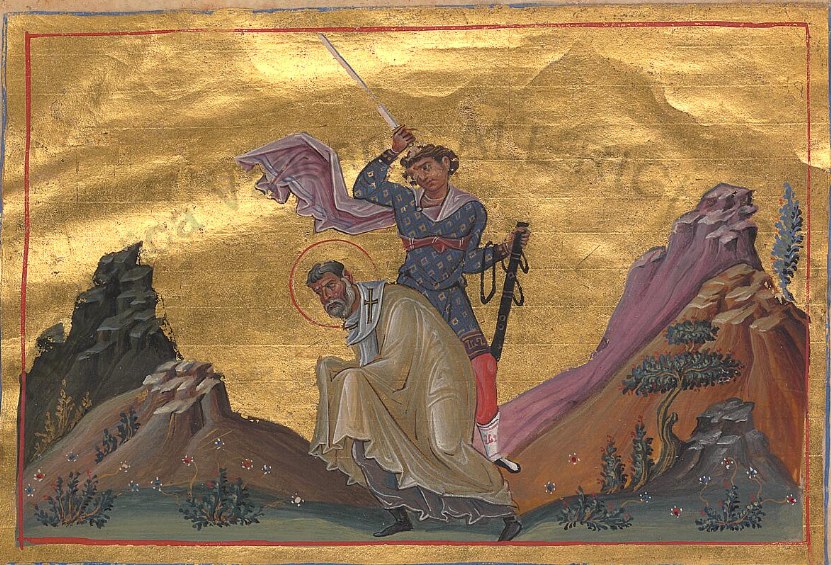
Reginos is depicted as a bishop-martyr: vested as a hierarch in the phelonion or polystavrion, the omophorion about his shoulders and the Gospel-book in his hand, and often bearing the cross of martyrdom or shown at the moment of his beheading. On Skopelos his portrait icon presides over the monastery that bears his name and is carried in procession on his feast.
The stored image is the miniature for February 25 from the Menologion of Basil II (Constantinople, c. 985; Vatican, Vat. gr. 1613), depicting the martyrdom of Reginos the bishop (source, public domain, pd-old-work).