
Theodosius of Antioch
Our Venerable Father Theodosius of Antioch
Venerable · b. mid-4th century — d. c. 412
Commemorated 11 January — Repose at his monastery near Rhosus
Theodosius of Antioch (mid-fourth century – c. 412) was a hermit and monastic founder of the Syrian coast, one of the ascetics whose lives Theodoret of Cyrrhus recorded from personal knowledge. Born of a wealthy and distinguished family of Antioch, he renounced the world in youth and settled in a solitary cell near Rhosus, on the Gulf of Issus, where he founded the monastery of Skopelos ("the crag"). He lived by the labour of his hands — tilling a garden, plaiting ropes — under a discipline of iron chains and a hair-shirt, and his renown for holiness spread so far among Christians and pagans alike that sailors in peril would cry out to "the God of Theodosius" and, it was said, the sea would grow calm at his name. Driven from Skopelos by the raids of the Isaurians, he founded a second monastery, Marathonium, and there reposed about the year 412. He is commemorated on January 11.

Theodosius is one of the ascetics of the region of Antioch whose lives were gathered by Theodoret, bishop of Cyrrhus (†c. 458), in his Religious History (the Philotheos Historia, or History of the Monks of Syria), a first-hand collection of the holy men of that country. From this near-contemporary source, supplemented by the synaxaria, the outline of his life is drawn.
He was born about the middle of the fourth century into a rich and honourable family of Antioch on the Orontes. Drawn early to the monastic life, he left his wealth and his kindred and withdrew to the region of Rhosus (modern Arsuz, on the coast near Iskenderun), settling in a small cell on the shore of the Gulf of Issus. There he founded and gathered a community, the monastery of Skopelos, "the crag," on a height above the sea. His ascetic discipline was severe: he bound himself with iron chains, wore a hair-shirt next to his skin, ate little, kept long vigils and countless prostrations, and would not spare his body. Yet he joined to this austerity the common labour of a Syrian monastery, working his garden and plaiting ropes with his own hands, and teaching his monks to live by their toil and their prayer together.
His holiness became widely known, to pagans as well as Christians. Theodoret records the great honour in which he was held along that coast, and the tradition of the sea: mariners caught in storm would call for help upon "the God of Theodosius," and at the mere invocation of his name the waves were said to be stilled — so that his intercession was sought by seafarers as a refuge in danger.
When the Isaurians — the fierce mountain people of the Taurus who repeatedly harried the coasts of Cilicia and Syria — overran the region, Theodosius and his monks were forced to abandon Skopelos. He withdrew inland and founded a second monastery, Marathonium, near a village called Maraton, where he continued the same rule of labour and prayer to the end of his long life. He reposed about the year 412 and is honoured among the fathers of the Syrian desert.
Feast and commemoration
Theodosius of Antioch is commemorated on January 11 (church date; Old Calendar civil January 24), within the afterfeast of the Theophany, together with the greater Theodosius the Cenobiarch and Theodosius, Metropolitan of Trebizond; the three saints of the name share the day and are distinguished by their epithets. This Theodosius is the fourth-to-fifth-century hermit of the Antiochene coast, a saint of the universal calendar known chiefly from Theodoret, not to be confused with the Cappadocian father of Palestinian cenobitic monasticism who leads the day, nor with Theodosius of the Kiev Caves (†1074, May 3), the father of cenobitic monasticism in Rus'.
Iconography
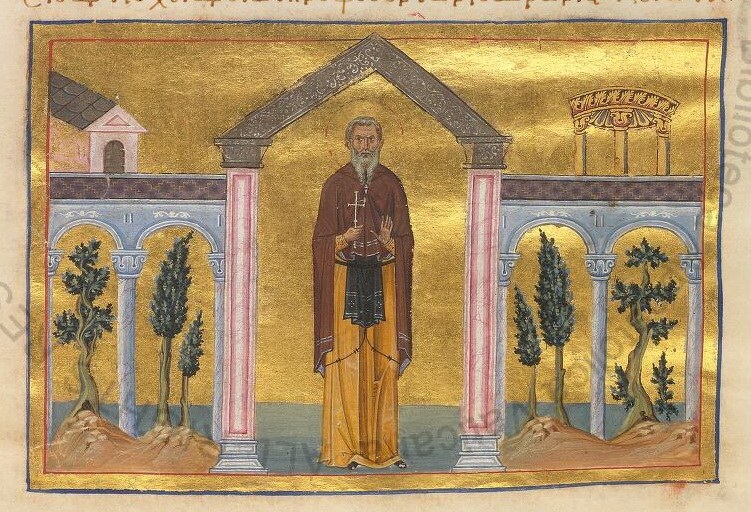
Theodosius of Antioch is depicted, where he appears, in the common manner of a Syrian desert father: an ascetic of advanced years, bearded, in the monastic habit, holding a scroll or making the sign of blessing. The stored image is the miniature of the Menologion of Basil II (Constantinople, 985) proper to him: the ascetic stands between the columns of a portico in the brown mantle of the desert, holding the cross of his profession. (The manuscript gives January 11 two miniatures, one for each Theodosius; the Cenobiarch's own — an orans figure beneath a round arch — is a distinct image, and the earlier note here that the day's miniature belonged only to the Cenobiarch was written before the second folio was found.) His memory is bound in particular to the sea, and to the sailors who invoked the God of Theodosius in the storm.