
Roman of Ryazan
The Holy Martyr Roman Olegovich, Prince of Ryazan
Martyr · Prince · b. c. 1237 — d. 19 July 1270, in the camp of the Golden Horde
Commemorated 10 June — Synaxis of the Saints of Ryazan, 19 July — Martyrdom in the Horde under Khan Mengu-Timur
Roman Olegovich, prince of Ryazan (c. 1237 – 19 July 1270), was the grandson of princes who died fighting Batu, and the last of his house to die at Tatar hands. Denounced to the khan Mengu-Timur by the baskaki, the tax-farmers of the Horde, on the charge of speaking against the khan and blaspheming the Tatar religion, he was summoned to the camp and offered the choice between apostasy and death. He answered by preaching Christ to his judges, and was put to death by a dismemberment carried out limb by limb while he was still able to speak, his tongue cut out, his eyes put out, and his head at last set on a spear. The Russian Church honours him as a martyr — not merely a passion-bearer — because the demand made of him was explicitly a demand to change his faith.

The house of Ryazan under the Horde
Roman was born about 1237, the year the Mongol armies of Batu fell upon the Ryazan land and destroyed it. The chronicles of the principality are, for the next generation, a record of survival on terms: tribute, hostages, journeys to the Horde for the yarlyk that confirmed a prince in his own inheritance, and the constant presence of the baskaki, the khan's tax-farmers, who collected the tribute of the Russian lands and were hated in proportion. Both of Roman's grandfathers, in the tradition preserved at Ryazan, perished in the struggle against Batu; his father was Oleg Ingvarevich the Red, who was carried off captive in the sack and held for many years before being released to rule what was left.
Roman succeeded his father about 1258 and governed for some twelve years. The notices that survive give him the character of a prince who defended his people against the extortions of the collectors — which is precisely the conduct that made him dangerous. The baskaki of the Ryazan land, the account says, hated him, and laid a charge against him at the Horde: that he had spoken contemptuously of the khan and had blasphemed the faith of the Tatars.
The summons and the choice
Under the Mongol settlement the Russian principalities kept their religion; the Horde was notably indifferent to Christianity as such, and the Church was exempted from tribute. Blasphemy against the Mongol religion, however, was an offence of a different order, and the charge was framed to make it one. Roman was summoned to the camp of Khan Mengu-Timur (ruled 1266–1280) and put to the question.
He denied the slander against the khan. He would not deny his faith. Set before the plain alternative — the Tatar religion or a martyr's death — he chose the second, and used what time he had to preach: the accounts have him confessing the truth of Christianity and the emptiness of what was offered him, to his judges' face and in the hearing of the camp.
The martyrdom
The execution was deliberately prolonged, and the chronicle records it in detail because the detail was the point. His tongue was cut out to stop the preaching. His eyes were put out; his ears and lips were cut away. His hands and feet were severed joint by joint, so that the dismemberment was extended as long as life lasted. The skin was flayed from his head. What remained was beheaded, and the head was set upon a spear and displayed. It was 19 July 1270.
The manner of it is the reason the Russian tradition never hesitated over his classification. A prince killed in war, or murdered in a dynastic quarrel and dying without resistance, is a passion-bearer; Roman was offered his life in exchange for his religion and refused it, and is therefore a martyr in the strict and ancient sense — the last, and one of the very few, in the Russian lands to die on that precise issue under the Horde, alongside Michael of Chernigov and his boyar Theodore, who had suffered on a comparable demand in 1246.
Veneration
His memory was kept locally at Ryazan from the first, and the Ryazan chronicles preserved the account of his passion. The formal expressions of the cult are, as often with local Russian saints, much later than the veneration itself: a cross-procession in his honour was established at Ryazan in 1854, and a church dedicated to him was consecrated there in 1861. He is numbered among the Saints of Ryazan, whose synaxis is kept on June 10, and appears in the general Russian calendars for July 19.
Feast and commemoration
July 19 (church date; Old Calendar civil August 1) — the day of his martyrdom, kept by the Russian Church, by the Ukrainian Church and by the Orthodox Church in America. He is also commemorated in the Synaxis of the Saints of Ryazan on June 10. He is not carried by the Greek or Antiochian calendars, and does not appear in the Synaxarion of Constantinople; the commemoration is Russian and local in origin, though it stands in the general menologia now. On the same day the Russian calendars keep the uncovering of the relics of Seraphim of Sarov (1903), which in practice overshadows him.
Hymns
Troparion — Tone 4 (common of a martyr)
Thy martyr Roman, O Lord, in his contest received from Thee our God an incorruptible crown; for having Thy strength, he cast down the tyrants and shattered the feeble insolence of the demons. By his intercessions save our souls.
Original translation from the Slavonic
Kontakion — Tone 2
Offered the choice of thy faith or thy life, thou didst count thy life the lesser thing, O right-believing Roman; and when they took away thy tongue thou didst confess with thy blood what thou couldst no longer speak. Wherefore, O martyr-prince, entreat Christ God for the land that bore thee.
Original translation from the Slavonic
Iconography
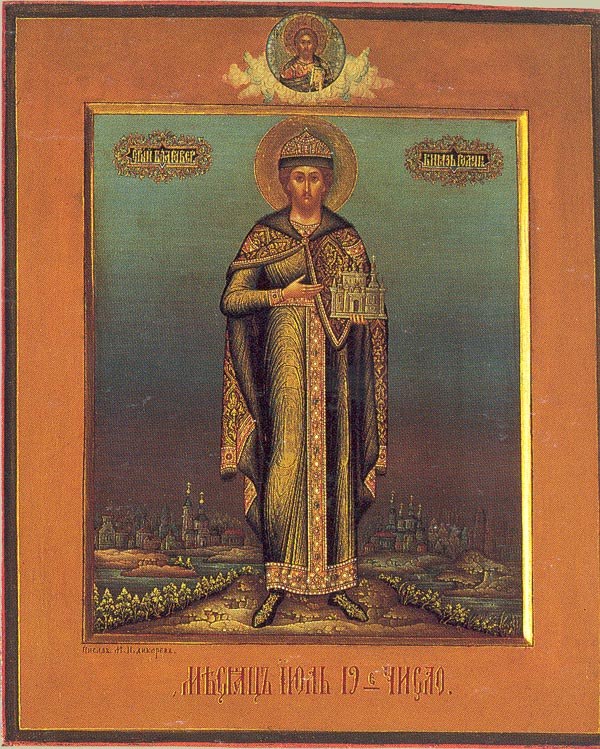
Roman is written as a martyred prince in the Russian manner: a young man with a short dark beard, in the princely kaftan and fur-trimmed mantle over a long belted robe, wearing the princely cap, and holding the martyr's cross in his right hand — the cross, not the sword, being the sign that distinguishes the martyr-prince from the warrior-prince. A church or a walled city held in the left hand identifies him as the ruler of Ryazan. His passion is sometimes shown in the border scenes: the trial before the khan in the Horde camp, the severing of the limbs, and the head upon the spear.
Nineteenth-century Ryazan produced icons of him for the church consecrated in 1861 and for the cross-processions instituted in 1854, and he appears in the composite icons of the Saints of Ryazan. The stored image is of exactly that revival: the menaion icon of Mikhail Dikarev (State Hermitage), the faithful prince full-length in the fur-trimmed mantle with a church in his hands, the Slavonic date-line "month of July, the 19th day" — his feast — along the lower border, and the painter's signature at the left edge.
Disputed questions
- His birth year and parentage. "About 1237" and the descent from Oleg Ingvarevich the Red rest on the Ryazan genealogies, which for this generation are thin and in places contradictory; the statement in the received life that both his grandfathers fell in the war with Batu is traditional and cannot be independently verified from the chronicles.
- The charge. Whether the accusation of blaspheming the Mongol religion was a fabrication of the baskaki, as the Russian sources uniformly present it, or reflected something Roman actually said, is beyond recovery. What is not in doubt is the form the trial took, which is what determines his status as a martyr.
- The details of the execution. The catalogue of mutilations is transmitted with remarkable consistency, but it also conforms closely to the pattern of such accounts in the chronicles, and a reader should hold the sequence more lightly than the fact.