
Rostislav-Michael of Kiev
The Holy Right-believing Grand Prince Rostislav-Michael Mstislavich of Kiev
Prince · b. c. 1110 — d. 14 March 1167, at Zarub near Smolensk
Commemorated 14 March — Repose of the Grand Prince
Rostislav Mstislavich (c. 1110 – 1167), called Michael in holy baptism, was Prince of Smolensk and thrice Grand Prince of Kiev, a grandson of Vladimir Monomakh and one of the most respected rulers of the divided Rus' of the twelfth century. Founder of the enduring line of the princes of Smolensk, he raised that city to greatness, established its bishopric, and adorned it with churches; as Grand Prince he laboured to keep peace among the quarrelling princes and to uphold the order of the Church, defending the rights of the metropolitan see of Kiev. Devout from his youth and longing in his last years for the monastic life, he died on his way home from Novgorod, receiving the news of his end with joy and prayer. He is venerated among the right-believing princes of Rus' and kept on March 14.
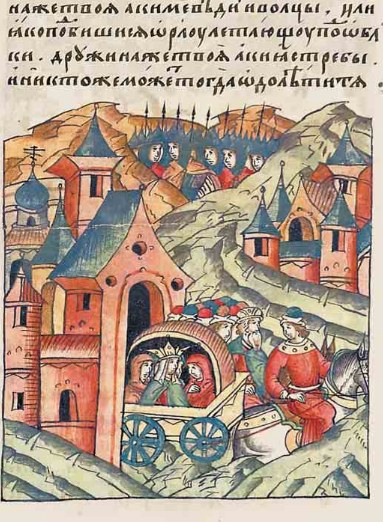

Rostislav was a son of the Grand Prince Mstislav I "the Great" of Kiev — the eldest son of Vladimir Monomakh — and thus of the senior line of the house of Rurik; his mother was Christina, daughter of the king of Sweden. Given in baptism the name Michael, he received in about 1125, on his father's accession to Kiev, the principality of Smolensk, which he was to hold for some thirty-five years and to make the foundation of a lasting dynasty, the Rostislavichi of Smolensk.
Prince of Smolensk
Rostislav's long rule at Smolensk was remembered as the making of the city. He governed it with justice and care, extended and ordered its lands, and in 1136 obtained the erection of a separate bishopric of Smolensk, endowing the new see with lands and revenues by a charter that is among the earliest documents of its kind in Rus'; he built and adorned churches, chief among them the cathedral of the Dormition, and made Smolensk a centre of Christian order and learning. His piety, his fidelity to the Church, and his skill in the endless arbitration of princely quarrels won him a moral authority beyond his own territory, so that he was repeatedly drawn into the affairs of Novgorod and of Kiev itself.
Grand Prince of Kiev
In the ceaseless contention for the throne of Kiev among the descendants of Monomakh and of Oleg, Rostislav held the grand-princely dignity three times. He first took Kiev briefly in 1154, was driven out, and returned to Smolensk; he held it again from 1159 to 1161; and from 1161 until his death in 1167 he reigned as Grand Prince with a stability and a respect that the office had seldom known in that age. He is remembered less for conquest than for his effort to reconcile the warring princes and to be a father among them, and for his staunch defence of the Church's order — in particular of the authority of the metropolitan of Kiev sent from Constantinople, in the disputes over the metropolitan see that troubled the Rus' Church in his reign, where Rostislav stood for canonical order against faction.
Piety and repose
The chroniclers dwell on his personal devotion. He kept the fasts strictly, loved the company of monks and clergy, and in his last years conceived an earnest desire to lay down his throne and receive the monastic tonsure — a wish his spiritual father, the abbot Polycarp of the Kiev Caves, counselled him rather to fulfil by a ruler's justice and mercy while God still gave him his charge. Returning from Novgorod, where he had gone to settle the affairs of that city and to place his son there, he fell ill on the road and, knowing his end was near, made his confession and received the Holy Mysteries; and, it is said, taking the words of the Psalter upon his lips and gazing on an icon, he gave up his soul with a prayer of thanksgiving. He died on 14 March 1167 at Zarub, near Smolensk, and was carried to Kiev and buried in the church of the Monastery of Saint Theodore, the burial-place of his line.
Feast and commemoration
Rostislav-Michael is commemorated on March 14 (church date; Old Calendar civil March 27), the day of his repose, among the right-believing princes of Rus'; his veneration is kept in the Russian Church and by the Orthodox Church in America. March 14 commonly falls within Great Lent; on a Lenten weekday the full Liturgy is not served, so no fixed Epistle and Gospel are appointed and the readings follow the Lenten cycle. He is not to be confused with the several other princely saints of Rus' — among them Michael of Chernigov the passion-bearer and the first metropolitan Michael of Kiev, with whom his baptismal name Michael might cause confusion, and the various other bearers of the name Rostislav in the princely genealogies.
Hymns
Troparion — Tone 4
Having lived devoutly in thy royal state, and preserved unshaken the true faith of Christ, thou didst rule thy people in justice and mercy, O right-believing prince Rostislav; and setting thy heart upon the monastic calm, thou didst pass in prayer to thy Lord. Entreat him that our souls may be saved.
Original translation from the Slavonic
Iconography
Rostislav is depicted in the type of the right-believing prince: a bearded ruler in princely robes and fur-trimmed cap or crown, a cloak over the shoulders, holding a church in his hands (for his founding and adorning of churches) or a cross and a scroll, sometimes shown in the monastic habit he longed for at the last. The stored image is a miniature of the Illustrated Chronicle of Ivan the Terrible (1560s–1570s): the prince and his retinue borne in the wagon from the city, the Slavonic chronicle text naming the event above the frame — identity by the chronicle's own narrative, on the same basis as the Theognostus miniature.
Disputed questions
- Not to be confused with Rostislav of Moravia (Rastislav, †c. 870, feast May 11), the prince of Great Moravia who summoned Cyril and Methodius from Constantinople and was blinded by the Franks. The two share only a name: this Rostislav is a Rurikid of twelfth-century Kiev, that one a ninth-century Moravian glorified in 1994.