
Sergius of Shukhtom
Our Venerable Father Sergius, Schema-monk of Shukhtom, Wonderworker
Venerable · Wonderworker · b. c. 1530, at Kazan — d. 19 May 1609, at the Shukhtom monastery near Cherepovets
Commemorated 19 May — Repose at the Shukhtom monastery
Sergius of Shukhtom (c. 1530 – 19 May 1609) was a schema-monk of the Vologda north whose long life divided into two halves: some fifty years of ascetic wandering and pilgrimage, in the course of which he worshipped at the holy places of Palestine, Constantinople and Greece and at Solovki in the White Sea, and six last years of stability in the little monastery of Shukhtom near Cherepovets, where he was tonsured in 1603 by Archimandrite Isaiah and given the name Sergius. His asceticism was of the severest northern kind — perpetual fasting, and sleep taken only sitting up — and the tradition credits him with unceasing prayer, clairvoyance and the working of miracles. He died at seventy-nine and was buried beneath the floor of the monastery church, which after the monastery's suppression became the parish church of the Protection of the Mother of God; his shrine remained there, and he is honoured among the saints of the Vologda land.
_%E2%80%94_%D1%81%D1%85%D0%B8%D0%BC%D0%BE%D0%BD%D0%B0%D1%85,_%D0%BF%D1%80%D0%B5%D0%BF%D0%BE%D0%B4%D0%BE%D0%B1%D0%BD%D1%8B%D0%B9_%D0%A0%D1%83%D1%81%D1%81%D0%BA%D0%BE%D0%B9_%D0%BF%D1%80%D0%B0%D0%B2%D0%BE%D1%81%D0%BB%D0%B0%D0%B2%D0%BD%D0%BE%D0%B9_%D1%86%D0%B5%D1%80%D0%BA%D0%B2%D0%B8.jpg)
Kazan, and fifty years on the road
He was born about 1530 at Kazan and was called Stephen in the world. Nothing else of his origins is transmitted — not his family, nor whether he was of the Russian population of the city or a convert from among its Tatar inhabitants, a question the notices do not raise.
What they do transmit is that his ascetic life began early and that for the greater part of it he had no house. He is said to have spent three years on a single continuous pilgrimage, worshipping at the holy places of Palestine, at Constantinople and in Greece — which for a Russian ascetic of that century means Athos — and, at the other end of the Orthodox world, at the Solovki monastery in the White Sea. The combination is worth noticing: it is the itinerary of a man who took the whole of Orthodox geography as his monastery, and the Russian Lives of the sixteenth century know a small class of such pilgrim-ascetics, canonically irregular and popularly revered.
Shukhtom
In 1603 — an old man of some seventy-three years — he came to the Resurrection monastery at Cherepovets in the Vologda country and was there tonsured by Archimandrite Isaiah, receiving the name Sergius. He then settled in the small house of Shukhtom (also written Shukhtov), about fifty kilometres from Cherepovets on the river Shukhtomka, and lived there for the remainder of his life in the great schema.
The ascetic detail preserved of these years is spare and exact: he fasted continually, and he never lay down to sleep, taking what rest he took seated. Upon this discipline, the tradition says, three gifts followed — prayer that did not cease, the discernment of what was hidden in men and at a distance, and the working of miracles. These are the standard three, but they are the standard three because they are what the Russian north expected to see in such a man, and his neighbours evidently saw them: his local veneration began at once and did not depend on any formal act.
Repose and shrine
He died on 19 May 1609, aged seventy-nine, in the middle of the Time of Troubles, when Polish and Cossack bands were moving through exactly this country. He was buried beneath the floor of the monastery church. The Shukhtom house did not survive as a monastery; its church became the Protection (Pokrov) parish church, and the saint's grave remained under it, a place of local pilgrimage in the Cherepovets district. It is from this neighbourhood — the Protection church at Dolgopolovo — that the surviving icon of him comes.
Feast and commemoration
May 19 (church date; Old Calendar civil June 1) — the day of his repose — in Russian and OCA usage. He is a local saint of the Vologda and Novgorod north, named in the synaxis of the saints of Vologda; his cultus is centred on the Cherepovets district and on the Protection church that grew out of his monastery. No proper service has been located: he is sung with the common of a venerable father. The day always falls within the Pentecostarion, whose movable hymns take precedence over the fixed commemoration.
Hymns
Troparion — Tone 8 (common of a venerable father)
In thee, O Father, that which was made after the image of God was preserved unimpaired; for taking up the Cross thou didst follow Christ, and by thy deeds thou hast taught us to despise the flesh, which passeth away, and to care for the soul, which is immortal. Wherefore, O venerable Sergius, thy spirit rejoiceth with the angels.
Original translation from the Slavonic
Iconography
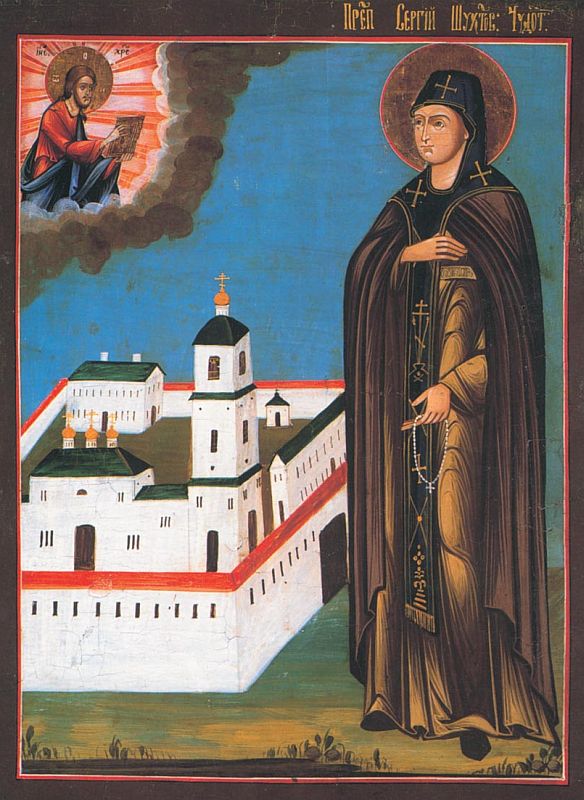
Sergius is painted as a schema-monk: standing, thin and long-faced, the great schema worn over the habit with its crosses, the analavos falling in front, the head covered by the pointed koukoulion marked with the cross, a prayer-rope in the lowered hand and the other hand at the breast. Because he was neither a founder nor a hierarch, his iconography carries no model of a church in his hands; instead the monastery in which he died is set beside him in the landscape, which is the northern Russian way of naming a saint by his place.
The stored image is a Russian icon of the late eighteenth or early nineteenth century, from the Protection church at Dolgopolovo in the Cherepovets district and now in the Cherepovets Museum Association. It shows him full-length on the right in the black mantle and grey-brown habit, the schema with its red crosses on his breast, the koukoulion on his head and a prayer-rope in his hand; the walled monastery with its white church and green cupolas stands at the left; and Christ blesses from a cloud in the upper corner with a book open in His hand. The inscription across the top reads Прп. Сергій Шухтом. Чудот. — "Venerable Sergius of Shukhtom, Wonderworker" — which confirms the identification. The panel is pre-1900 and therefore out of copyright; the Commons file's CC BY-SA tag applies only to the photograph of a flat work and creates no rights in the icon.
Disputed questions
- Fifty years a monk, but tonsured in 1603? The OCA notice says both that he died "after fifty years of monastic practice" and that he was tonsured at Cherepovets in 1603, six years before his death. The two statements are reconciled if the fifty years describe his ascetic life in the broad sense — the wandering, the pilgrimages, perhaps a first tonsure elsewhere — and 1603 the date of his reception into the great schema at Cherepovets. The corpus records the tension rather than smoothing it away.
- Shukhtom or Shukhtov — both forms are used of the monastery and of the saint; the river is the Shukhtomka, and the adjectival forms Шухтомский and Шухтовский are both current in Russian, including on the surviving icon.
- Not to be confused with Sergius of Radonezh (September 25), whose name he bears, nor with the several other Vologda and Belozersk Sergii; nor with Euphrosynus of Sinozersky (March 20), a hermit of the same district killed by marauders in 1612, three years after this Sergius died — the two are near neighbours in place, time and type, and are easily transposed.