
Seven Maccabee Martyrs
The Holy Seven Maccabee Martyrs, their Mother Solomonia and their Teacher Eleazar
Martyr · Child Martyr · d. 166 BC
Commemorated 1 August — Martyrdom under Antiochus IV Epiphanes
The seven Maccabee brothers, their mother Solomonia and their aged teacher Eleazar are the Church's Old Testament martyrs: Jews of Judaea who in 166 BC, under the Syrian king Antiochus IV Epiphanes, refused to eat the flesh of swine and to renounce the Law of their fathers, and were tortured to death one after another in their mother's sight — she encouraging each in turn and dying last of all. Their passion is told in 2 Maccabees 6–7, where the fourth brother's answer to the tyrant — that he looked to be raised up again by God — is among the clearest confessions of the resurrection of the body in the Old Testament, and the mother's charge to her youngest, to look upon heaven and earth and know that God made them out of nothing, is the classical scriptural warrant for creation ex nihilo. Venerated at Antioch from an early date, praised by Chrysostom, Gregory the Theologian, Ambrose and Augustine, they are hymned as "martyrs before the martyrs."

The persecution of Antiochus Epiphanes
Antiochus IV, called Epiphanes ("God manifest"), king of the Seleucid empire from 175 BC, ruled a Judaea he had inherited as a province and treated as a problem of policy. A Hellenising party in Jerusalem itself had bid for his favour, and after a campaign in Egypt turned back by Rome, the king answered a disturbance in the city with a deliberate programme to abolish the religion of the Jews. In 167 BC he plundered and profaned the Temple, set upon its altar what the Book of Daniel names the abomination of desolation — by the received account an altar and image of Olympian Zeus, before which swine were sacrificed — and by edict forbade the Sabbath, the feasts, circumcision, and the possession of the books of the Law, on pain of death. Officers were sent through the towns to compel the people, village by village, to sacrifice and to eat of the flesh offered. It was not a persecution of individuals for private belief but an attempt to extinguish a people's whole manner of life, and it is the first such attempt of which any full account survives.
The test the officers used was deliberately simple and deliberately public: eat the swine's flesh. To eat was to declare in the sight of one's neighbours that the Law had ceased to bind; to refuse was to die. It is this test, and not any question of doctrine, that produced the martyrs of August 1.
Eleazar the scribe
The first of them was Eleazar, one of the principal scribes, "a man already well stricken in years and of a noble countenance," ninety years old. Brought forward and forced to open his mouth to receive the flesh, he spat it out and went of his own accord to the place of torment. The account preserves what is most remarkable about him. Those in charge of the sacrifice, who had known him a long time, took him aside and offered him a way out: he should bring meat of his own that he was permitted to eat, and only appear to eat what the king commanded — the deceit would save his life and cost him nothing. Eleazar refused the compromise, and gave the reason: at ninety, it did not become him to dissemble, "lest many young persons should suppose that Eleazar in his ninetieth year had gone over to a strange religion, and so through my hypocrisy, for a little time and a moment longer of life, they should be led astray by me, and I should get a defilement and a blot upon mine old age." He would leave a noble example to the young of how to die willingly and courageously for the venerable and holy laws. Under the blows he groaned aloud and said that the Lord, who has holy knowledge, knew that he might have escaped death, and that in his body he suffered grievous pains for fear of him but in his soul was glad to bear them. So he died, and the Church remembers him as the teacher of the seven, which is the sense the synaxaria give to his place in the story: the master went first, and the disciples followed the lesson.
The seven brothers and their mother
After him seven brothers were arrested with their mother and brought before the king, who had them scourged with whips and thongs to compel them to eat. The eldest spoke for all: "What wouldest thou ask or learn of us? We are ready to die rather than transgress the laws of our fathers." Antiochus, in a rage, ordered pans and cauldrons to be heated; and when they were hot, the tongue of the eldest was cut out, the skin of his head drawn off, and his hands and feet struck off, in the sight of his brothers and his mother, and what was left of him was set on the fire in the pan, alive. The brothers and the mother exhorted one another to die nobly, saying, "The Lord God looketh upon us, and in truth hath comfort in us."
The second was dealt with in the same way, and said to the king with his last breath: "Thou, like a fury, takest us out of this present life, but the King of the world shall raise us up, who have died for his laws, unto everlasting life." The third put out his tongue and stretched out his hands when they were demanded, saying that he had received them from Heaven and for the sake of God's laws despised them, and looked to receive them of him again. The fourth, at the point of death, spoke the sentence that the Fathers never tired of quoting: "It is good, being put to death by men, to look for hope from God to be raised up again by him; but as for thee, thou shalt have no resurrection to life." The fifth told the king that he had power among men and did what he would, but should not think that God had forsaken the nation. The sixth warned him not to think he would go unpunished for having fought against God.
The mother is the centre of the account, and the reason the Church honours her with her sons rather than beside them. She saw seven sons die in one day, and — the text insists — bore it "with good courage, because of the hope that she had in the Lord." She encouraged each of them in the language of her fathers, filled with a noble spirit and "stirring up her womanish thoughts with a manly stomach." To the last and youngest, when Antiochus, out of patience, promised the boy riches, friendship and office if he would only turn from the laws of his fathers, and then called upon the mother herself to counsel her son to save himself, she bent over him and, mocking the tyrant in a tongue he could not understand, said: "O my son, have pity upon me that bare thee nine months in my womb and gave thee suck three years and nourished thee and brought thee up. I beseech thee, my son, look upon the heaven and the earth, and all that is therein, and consider that God made them of things that were not; and so was mankind made likewise. Fear not this tormentor, but, being worthy of thy brethren, take thy death, that I may receive thee again in mercy with thy brethren." The boy, before she had finished, cried out that he would not obey the king's commandment but the commandment of the Law given to their fathers by Moses; he called down judgment on the king and offered his own body and life for the laws of his fathers, praying that in him and his brothers the wrath of the Almighty against the nation might cease. Antiochus, handled worse than by any of the others, put him to death with peculiar cruelty. Last of all, after her sons, the mother died.
Their example, the book says, roused the nation: the revolt of Judas Maccabeus followed, the Temple was cleansed and rededicated, and the memory of the martyrs stood at the head of the deliverance. The synaxaria date the passion to 166 BC.
The shrine at Antioch
The veneration of these martyrs is bound up with Antioch, and this is the principal point at which their cult touches the tradition of this collection. The Antiochene Church kept their relics in a shrine in the quarter called the Kerateion, in the southern part of the city, and both the antiquity of the shrine and the character of the quarter — which held a large Jewish population — gave rise to the ancient and persistent belief that the martyrium had once been a synagogue, taken over or shared, in which the Jews of Antioch had venerated the tomb of the Maccabean martyrs before the Christians came to venerate it in the same place. Whether the burial itself was at Antioch is another matter (see Disputed questions): the shrine, not the grave, is what the evidence establishes.
From that shrine the cult radiated. John Chrysostom, preaching at Antioch in the 380s, delivered homilies on the Maccabees for their feast and used them constantly elsewhere; Gregory the Theologian devoted his fifteenth oration to them; Ambrose retold their passion in his treatise on Jacob, and Augustine preached on them at Hippo. That so many of the greatest preachers of the fourth and fifth centuries took the same subject in the same generation is a measure of how firmly the feast had established itself East and West by then. The martyrs were also commemorated at Rome, in the basilica of St Peter in Chains (San Pietro in Vincoli), which claimed their relics and whose own dedication feast falls on the same August 1 — a coincidence of date with the Roman Veneration of the Chains of Peter (kept in the East on January 16) that has caused endless confusion in western calendars.
Martyrs before Christ
The Fathers who preached on them were conscious that these saints raised a question no other martyrs raised: how can those who died before the Incarnation, for a Law that Christ came to fulfil, be honoured as martyrs of Christ? The answer given, in various forms by Gregory the Theologian, Chrysostom and Augustine, is that they died for the Law which is Christ's own, given by him through Moses; that the grace which crowned the martyrs of the persecutions was not withheld from those who suffered for the same God before he was made man; and that their witness — enduring torments for God with an explicit hope of the resurrection — is materially the same act as that of the martyrs of Diocletian. Gregory argues that they should be honoured by all, and reproaches those who thought them beneath Christian veneration because they suffered before the Cross. The hymnography of the day puts the same thought more compactly, calling them "greatest martyrs before the martyrs" — first in time, and not least in rank.
Two texts of theirs entered the permanent theological vocabulary of the Church. The fourth brother's "raised up again by him" (2 Macc. 7:14) is quoted as a witness that the resurrection of the body was believed in Israel before Christ; and the mother's "God made them of things that were not" (7:28) became the standard proof-text of creation out of nothing in the Greek and Latin Fathers alike. The Epistle appointed for their feast, Hebrews 11:33–12:2, is itself a description of them: "others were tortured, not accepting deliverance, that they might obtain a better resurrection."
Feast and commemoration
August 1 (church date; New Calendar civil August 1, Old Calendar civil August 14), kept universally in the Byzantine rite, and until the reform of 1969 in the Roman calendar also. The commemoration is joined to the Procession of the Precious Cross, the principal observance of the day, and to the opening of the Dormition Fast — a conjunction the service itself exploits, setting the beginning of the Church's fourteen-day fast beside the martyrs who died rather than break the fasting laws of their fathers. Uniquely among the saints of the fixed year, the Maccabees are commemorated with their whole household in one office: the seven sons, the mother, and the teacher share a single service, a single troparion and a single kontakion, and no member has a separate feast.
Their veneration is oldest and warmest at Antioch, where the shrine in the Kerateion was a fixture of the city's religious life and their feast the occasion of Chrysostom's homilies; the Antiochian tradition accordingly keeps them with particular honour. In Greek usage the day's service gives them the canon and the stichera; in Slavonic usage the service is shared with the propers of the Cross and, in Russia, with those of the All-Merciful Saviour.
Hymns
Apolytikion — Tone 4 (common of martyrs)
Be entreated, O Lord, by the sufferings which thy saints endured for thy sake, and heal thou all our pains, we beseech thee, O Lover of mankind.
Kontakion — Tone 2
O seven pillars of the Wisdom of God, O seven-branched lampstands of the light divine, all-wise Maccabees, greatest of martyrs before the martyrs: together with them entreat the God of all, that they may be saved who sing your praise.
Original translation from the Greek
Appointed readings
Epistle — Hebrews 11:33–12:2
33Who through faith subdued kingdoms, wrought righteousness, obtained promises, stopped the mouths of lions, 34Quenched the violence of fire, escaped the edge of the sword, out of weakness were made strong, waxed valiant in fight, turned to flight the armies of the aliens. 35Women received their dead raised to life again: and others were tortured, not accepting deliverance; that they might obtain a better resurrection: 36And others had trial of cruel mockings and scourgings, yea, moreover of bonds and imprisonment: 37They were stoned, they were sawn asunder, were tempted, were slain with the sword: they wandered about in sheepskins and goatskins; being destitute, afflicted, tormented; 38(Of whom the world was not worthy:) they wandered in deserts, and in mountains, and in dens and caves of the earth. 39And these all, having obtained a good report through faith, received not the promise: 40God having provided some better thing for us, that they without us should not be made perfect. 1Wherefore seeing we also are compassed about with so great a cloud of witnesses, let us lay aside every weight, and the sin which doth so easily beset us, and let us run with patience the race that is set before us, 2Looking unto Jesus the author and finisher of our faith; who for the joy that was set before him endured the cross, despising the shame, and is set down at the right hand of the throne of God.
Gospel — Matthew 10:32–36; 11:1
32Whosoever therefore shall confess me before men, him will I confess also before my Father which is in heaven. 33But whosoever shall deny me before men, him will I also deny before my Father which is in heaven. 34Think not that I am come to send peace on earth: I came not to send peace, but a sword. 35For I am come to set a man at variance against his father, and the daughter against her mother, and the daughter in law against her mother in law. 36And a man’s foes shall be they of his own household. 1And it came to pass, when Jesus had made an end of commanding his twelve disciples, he departed thence to teach and to preach in their cities.
Iconography
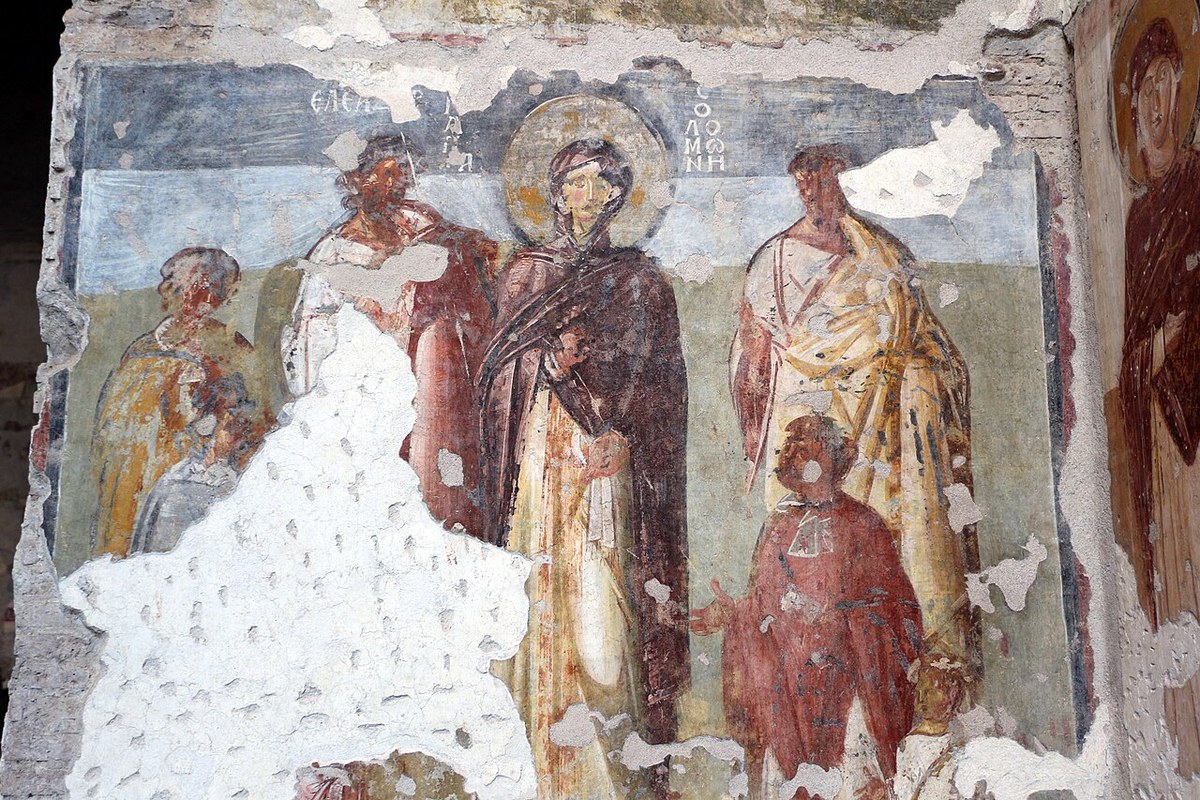
The Maccabees are painted as a family group, and the composition is remarkably stable from the earliest surviving examples to the printed menologia. The mother stands in the centre, veiled in the maphorion, haloed, her hands raised in prayer or extended over her children; the seven sons are ranged about her in graduated heights, from a grown young man to a small child, in tunic and mantle, each holding the martyr's cross; and the aged Eleazar, white-bearded and often in the scribe's or teacher's dress, stands at one side of the group. Where the passion itself is shown — chiefly in Russian menaion icons and in manuscript cycles — the instruments are the heated pan or cauldron over the fire and the tyrant enthroned at the left, with the mother watching. Their inscriptions in Greek give the mother as Η ΑΓΙΑ ϹΟΛΟΜΩΝΗ and the group as ΟΙ ΑΓΙΟΙ ΜΑΚΚΑΒΑΙΟΙ.
The stored image is among the oldest icons of these saints in existence: a Byzantine fresco of about 600–650 on the painted pillar of Santa Maria Antiqua in the Roman Forum, the church whose layers of Greek-language painting make it the richest surviving witness to Byzantine art in Rome. The plaster is much lost, but the essentials are legible: in the centre the haloed mother, inscribed in Greek Η ΑΓΙΑ ϹΟΛΟΜΩΝΗ, "the holy Solomone," in dark mantle over a pale tunic; at the upper left a figure inscribed ΕΛΕΑ[ΖΑΡ]; and the children ranged about her at both sides, one small son at the lower right reaching toward her, another at the far left. It is a Solomonia with her sons of precisely the type described above, painted within a few generations of the Antiochene cult's greatest fame.
Disputed questions
- The names are not in Scripture. 2 Maccabees names neither the brothers nor their mother. All the names come from later tradition and vary between the calendars. The Greek synaxarion of August 1 gives Abim, Antonius, Gurias, Eleazar, Eusebonus, Achim and Marcellus; Slavonic and English calendars usually give Alimus where the Greek has Achim, and the first name appears as Abim or Abimus, the second as Antonius or Antoninus, the fifth as Eusebonus or Eusabonus. This entry gives the roll as transmitted and does not attempt to fix it. The mother is Solomonia (Greek Solomone); Latin tradition sometimes calls her Salome, and later Jewish tradition Hannah. Note that one of the brothers is also named Eleazar, distinct from the aged teacher.
- "Maccabee" is a borrowed name. The epithet properly belongs to Judas Maccabeus and his Hasmonean family, who were not these martyrs' kin. The martyrs are called Maccabees only because their passion is narrated in the books that bear that name — a transfer of title so old that it cannot now be undone.
- Where did they suffer? 2 Maccabees does not say. The narrative has the king present in person, which has been taken to point to his capital, Antioch, and the Antiochene shrine is the ancient anchor of the tradition; but Jerusalem, where Eleazar's death is set, is equally possible for the seven, and some hold that the Antiochene relics were brought there rather than buried there. The tradition of the shrine is firm; the tradition of the place of death is not.
- The synagogue tradition. The belief that the Antiochene martyrium in the Kerateion had been a Jewish synagogue is ancient and widely repeated, and it fits what is known of the quarter; but it rests on later report rather than on contemporary documentation, and modern scholarship treats it as probable tradition rather than established fact.
- The date. The synaxaria say 166 BC. The events belong to the persecution of 167–166 BC, before the victories of Judas Maccabeus; a precise year is not recoverable.
- The literary tradition. Besides 2 Maccabees 6–7, the passion is retold at great length in 4 Maccabees, a Hellenistic-Jewish philosophical treatise on the sovereignty of pious reason over the passions, transmitted in some manuscripts of the Greek Bible and anciently — and wrongly — ascribed to Josephus. Much of the rhetorical shape the Christian Fathers gave the martyrs derives from it rather than directly from 2 Maccabees.
- Not to be confused with Solomonia Saburova, the divorced first wife of Grand Prince Vasily III of Moscow, who became the nun Sophia of Suzdal — an entirely different person, of the sixteenth century AD, whose relics were uncovered in 1995 and whose commemoration is also entered by some Russian calendars near this date. The names are identical and the confusion is easily made.