
Procession of the Precious and Life-giving Cross
The Procession (Going-forth) of the Precious and Life-giving Cross of the Lord
August 1 keeps the memory of the procession of the relic of the True Cross through Constantinople: on the last day of July the wood was taken from the treasury of the Great Palace and laid on the holy table of Hagia Sophia, and from August 1 until the eve of the Dormition it was carried by the streets and quarters of the city, so that the people might venerate it and the city be sanctified against the sicknesses of the August heat. The day is therefore also the first day of the Dormition Fast, and the first of the three August "feasts of the Saviour." It is marked everywhere by the lesser blessing of the waters; in Russian usage it carries in addition the memory of the Baptism of Rus (988) and the feast of the All-Merciful Saviour (1164), and in the villages the blessing of the new honey gave it the folk name the Honey Saviour.
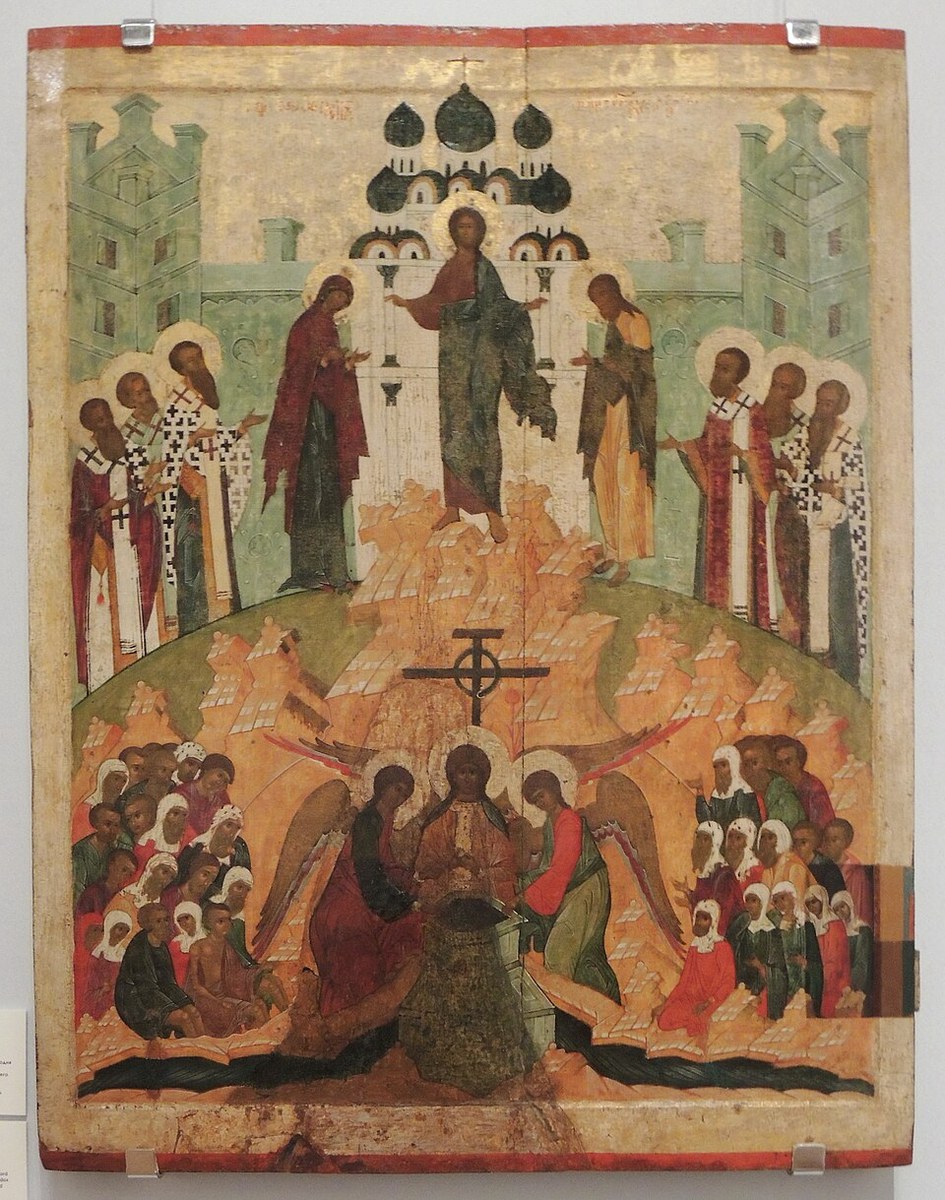
_by_shakko.jpg)
The name, and a famous mistranslation
The Greek title of the day is ἡ πρόοδος τοῦ τιμίου καὶ ζωοποιοῦ Σταυροῦ — the "going-forth" or procession of the Cross: proodos is the ordinary word for a solemn processional advance, and it describes exactly what the day commemorates, a relic carried out and carried round. The Slavonic books translated proodos by происхождение, a calque built on the same roots (pro- + "going"), which in later Russian settled into the sense "origin, derivation." English translations made from the Slavonic therefore produce the puzzling title "the Origin of the Honourable Wood of the Life-giving Cross," which is still the commonest form in North American service books and calendars and which suggests, quite wrongly, that the feast is about where the wood of the Cross came from. Nothing in the day's hymnography or synaxarion notice concerns the origin of the wood. The Greek sense — a procession — is the right one, and this entry uses it; the Slavonic-derived title is given among the alternates because the reader will meet it constantly.
The Constantinopolitan custom
The feast is a Constantinopolitan institution, and unlike September 14 it commemorates no single historical event but a recurring civic rite. The relic of the True Cross — the portion brought to the capital from Jerusalem and afterwards enlarged by other fragments — was kept not in a church but in the treasury (σκευοφυλάκιον) of the Great Palace, in the emperor's own custody. Each year, on July 31, the clergy took it out of the palace and bore it to the Great Church, where it was laid upon the holy table of Hagia Sophia; and from August 1 for the fourteen days of the fast the wood was carried in procession through the city — from quarter to quarter, along the streets and squares, with litanies sung at the stations — and set out for the veneration of the people. On August 14, the eve of the Dormition, it was returned to the palace. July 31 is accordingly kept in the Greek books as the forefeast, with the rubric ἡ ἐξέλευσις αὐτοῦ ἐκ τοῦ βασιλικοῦ Παλατίου εἰς τὴν πόλιν, "its going forth from the imperial Palace into the city."
The purpose the sources give is unembarrassedly practical: health. The Greek Horologion explains the custom by "the illnesses that occur in the month of August" — August in a crowded, hot, ill-drained Mediterranean capital was the month of fevers, dysentery and plague, and the city met it by carrying the Cross through its own streets and sanctifying its water. The Byzantines did not experience this as superstition set beside medicine; the procession of the Cross was the city's public act of supplication in the season when it was most likely to bury its people. The rite is thus a near relation of the litanies of Constantinople generally — the processions against earthquake, siege and drought that fill the capital's calendar — and it is the reason the Church's oldest "public health" observance stands at the head of a fast.
The blessing of the waters
The feast's proper rite is the lesser blessing of the waters (μικρὸς ἁγιασμός; Slavonic малое освящение воды), served before or after the Liturgy, at which the celebrant immerses the Cross in the water three times at the singing of the troparion of the Cross. Together with the day of the Origin of the Fast in Greek parish practice and the temple-blessings served at any season, August 1 is one of the two days of the year on which the blessing of water is universally appointed — the other being Theophany, January 6, whose great blessing it deliberately echoes at lesser rank. In Russia and the Slavic lands the water was blessed not in the church but at the rivers, springs and wells, with a cross-procession out to the water; the ill and, in country districts, the cattle and horses were washed in it, whence the folk name "the Wet Saviour" or "the Saviour on the Water" (Мокрый Спас, Спас на воде). The blessing is not a survival grafted on to the feast: it is the natural liturgical form of a commemoration whose whole point is the sanctification of a city against sickness.
The Russian layer: the Baptism of Rus and the All-Merciful Saviour
Three commemorations converge on August 1 in Russian usage, and they must be kept distinct.
The Baptism of Rus. Sixteenth-century Russian chronicles place the baptism of the Great Prince Vladimir of Kiev and of all Rus on August 1 — "the baptism of the Great Prince Vladimir of Kiev and of all Rus took place on August 1," in the formula the chronicle repeats — and it was on this ground that the day acquired a national character in Russia. A well-known ecclesiastical order of 1627, promulgated under Patriarch Philaret, directs that on this day there be held "a cross-procession with the sanctification of water, for the enlightenment of the people, in all the towns and places" — that is, the water-blessing of August 1 was to be kept everywhere as a remembrance of the nation's own baptism. Modern Russian calendars accordingly print "the Baptism of Rus, 988" against August 1, and since 2008 it has been a civil as well as an ecclesiastical observance in Russia and Ukraine (kept on the civil date July 28, the day of Saint Vladimir, in the state calendars, while the church memory of the baptism itself stays on August 1). The chronicle date is a late tradition and cannot be checked against any contemporary source; the entry records it as the tradition it is.
The All-Merciful Saviour. A second and separate Russian feast of August 1 is that of the All-Merciful Saviour and the Most Holy Mother of God, instituted after the victory of Andrew Bogoliubsky over the Volga Bulgars in 1164, when the Cross and the Vladimir Icon were carried before his army. The received account adds that the same day brought the emperor Manuel Comnenus a victory over the Saracens, that both rulers saw fire and light going out from the icons over their troops, and that the two agreed to keep the feast together — a story of the kind that Byzantine and Russian sources tell about each other in the twelfth century, and which the entry reports without vouching for the synchronism. The Russian Menaion carries a proper service of the All-Merciful Saviour on this day beside the service of the Cross.
The three Saviours of August. In popular Russian reckoning August holds three "feasts of the Saviour" (Спас): August 1, the Honey Saviour (Медовый Спас); August 6, the Transfiguration, the Apple Saviour; August 16, the Image Not-Made-by-Hands, the Nut or Linen Saviour. The names are folk overlay, not liturgical titles, and they mark what the fast permitted the household to bless and eat as the harvest came in.
The Honey Saviour
On August 1 the new honey was brought to the church to be blessed and first tasted — the beekeepers' hives were broken open about this date, and the fast, which forbade meat, dairy, fish and (on most days) oil, left honey among the few sweet things a Russian household could lawfully eat for the next fortnight. Hence Медовый Спас, "the Honey Saviour," the name by which August 1 is still known in Russian and Ukrainian villages and in most of the diaspora. A blessing of honey stands in the Russian Trebnik and is commonly served after the Liturgy of the day. It should be seen for what it is: a folk and agricultural overlay on a Constantinopolitan feast of the Cross, of no antiquity in the liturgical books and unknown to the Greek tradition, but expressive of exactly the instinct that produced the feast — the sanctification of ordinary life, its water, its food and its health, by the Cross.
Relation to the other feasts of the Cross
The Church keeps the Cross on four occasions in the year, and they are not interchangeable. The Elevation on September 14 is the Great Feast, the only one with the full rite of the fivefold elevation, and it commemorates the finding of the Cross and its exaltation at Jerusalem. The Veneration of the Cross on the third Sunday of Great Lent is movable, and belongs to the Lenten cycle. The Apparition of the Cross over Jerusalem on May 7 commemorates the sign seen in the sky in 351. August 1 is different from all three: it commemorates neither a finding nor a vision but a usage — the annual carrying of a relic through a city for the health of its people — and it is the only one of them that opens a fast. Its hymnody is borrowed from September 14 (see below), which is one mark of its origin as a civic rite rather than as a composed feast.
Feast and commemoration
August 1 (church date; New Calendar civil August 1, Old Calendar civil August 14), kept universally in the Byzantine rite, with the forefeast on July 31 and no afterfeast. The rank is that of a feast of the Lord of middle solemnity — polyeleos in most usages, with the service of the Cross joined to that of the Seven Maccabee Martyrs, who are never displaced by it. The lesser blessing of the waters is appointed before or after the Liturgy.
The day opens the Dormition Fast, which runs from August 1 to August 14 inclusive and is, after Great Lent, the strictest of the year: meat, dairy, eggs, fish, wine and oil are all excluded on weekdays, wine and oil are allowed on Saturday and Sunday, and fish is permitted only on the Transfiguration (August 6). The feast of the Cross does not relax the fast — as at the Elevation, the Cross is honoured in fasting — and the fourteen days correspond exactly to the fourteen days for which the relic was borne through Constantinople.
In Russian and Ukrainian usage the service of the Cross is joined by the proper service of the All-Merciful Saviour and by the commemoration of the Baptism of Rus, and the water is blessed at rivers and wells; in Greek usage the day is simply the Procession and the opening of the fast, and it is on this evening that the Paraklesis canons to the Theotokos begin to be sung nightly through the fast, alternating the Small and the Great Paraklesis until the Dormition. In the Antiochian Archdiocese the day is kept as the Procession of the Cross with the Maccabees, with the lesser blessing of water, and the Paraklesis is sung through the fast as in Greek practice.
Hymns
Troparion — Tone 1
O Lord, save thy people and bless thine inheritance, granting to kings victories over the barbarians, and by thy Cross guarding thine own commonwealth.
Original translation from the Greek
Kontakion — Tone 4
Thou who wast lifted up upon the Cross of thine own will, bestow thy compassions upon the new commonwealth that bears thy name, O Christ God; gladden with thy power our faithful kings, granting them victories over their enemies: may they have thine alliance as a weapon of peace, a trophy invincible.
Original translation from the Greek
Appointed readings
Epistle — 1 Corinthians 1:18–24
18For the preaching of the cross is to them that perish foolishness; but unto us which are saved it is the power of God. 19For it is written, I will destroy the wisdom of the wise, and will bring to nothing the understanding of the prudent. 20Where is the wise? where is the scribe? where is the disputer of this world? hath not God made foolish the wisdom of this world? 21For after that in the wisdom of God the world by wisdom knew not God, it pleased God by the foolishness of preaching to save them that believe. 22For the Jews require a sign, and the Greeks seek after wisdom: 23But we preach Christ crucified, unto the Jews a stumblingblock, and unto the Greeks foolishness; 24But unto them which are called, both Jews and Greeks, Christ the power of God, and the wisdom of God.
Gospel — John 19:6–11, 13–20, 25–28, 30–35
6When the chief priests therefore and officers saw him, they cried out, saying, Crucify him, crucify him. Pilate saith unto them, Take ye him, and crucify him: for I find no fault in him. 7The Jews answered him, We have a law, and by our law he ought to die, because he made himself the Son of God. 8When Pilate therefore heard that saying, he was the more afraid; 9And went again into the judgment hall, and saith unto Jesus, Whence art thou? But Jesus gave him no answer. 10Then saith Pilate unto him, Speakest thou not unto me? knowest thou not that I have power to crucify thee, and have power to release thee? 11Jesus answered, Thou couldest have no power at all against me, except it were given thee from above: therefore he that delivered me unto thee hath the greater sin. 13When Pilate therefore heard that saying, he brought Jesus forth, and sat down in the judgment seat in a place that is called the Pavement, but in the Hebrew, Gabbatha. 14And it was the preparation of the passover, and about the sixth hour: and he saith unto the Jews, Behold your King! 15But they cried out, Away with him, away with him, crucify him. Pilate saith unto them, Shall I crucify your King? The chief priests answered, We have no king but Cæsar. 16Then delivered he him therefore unto them to be crucified. And they took Jesus, and led him away. 17And he bearing his cross went forth into a place called the place of a skull, which is called in the Hebrew Golgotha: 18Where they crucified him, and two other with him, on either side one, and Jesus in the midst. 19And Pilate wrote a title, and put it on the cross. And the writing was, JESUS OF NAZARETH THE KING OF THE JEWS. 20This title then read many of the Jews: for the place where Jesus was crucified was nigh to the city: and it was written in Hebrew, and Greek, and Latin. 25Now there stood by the cross of Jesus his mother, and his mother’s sister, Mary the wife of Cleophas, and Mary Magdalene. 26When Jesus therefore saw his mother, and the disciple standing by, whom he loved, he saith unto his mother, Woman, behold thy son! 27Then saith he to the disciple, Behold thy mother! And from that hour that disciple took her unto his own home. 28After this, Jesus knowing that all things were now accomplished, that the scripture might be fulfilled, saith, I thirst. 30When Jesus therefore had received the vinegar, he said, It is finished: and he bowed his head, and gave up the ghost. 31The Jews therefore, because it was the preparation, that the bodies should not remain upon the cross on the sabbath day, (for that sabbath day was an high day,) besought Pilate that their legs might be broken, and that they might be taken away. 32Then came the soldiers, and brake the legs of the first, and of the other which was crucified with him. 33But when they came to Jesus, and saw that he was dead already, they brake not his legs: 34But one of the soldiers with a spear pierced his side, and forthwith came there out blood and water. 35And he that saw it bare record, and his record is true: and he knoweth that he saith true, that ye might believe.
Iconography
The feast has a developed icon only in the Russian tradition, where it is titled Происхождение честных древ Креста Господня and belongs to the family of "blessing of the waters" compositions. The type is in two registers. Above, Christ stands in glory before a many-domed church, blessing with both hands, flanked by the Mother of God and the Forerunner in the attitude of the Deesis and by ranks of hierarchs in the crossed polystavrion — the heavenly liturgy, and the Great Church out of which the Cross was carried. Below, on the earth, the Cross is set upright in or over a font of water between two angels who bend toward it in the deacons' posture, and on either side press the people: at the left the men and the sick, at the right the women and children, some lying, some reaching toward the water. The composition says in one image everything the feast is: the Cross brought out of the church into the midst of the city, plunged into the water, and the water given to the people for their healing.
The stored icon is a Suzdal panel of the 1510s from the church of the Origin of the Precious Wood at the Pokrov Monastery (now in the Vladimir-Suzdal Museum-Reserve), and shows the type in its classic early-sixteenth-century form: Christ enthroned on the rock before the white five-domed church with the Theotokos and the Forerunner, six hierarchs in two groups of three, and beneath, the eight-pointed Cross standing in the water between two winged angels, with the crowds of the faithful — the men bare-headed at the left, the women in white kerchiefs at the right — gathered at the water's edge.
Greek practice has no distinct icon of August 1: the feast is served before the icon of the Elevation or before the Cross itself, laid on the analogion and adorned, as on September 14, with basil.
Disputed questions
- What relic, and when did the custom begin? The sources describe the procession as established usage but do not date its institution; it is generally placed in the ninth or tenth century, when the Typikon of the Great Church took the shape in which we have it, and it plainly presupposes the concentration of relics of the Passion in the palace treasury that is characteristic of middle Byzantine Constantinople. Whether the wood carried was the principal Constantinopolitan relic or a portion set aside for the purpose is not stated.
- The end of the custom. The rite as described could not survive the loss of the palace treasury in the Latin sack of 1204, and there is no evidence that it was revived in its old form after 1261; what survives is the calendar commemoration and the water-blessing, which passed intact into the Slavic books and there acquired the national and agricultural additions described above.
- The "Origin of the Honourable Wood." See The name above. English-language jurisdictional calendars, including the OCA's, keep the Slavonic-derived title; Greek usage keeps proodos. This is a difference of translation, not of observance.