
Severian of Sebaste
The Holy Martyr Severian of Sebaste
Martyr · d. 320
Commemorated 9 September — Martyrdom at Sebaste
Severian (†320) was a nobleman of Sebaste in Armenia who suffered martyrdom under the emperor Licinius, in the same persecution and the same city as the famous Forty Martyrs of Sebaste. Before his own arrest he had visited the Forty in prison, encouraging them to endure to the end; about half a year after their death in the frozen lake he was himself brought to trial, scourged, torn with iron scrapers, and finally hanged upon the city wall with a heavy stone bound to his body until he died. His memory is kept on September 9, and the Menaion styles him the "trainer" of the Forty whom he had strengthened for their contest.
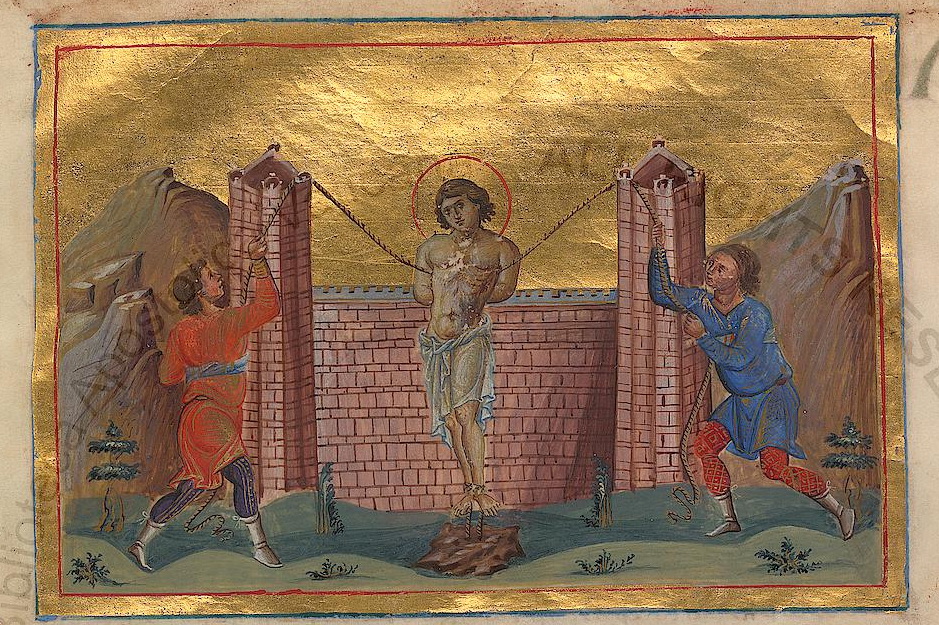
.jpg)
Origins and early life
Severian was a Christian of Sebaste in Armenia Minor (the modern Sivas), remembered in the tradition as a man of standing in the city — the synaxaria present him moving freely among prisoners and magistrates — during the reign of the emperor Licinius, who in his final years of struggle with Constantine turned to persecuting the Christians of the eastern provinces. The OCA synaxarion places his suffering "during the governorship of Licius"; the Greek tradition transmits the governor's name in other forms, and the variance is noted below.
The deed for which the Church chiefly remembers him before his own contest was his ministry to the Forty Martyrs of Sebaste — the forty soldiers of the Twelfth Legion who, refusing to sacrifice, were exposed naked on the frozen lake of Sebaste and perished there in the winter of 320 (commemorated March 9). While they were held in prison awaiting their contest, Severian visited them, raised their spirits, and appealed to their valour and endurance. The Menaion enshrines this in the exapostilarion of his feast, which addresses him as the ἀλείπτης — the "anointer" or trainer, the word used of him who oils and prepares athletes for the arena — "of the forty martyrs who triumphed in the lake," and asks that he remember with them those who keep his memory.
Martyrdom
About half a year after the death of the Forty, Severian was himself denounced and brought to trial for confessing Christ. The hymns of his canon preserve the shape of the tradition: the tyrant first tried flattery to soften him; he was then bound and led through the city, scourged, hanged upon a stake, his flesh raked with iron scrapers, his jaws broken with stones, his sides scored with blades, and he was commanded throughout to sacrifice to the idols. He refused, answering — so the canon sings — that unless a power from on high had been given him, mere flesh could not have borne the cutting away of its members; and amid the tortures he prayed for strength to finish his course.
His death was of a piece with the cruelty of the rest. He was hanged from the wall of the city with a great stone — the Greek synaxarion's epigram speaks of the stone dragging at his feet, "rejoicing to be hanged, as one tearing his feet free of the earth," while the account transmitted by the OCA has one stone chained about his neck and another at his feet — and so, suspended between earth and heaven, he died. The year received in the calendars is 320.
The tradition adds a wonder at his burial. His body was taken down and carried in procession by the Christians of Sebaste toward his home, the people thronging to venerate it; and a servant of Severian who had died and lay yet unburied rose from his bed at his master's passing to follow the bier. The account transmitted by the OCA relates that the man lived another fifteen years, never leaving the place of the martyr's burial. The Church records the tradition as she received it, a witness to the honour in which the martyr's intercession was held from the first.
Veneration and later cultus
Severian's veneration is universal in the Byzantine calendar, fixed on September 9 from the early synaxaria onward. The Menaion gives him a full proper service joined to that of the Ancestors of God — three stichera at Vespers, a canon in Tone 8, and his own exapostilarion — and the Menologion of Basil II (c. 1000) both recounts his passion and depicts it in one of its miniatures, the martyr suspended between two towers of the city wall. His memory has always stood in the shadow of the Forty whom he served, and the Church's instinct in joining them is sound: the trainer followed his athletes into the same arena within the year.
Feast and commemoration
September 9 (church date; Old Calendar civil September 22) is the sole and primary feast of Severian, kept universally. The day falls within the afterfeast of the Nativity of the Theotokos, and the Menaion appoints his service together with that of the Synaxis of Joachim and Anna and the hymns of the feast; no proper apolytikion of the martyr is appointed, the common of a martyr being used where one is wanted. His connection with the Forty Martyrs of Sebaste gives him a natural secondary presence in the mind of the Church on their feast of March 9, though the calendars appoint him no commemoration that day.
Hymns
Troparion — Tone 4
Thy Martyr, O Lord, in his contest received the crown of incorruption from Thee our God; for possessing Thy strength he cast down the tyrants and shattered the strengthless insolence of the demons. By his intercessions, O Christ God, save our souls.
Original translation from the Greek
Stichera
Thy jaws crushed with stones, O far-famed one, thy sides scored with blades, thy neck and thy feet weighed down by a mighty stone, thy joints cruelly wrenched apart — yet by the nobility of thine endurance thou didst truly crush the head of the dragon, whom the malice of the torments had no strength to make thy master.
Iconography
Severian is depicted as a young to middle-aged martyr, dark-haired and bearded, in the tunic and mantle of a nobleman, bearing the martyr's cross; narrative images show the singular manner of his death. The stored image is the miniature of his martyrdom from the Menologion of Basil II (Constantinople, c. 985): the martyr, haloed and stripped to a loincloth, hangs by cords stretched between two towers of the city wall of Sebaste, his feet weighted toward the stone beneath, while two executioners haul on the ropes — precisely the scene of the synaxarial epigram.
Disputed questions
- The governor's name. The OCA synaxarion names the governor of Armenia "Licius"; other recensions of the synaxarion transmit the name as Lysias, a name borne by the persecuting governor in many Armenian martyrdoms. The entry records the variance without resolving it.
- The manner of suspension. The Greek synaxarial epigram has the stone bound at his feet as he hung from the wall; the Slavonic-derived account (OCA) has a stone at the neck and another at the feet. The substance — death by suspension from the city wall under the weight of stone — is common to all.
- Not to be confused with Severian, bishop of Gabala, the fourth–fifth century preacher and opponent of John Chrysostom, who is no saint of the calendar; nor with the martyr Severian commemorated with Memnon on August 20.