
Simeon of Verkhoturye
The Holy and Righteous Simeon of Verkhoturye, Wonderworker of Siberia
Righteous · Wonderworker · b. c. 1607 — d. 1642
Commemorated 12 September — Translation of the relics to Verkhoturye (1704), 18 December — Repose (Merkushino, 1642)
Simeon of Verkhoturye (c. 1607–1642) is the most beloved saint of the Russian Urals and Siberia — a nobleman who hid his birth to live as a poor wanderer among the newly settled and half-Christianised peoples of the frontier. Making his home by the village church of Merkushino near Verkhoturye, he supported himself by sewing coats for the poor, deliberately leaving each garment a little unfinished so as to earn reproach rather than praise, and he taught the faith to the local Russians and native peoples while fishing and praying in the wilderness. He died young and obscure, but in 1692 his coffin rose from the earth and his incorrupt relics began to work abundant healings; their translation to Verkhoturye in 1704 is his second feast.
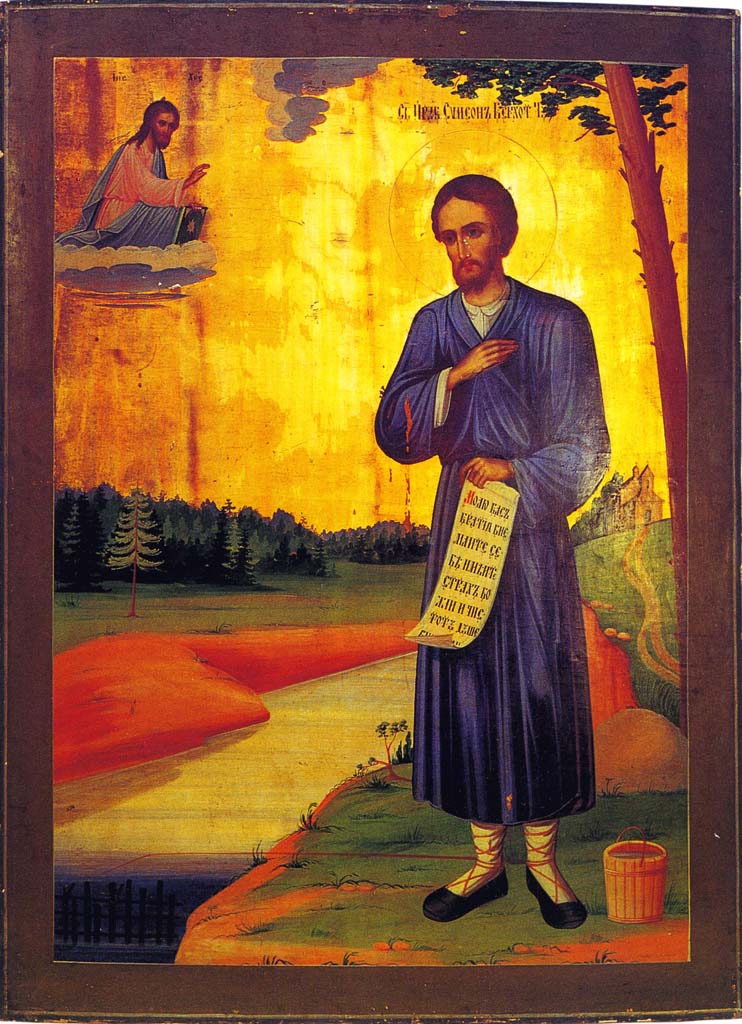

A hidden nobleman on the Siberian frontier
Simeon was born, about 1607, of noble Russian parents, but he concealed his origin and chose the life of a poor and homeless wanderer. He came east, into the lands beyond the Urals only lately opened to Russian settlement, and attached himself to the region of Verkhoturye in the Perm country — a raw missionary frontier where Russian colonists and the native peoples of the Urals and western Siberia lived side by side. Most often he lodged at the churchyard of the village of Merkushino, some fifty versts from Verkhoturye, by the church of the Archangel Michael.
Manner of life
He earned his bread by his craft, going from village to village to sew fur coats and other garments, and taking his pay chiefly in a place to sleep and eat rather than in money; he worked especially for the poor. The tradition preserves a telling detail of his humility: he would leave each piece of work not quite finished — a missing glove or trim — and then quietly depart, so drawing on himself the scolding and cheating of his customers, that he might practise patience and escape any thanks. He loved the beauty of the Ural country, and in his free hours fished in the solitude of its rivers, an occupation that put him in mind of the Apostles whose work of drawing men to the true faith he continued among the frontier folk. His unhurried conversations, the sources say, were seeds of grace from which the fruits of the Spirit grew across the Urals and Siberia, where he is venerated above all other saints.
Repose and glorification
Simeon died at Merkushino in 1642, only about thirty-five years old, and was buried by the village church of the Archangel Michael. Half a century later, in 1692, his coffin was seen to rise to the surface of the ground, the body within it found incorrupt; healings followed for those who came to it, and the identity of the long-forgotten wanderer was established. On September 12, 1704, with the blessing of Metropolitan Philotheus (Leshchinsky) of Tobolsk, the relics were carried in solemn procession from Merkushino to the St Nicholas Monastery at Verkhoturye, which became — and remains — the great pilgrimage centre of the Urals. After his death Simeon worked many miracles: he appeared in dreams to the sick and healed them, and delivered many from drunkenness, characteristically joining to each bodily cure a word of counsel for the soul.
Feast and commemoration
December 18 (church date; Old Calendar civil December 31) is Simeon's principal feast, the day of his repose. His second feast, on September 12 (Old Calendar civil September 25), keeps the translation of his relics to Verkhoturye in 1704. He is a saint of the Russian Church, kept also in the calendar of the Orthodox Church in America, and is not among the pan-Orthodox commemorations of the day.
Hymns
Troparion — Tone 4
Fleeing the tumult of the world, thou didst turn all thy longing toward God, that thou mightest find the ascent to the vision of things on high; and turning not aside into the guile of the heart, but cleansing soul and body, thou didst receive the grace to pour forth healings upon the faithful and the faithless who run to thee, O righteous Simeon. Therefore, by the gift given thee, ask of Christ God healing for us who are sick with the passions of the soul, and pray that our souls may be saved.
Original translation from the Slavonic
Kontakion — Tone 2
Thou didst renounce the vain world to inherit the good things of eternal life, loving guilelessness and purity of soul and body. Thou hast gained what thou didst love, for thy grave and the incorruption of thy relics bear witness thereto, and the grace of wonderworking most of all; for thou pourest forth healings upon all who run to thee, and upon the unenlightened, O blessed Simeon, most marvellous wonderworker.
Original translation from the Slavonic
Iconography
Simeon is shown as a young layman of the Russian north, beardless or with a soft young beard, in a simple belted tunic, usually in an attitude of prayer toward Christ blessing from heaven, and often against the fir-covered hills and the river of the Urals; hagiographic icons surround the central figure with scenes of his life, his fishing, and the raising and translation of his relics. The stored image is a 1903 icon from the St Nicholas Monastery at Verkhoturye, showing the righteous one at prayer before the Saviour.
Disputed questions
- Dates of life. The year of birth is not recorded; c. 1607 is inferred from his reported age of about thirty-five at his death in 1642.
- Not to be confused with Symeon the Stylite or Symeon the New Theologian, nor with Simeon the God-Receiver of the Meeting (February 3); Simeon of Verkhoturye is a seventeenth-century Russian layman.