
Symeon the Stylite
Our Venerable and God-bearing Father Symeon the Stylite
Venerable · b. c. 390 — d. 459
Commemorated 1 September — Repose; opens the church new year
Symeon the Stylite (c. 390–459) was a Syrian ascetic who became the most famous holy man of the fifth-century Christian world by spending nearly four decades in unceasing prayer atop a pillar east of Antioch. The first and greatest of the stylites — the "pillar-saints" whose way of life he founded — he drew pilgrims from Britain to Persia, converted whole tribes of Arab nomads, corresponded with emperors, and lent his immense moral authority to the Council of Chalcedon. His feast on September 1 opens the Orthodox church year.
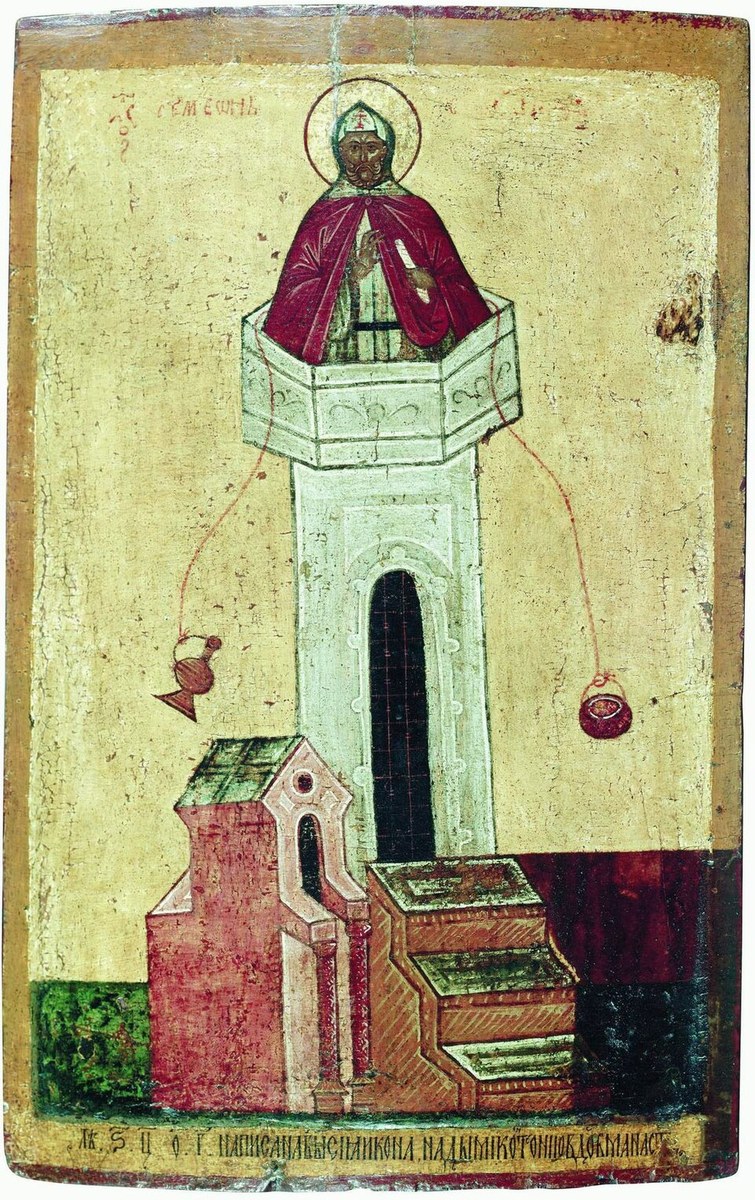

Origins and early life
Symeon was born around 390 in the village of Sisan (Sis), on the border country between Cilicia and northern Syria, to a family of shepherds. He passed his boyhood tending his father's flocks, unlettered and unremarkable. The turning point of his life, recorded in all the early Lives, came in his early teens: kept from the pasture one winter Sunday, he heard the Beatitudes read in church and asked a bystander what such blessedness meant and how it might be won. The answer — prayer, fasting, hardship, and the monastic life — struck root at once. The tradition relates that he then spent a night in prayer and saw a vision of himself digging a foundation, being told repeatedly to dig deeper before he could build: an image the hagiographers took as the pattern of his whole ascetic career.
He presented himself first at a nearby monastery, where he lay at the gate for days without food until he was admitted, and after initial formation moved to the large and celebrated monastery of Eusebona at Teleda, where he remained about ten years.
Ascetic struggle
Even among Syrian monks — the most austere in Christendom — Symeon's severities were found excessive. He fasted beyond the rule, and at one point bound a rough cord of palm fibre so tightly about his waist, next to the skin, that it embedded itself in his flesh and was discovered only when the wound began to fester; the abbot, fearing both for Symeon's life and for the effect of such rivalry-provoking feats on the community, eventually dismissed him from the monastery.
Symeon withdrew to the village of Telanissos (Telneshe, the modern Deir Sem'an), at the foot of the rocky height where he would spend the rest of his life. There he first enclosed himself in a hut, where — according to Theodoret of Cyrrhus, who knew him personally — he passed an entire Great Lent without eating or drinking, a feat he repeated annually thereafter. He next chained himself to the rock of the summit within a small circular enclosure (a mandra), until Meletius, the visiting chorepiscopus of Antioch, remarked that the will, not iron, should bind a man; Symeon had the chain struck off.
Crowds now came in such numbers, each seeking to touch him or carry off a relic-thread from his garments, that around 423 he adopted the expedient that made him famous: he mounted a pillar. The first was low — a few cubits — but successive pillars rose higher, until the last stood some forty cubits (perhaps eighteen metres) above the enclosure. On its small platform, exposed to the Syrian sun and the winter storms, he stood for about thirty-six years until his death, never descending. He bowed in prayer so continuously that visitors tried to count the prostrations and gave up in the hundreds; Theodoret records an observer abandoning the count at 1,244.
The pillar was not a flight from humanity but a pulpit. Twice daily Symeon preached to the crowds below, settled lawsuits, reconciled enemies, healed the sick brought to the base of the column, and gave rulings that carried from village disputes to imperial policy. The Bedouin Arabs of the desert came in their thousands, and the Lives record whole encampments renouncing idols at his word. Pilgrims are attested from Persia, Armenia, Georgia, Arabia, Spain, Gaul, and Britain; Theodoret says that in Rome small images of Symeon were set up in the workshops for protection — a remarkable early witness to the devotional use of images of a living saint.
Emperors sought his counsel. Theodosius II wrote to him and heeded his protests; the empress Eudocia, drifting toward the monophysite party after Chalcedon, was recalled toward the orthodox confession partly through his letters; and Leo I received Symeon's written support for the Council of Chalcedon (451) when its authority hung in the balance in Syria — a significant fact, since the later Syriac non-Chalcedonian tradition also claimed his memory.
His mother Martha, who had long sought to see him, was refused entry to the enclosure, since women were not admitted; the tradition relates that she died nearby and that Symeon had her coffin brought to the foot of the pillar, where he prayed over her. She is herself venerated as a saint, chiefly in the Syriac and Maronite tradition, and lies at the foot of his column in what became the great martyrium of Qalʿat Simʿān.
She is not to be confused with the other Martha. The mother of Symeon the Stylite of the Wonderful Mountain, the Younger Symeon, was also named Martha, and it is she — Martha of Antioch, widow of John the perfumer, who died in 551 and is buried at the foot of the Wonderful Mountain south-west of the city — who is commemorated in the Byzantine calendar on July 4. Two stylites named Symeon, two mothers named Martha, and two mothers' graves at the foot of two columns on opposite sides of Antioch: the Greek calendars say only "Martha, mother of Symeon the Stylite," and leave the reader to supply which Symeon. This Martha has no July 4 commemoration.
Repose
Symeon died on his pillar in 459, aged about seventy. His death was discovered when he remained motionless in prayer for three days; his disciple Antonius, author of one of the Lives, describes finding the body bent in the attitude of prayer. The report brought out the population of the countryside, and the Patriarch Martyrius of Antioch, with six bishops and an escort of Gothic soldiers under the magister militum Ardaburius, conducted the body in procession to Antioch — the escort being needed because the villages along the route attempted to seize the relics for themselves.
Relics and translations
The body was received in Antioch with unprecedented honours and enshrined in the great church; the city, which had recently suffered earthquake, regarded the saint's relics as its new wall and protector, and successfully resisted the emperor Leo's request that they be surrendered to Constantinople. Portions of the relics were later distributed; the head was long claimed by several centres, and smaller relics spread through both the Greek and Syriac worlds.
Veneration and later cultus
Within a generation of his death, the emperor Zeno's era saw the construction (c. 475–491) of the vast cruciform martyrium of Qal'at Sim'an ("the fortress of Symeon") around the pillar itself: four basilicas radiating from a central octagon enclosing the column, at the time among the largest church buildings in the world. The remnant of the pillar, whittled away for centuries by relic-seeking pilgrims, survived as a boulder on its base into modern times; the site, a UNESCO World Heritage location, was damaged during the Syrian civil war (the pillar-base itself was struck in 2016).
Symeon founded not merely a shrine but a way of life. Stylitism — the ascetic vocation of the pillar — continued for a millennium: Daniel the Stylite took up the practice at Constantinople within Symeon's own lifetime and inherited his very mantle; Symeon the Stylite of the Wonderful Mountain (the "Younger," †596), Alypius of Adrianopolis, Luke the New Stylite, and many others followed, and the type entered the standard iconographic and hymnographic repertoire of the Church.
In the Byzantine rite his feast on September 1 coincides deliberately with the Indiction, the opening of the church year, so that the first saint the Church commemorates annually is the man who stood between earth and heaven; the liturgical texts of the day interweave the new year and the stylite.
Feast and commemoration
September 1 (church date; Old Calendar civil September 14), the same day as the beginning of the Indiction — the church new year — with which his service is combined in the Menaion, together with the synaxis of the Theotokos of Miasena. The feast is kept universally in the Byzantine rite. The Syriac churches, which also claim him, keep his memory on other days (notably in July), and the Roman Martyrology commemorates him on January 5.
Hymns
Troparion — Tone 1
Thou wast a pillar of patience, O venerable one, rivalling the forefathers: Job in his sufferings, Joseph in his temptations, and the life of the bodiless powers while yet in the body. O Symeon, our venerable father, intercede with Christ God that our souls may be saved.
Original translation from the Greek
Kontakion — Tone 2
Seeking the things on high, joined to those below, thou madest thy pillar a chariot of fire, O venerable one; by it thou becamest a companion of the angels, and with them thou dost entreat Christ God unceasingly for us all.
Original translation from the Greek
Appointed readings
Epistle — Colossians 3:12–16
12Put on therefore, as the elect of God, holy and beloved, bowels of mercies, kindness, humbleness of mind, meekness, longsuffering; 13Forbearing one another, and forgiving one another, if any man have a quarrel against any: even as Christ forgave you, so also do ye. 14And above all these things put on charity, which is the bond of perfectness. 15And let the peace of God rule in your hearts, to the which also ye are called in one body; and be ye thankful. 16Let the word of Christ dwell in you richly in all wisdom; teaching and admonishing one another in psalms and hymns and spiritual songs, singing with grace in your hearts to the Lord.
Gospel — Matthew 11:27–30
27All things are delivered unto me of my Father: and no man knoweth the Son, but the Father; neither knoweth any man the Father, save the Son, and he to whomsoever the Son will reveal him. 28Come unto me, all ye that labour and are heavy laden, and I will give you rest. 29Take my yoke upon you, and learn of me; for I am meek and lowly in heart: and ye shall find rest unto your souls. 30For my yoke is easy, and my burden is light.
Iconography
Symeon is instantly recognisable: a monastic figure — usually in the great schema, often with the koukoulion — emerging waist-high from the capital of his pillar, which is commonly shown with a ladder set against it and sometimes with his mother Martha or a disciple below. He blesses with his right hand or holds a scroll. The stored icon is a Russian icon of 1465, showing the saint on the column in schema with hands raised in prayer.
Disputed questions
- Birth date. The Lives imply dates between about 388 and 392; c. 390 is conventional.
- Day of death. The sources divide between 1 and 2 September 459 (and the Syriac tradition gives variant days); the Byzantine calendar keeps September 1, while some martyrologies of the West commemorate him on January 5.
- The sources. Three early Lives survive — Theodoret of Cyrrhus's chapter in the History of the Monks of Syria (written while Symeon still lived), the Greek Life by his disciple Antonius, and an extensive Syriac Life — and they differ in detail (the number and heights of the pillars, the chronology of his monastic years, several miracle accounts). The account above follows Theodoret where the witnesses diverge.
- Not to be confused with Symeon the Stylite of the Wonderful Mountain, "the Younger" (521–596; some sources 592), commemorated May 24, with whom he is constantly conflated in image collections, museum captions and popular accounts — this is the classic confusion of the Syrian calendar. The distinction is firm: this Symeon, the Elder, was a Cilician shepherd's son (c. 390–459) who mounted his pillar as a grown man about 423 at Telanissos, north-east of Antioch, stood on it some thirty-six years, was never ordained, and had the vast martyrium of Qal'at Sim'an raised over his column, his relics being carried to Antioch in 459. The Younger was an Antiochene born in 521, orphaned by the earthquake of 526, set upon a pillar as a child of seven, ordained deacon and afterwards priest on the column itself, and spent his last decades on the Wonderful Mountain (Mons Admirabilis) south-west of Antioch above Seleucia Pieria, where he reposed in 596. Because both are painted in the identical stylite type, an uninscribed icon of a saint on a column identifies neither; the Younger's Greek title ὁ Θαυμαστορείτης ("of the Wondrous Mountain") is the reliable mark.