
Symeon the New Theologian
Our Venerable and God-bearing Father Symeon the New Theologian, Abbot of St. Mamas
Venerable · b. 949 — d. 1022
Commemorated 12 March — Repose (1022); the day kept as principal by the OCA, 12 October — Principal celebration, transferred from the day of repose because March 12 falls in Great Lent
Symeon the New Theologian (949–1022) is the great mystical theologian of Byzantium: monk of Stoudios, abbot of St. Mamas in Constantinople, spiritual son of Symeon the Pious, and the poet of the Hymns of Divine Love. He taught, against the polite religion of his age, that the conscious experience of God — the vision of the divine light, the felt presence of the Holy Spirit — is not the privilege of a vanished apostolic past but the birthright and calling of every baptised Christian now; for this he was tried, exiled, and finally vindicated. Of all the saints, only he, John the Theologian, and Gregory of Nazianzus bear the title "Theologian."

Origins and early life
Symeon was born in 949 at Galatai in Paphlagonia, to Basil and Theophano, provincial gentry with connections at court, and was baptised George. Sent as a boy to Constantinople to an uncle in the imperial service, he received a secondary education but declined, by his own account, the higher rhetorical training that led to preferment — a fact he later wore as a badge, and which his opponents cast in his teeth. At about fourteen he found in the monastery of Stoudios the man who formed his whole life: the elder Symeon called the Pious (Eulabes), a simple monk, not ordained, whose disciple he became while still living in the world. Under this direction the young courtier passed years in a divided life — by day the emperor's antechambers, by night vigils and the reading his elder set him. In his twentieth year, as he stood at prayer repeating "God, be merciful to me a sinner," there came upon him the first of the experiences that would define his teaching: a flood of immaterial light in which, as he later wrote of himself in the third person, he saw nothing but light, forgot whether he was in the body, and found the elder whose prayers he believed had obtained it standing, as it seemed, within the radiance.
The Studite formation
Only years later, at twenty-seven (about 977), did he leave the world and enter Stoudios as a novice at his elder's feet. His attachment to the old man proved too absolute for the community's discipline: refusing to accept another director, he was dismissed, and passed with his elder's blessing to the small neighbouring monastery of St. Mamas, taking in tonsure the name Symeon — his elder's name, a choice that was itself a programme. There he was ordained priest, and about 980, barely three years a monk of the house, he was elected its abbot.
Abbot of St. Mamas
Symeon ruled St. Mamas for a quarter of a century and rebuilt it from a half-derelict burial-church of visiting easterners into a serious ascetic community. His instrument was the word: the Catecheses, the addresses he delivered to his monks morning by morning, survive as one of the most personal documents of Byzantine monasticism — vehement, confessional, tender, and unrelenting on the one point on which he would not yield: that dispassion, tears, and the conscious vision of God are commanded of all, and that to claim the times of grace are past is the one real heresy. The demand was not painless inside his own house: about 996–998 a party of some thirty monks rose against the abbot in church and appealed to the patriarch; Symeon was upheld, and — characteristically — begged back and forgave the rebels. About 1005 he resigned the abbacy to his disciple Arsenius to give himself to writing and stillness.
The conflict with Stephen of Nicomedia and the exile
From about 1003 Symeon was engaged by a formidable adversary: Stephen, former metropolitan of Nicomedia, now synkellos at the patriarchate — a career theologian of exactly the type Symeon's teaching indicted. Beginning from a trap-question on the manner of the Son's distinction from the Father — answered by Symeon in verse, contemptuously, that theology is not a parlour game but the speech of those who have seen — the quarrel settled on a charge of substance: Symeon's public veneration of his departed elder. Year by year he kept Symeon the Pious's memory with a festal service, icons, and a growing local cultus; Stephen argued the elder was no saint but an eccentric of doubtful repute, and that the disciple was canonising his own teacher on his own authority. After six years of process the Holy Synod, under the patriarch Sergius II, ordered the elder's icons removed; in January 1009 Symeon was exiled across the Bosphorus to Paloukiton, near Chrysopolis, set down, as he records, in midwinter with nothing.
There, beside a ruined oratory of St. Marina, he founded a small monastery with the help of his spiritual children — among them the patrician Genesios — and continued exactly as before. The sentence embarrassed the capital: the patriarch offered rehabilitation and, according to his biographer, even a metropolitan see, asking only that Symeon moderate the elder's festival. Symeon accepted the vindication and declined the terms, choosing to remain at St. Marina, where he passed his last years writing the Hymns and directing his community.
Repose and glorification
Symeon reposed at St. Marina on March 12, 1022, having foretold, his biographer records, the translation of his relics; that translation was accomplished thirty years later, in 1052, when his remains were brought out with honour — the beginning of his formal cultus. His disciple Nicetas Stethatos, monk of Stoudios, wrote the Life, edited and published the works, and secured the memory of both Symeons — the Pious and the New Theologian — against the verdict of 1009.
Theological legacy
Symeon's corpus — the 34 Catecheses, the Theological and Ethical Discourses, the Chapters, and the 58 Hymns of Divine Love — is a single sustained witness to one conviction: that the Kingdom of God is consciously experienceable in this life, and that baptism, unfelt, is completed by what he calls the baptism of the Spirit — the deliberate, tearful, and finally luminous awakening of the grace already given. His characteristic image is light: not metaphorical illumination but the uncreated light in which God is personally encountered — seen, he insists from his own repeated experience, "not as a figure but in fact." From this centre flow his other emphases: the necessity of a Spirit-bearing father (his defence of his elder was doctrine, not sentiment); the priority of experienced holiness over office, including his sharp teaching that the unordained saint may bind and loose while the graceless cleric cannot; and the audacity of divinisation, the Hymns daring to say of the redeemed body what scholastic caution would not. The title "the New Theologian" — bestowed, it may be, first in irony by opponents for whom "new theology" was no compliment — was ratified by the Church in its strongest form: he stands third in the line of John the Theologian and Gregory the Theologian, the three to whom alone the calendars grant the name. In the hesychast controversies three centuries later, Gregory Palamas and his fellow Athonites read Symeon as their chief recent witness, and through the Philokalia — which prints texts of and about him — his doctrine of conscious grace passed into the modern Orthodox revival.
Feast and commemoration
Symeon reposed on March 12, but that date falls perpetually within Great Lent, when festal services are curtailed; the Greek practice therefore keeps his principal celebration on October 12 (church date; Old Calendar civil October 25), where the Russian calendar also lists him. The OCA keeps him principally on March 12. This entry accordingly records October 12 as the primary feast — the day on which his full service is actually sung in the Greek books, and the usage this collection's calendar follows — with March 12, the historical repose, as the secondary; the jurisdictional difference is recorded here rather than resolved, since each usage is internally consistent. His glorification is anchored in the translation of his relics in 1052.
Hymns
Troparion — Tone 3
Having received the divine illumination within thy soul, O father Symeon, thou wast shown to the world a most radiant light, dispelling its deep darkness and persuading all to seek the grace of the Spirit which they had lost. Entreat him fervently, that he grant us great mercy.
Original translation from the Slavonic
Kontakion — Tone 3
Enlightened by the light three-sunned, O God-wise one, thou wast shown a theologian of the all-divine Trinity. Enriched from on high with the wisdom of words, thou didst pour forth the divine streams of the wisdom of God; drinking of them, we cry: Rejoice, thrice-blessed Symeon, taught of God.
Original translation from the Slavonic
Iconography
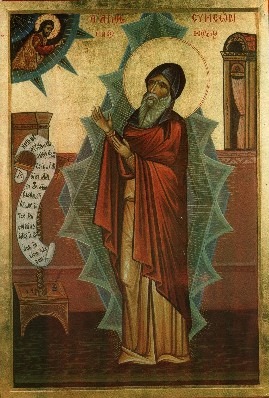
Symeon is painted as an aged monk of the great schema with a long grey beard, most often with his features drawn fine by fasting; his distinguishing iconography, where the painters attempt it, is the light itself — the saint standing in prayer within a mandorla or aureole of rays, the visible sign of the doctrine he suffered for. The stored image is a Russian icon of the 19th century of exactly this type: the saint standing orans in a blue-white blaze of uncreated light, an angel above, and beside him a scroll bearing his words. A pre-1800 image of comparable quality remains wanted.
Disputed questions
- Chronology. The dates 949–1022, constructed from the Life of Nicetas Stethatos, are the scholarly convention (Hausherr's reconstruction); the Slavic calendars give 1021 for the repose (so azbyka, "†1021"), and a minority of modern scholarship has proposed shifting the whole life about two decades later (c. 969–1035/40) on a rereading of the Life's synchronisms. The convention is followed here and the variance recorded.
- The "Messalian" charge. Both in his lifetime and in modern scholarship Symeon's insistence on felt experience has drawn the charge of enthusiasm — in Byzantine terms, Messalianism. His defenders, medieval and modern, answer that he binds experience wholly to the sacraments, the commandments, and obedience; the Church's judgment is embodied in his glorification and title.
- The writings under his name. The famous "Method of Holy Prayer and Attention," a practical hesychast manual transmitted under Symeon's name (and printed as his in older collections), is judged by modern scholarship the work of a later hand (often assigned to Nicephorus the Hesychast); the authentic corpus is that edited from Nicetas's tradition.
- Not to be confused with his elder Symeon the Pious (Eulabes) of Stoudios, with Symeon the Stylite (September 1), or with the other Symeons of the calendar; the epithet "the New Theologian" is his alone.