
Simon of Vladimir
Our Father among the Saints Simon, first Bishop of Vladimir and Suzdal, of the Kiev Caves
Venerable · Bishop · d. 1226, at Vladimir
Commemorated 10 May — Principal commemoration of the first bishop of Vladimir and Suzdal, 28 September — Synaxis of the Venerable Fathers of the Near (Antoniev) Caves, where his relics rest
Simon (†1226) was a monk of the Kiev Caves who became abbot of the Nativity monastery at Vladimir and, in 1214, the first bishop of the newly separated see of Vladimir-on-the- Klyazma and Suzdal, appointed by the Grand Prince George Vsevolodovich and consecrated by the Metropolitan Matthew of Kiev. He governed the young diocese for twelve years, consecrating its churches, and is remembered above all as one of the authors of the Kiev Caves Paterikon: his narratives of the wonders of the Caves fathers, and the long epistle to the monk Polycarp which stands at the head of the collection, gave the Russian Church one of its classic monastic books and its most famous protest against ambition for office. He took the great schema before his death, and though buried at Vladimir his relics were carried, according to his own wish, to the Near (Antoniev) Caves at Kiev, where they rest. His memory is kept on May 10.

The Caves and Vladimir
Simon was formed in the monastery of the Caves at Kiev in the second half of the twelfth century, the house that gave the Russian Church a great part of its early episcopate. From there he was called north, into the rising principality of Vladimir-Suzdal, and made igumen of the monastery of the Nativity of the Theotokos at Vladimir — the princely foundation which was then the first monastery of the north-east and which would, two generations later, receive the body of Alexander Nevsky.
Until 1214 the whole of the north-east lay in the vast diocese of Rostov. In that year the Grand Prince George (Yuri) Vsevolodovich, son of Vsevolod the Big Nest, obtained the division of the see and had his own capital made a bishopric: Simon was sent to Kiev and consecrated by the Metropolitan Matthew as the first bishop of Vladimir and Suzdal. The Illustrated Chronicle of the sixteenth century still shows the two scenes side by side — the prince sending Simon to the metropolitan, and the metropolitan laying hands on him.
The bishop
His twelve years in the see fall in the last quiet decade before the Mongol catastrophe, and the chronicles record of them chiefly what they record of good bishops: building and consecrating. He consecrated churches in 1218 at Vladimir and in 1225 at Suzdal — the latter the cathedral of the Nativity of the Theotokos, rebuilt in stone, whose foundation belongs to his episcopate and which stands, much altered, to this day. He kept the peace between the sons of Vsevolod when it could be kept, and he remained, in the judgement of every Russian account of him, a monk of the Caves who happened to wear the omophorion.
The Paterikon and the letter to Polycarp
Simon's lasting work is literary. Among the strata that make up the Paterikon of the Kiev Caves — the collection of narratives of the monastery's fathers which, with the Primary Chronicle, is the foundation of Russian monastic literature — a group of chapters is attributed to him: accounts of the wonders and the ascetics of the Caves, written down for a younger monk's instruction. And at the head of the whole collection, in the manuscript tradition, stands his Epistle to Polycarp.
Polycarp was a monk of the Caves who chafed under his abbot, wanted advancement, and had hopes — through the patronage of a princess — of a bishopric of his own. Simon, himself a bishop, wrote to him to tell him what that ambition was worth. The letter's force lies in its reversal of the ordinary hierarchy of honours: Simon says that for all his own episcopal dignity he would gladly count it nothing to be cast out as rubbish in the Caves monastery and trodden underfoot there, or to be a beggar at its gates, rather than hold the honours he holds; that the glory of the Caves is not in its walls but in the fathers who lie in them; and he sets out for Polycarp, one after another, the ascetics whose obedience he should be imitating. The Russian Church has read it ever since as the classic statement of the monastic estimate of preferment, and it is the reason Simon is remembered as a spiritual writer and not merely as a diocesan.
Repose and relics
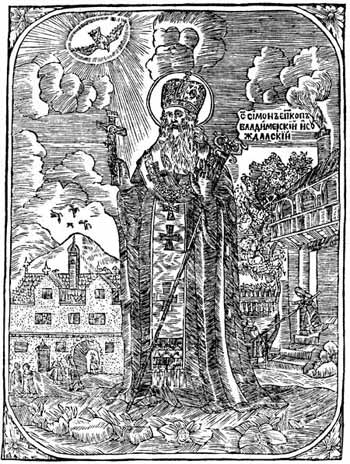
Before his death Simon received the great schema, laying down the bishop's state for the monk's. He died in 1226 — the repose is generally dated to the twenty-second of May — and was buried in the cathedral church at Vladimir. But he had asked to lie at the Caves; and his relics were afterwards translated to Kiev and placed in the Near (Antoniev) Caves of the Lavra, where they remain and where he is numbered among the fathers commemorated together on September 28. The printed Paterikon of 1661, the book he had helped to make, carried a woodcut of him among the Caves saints — the image stored with this entry.
Feast and commemoration
May 10 (church date; New Calendar civil May 10, Old Calendar civil May 23). The commemoration is Russian, and is carried also by the Greek synaxaristes, which lists him as "Saint Simon, bishop of Vladimir and Suzdal" among the day's saints; the day's office belongs to Simon the Zealot. He is commemorated a second time with the Synaxis of the Venerable Fathers of the Near (Antoniev) Caves on September 28, and he is numbered among the saints of the Vladimir and the Suzdal lands in their local synaxes. In Nizhny Novgorod he stands in bronze beside the prince who made him a bishop: the monument to George Vsevolodovich and Bishop Simon in the Kremlin there, raised for the city's octocentenary.
Hymns
Troparion — Tone 4 (common of a hierarch)
O God of our fathers, who dealest with us ever according to Thy gentleness: take not Thy mercy from us, but by the prayers of Thy hierarch Simon guide our life in peace.
Original translation from the Slavonic
Iconography
Simon is painted as a Russian hierarch of the pre-Mongol period: a long grey or white beard, the mitre or bare head, the phelonion and crossed omophorion, blessing with the right hand and holding the Gospel in the left, and — as a founder-bishop and monastic writer — sometimes a scroll instead, on which his words to Polycarp may be lettered. Where he appears in the great composite icons of the Fathers of the Near Caves he stands among the hierarchs of the upper ranks, named by inscription. The Illustrated Chronicle of Ivan the Terrible gives him two narrative miniatures instead of a portrait: the prince despatching him to the metropolitan, and his consecration.
The stored image is the woodcut of 1661 cut by the engraver Iliya for the printed Paterikon of the Kiev Caves Lavra — the first illustrated edition of the very book Simon helped to write. He stands full-length before the monastery, in mitre, phelonion and omophorion, with the crozier in his left hand and the right raised in blessing, the Holy Spirit descending in the upper corner; the Slavonic inscription beside his head reads С(вятый) Сімонъ Епископъ Владімерский и Соуждальский — "Saint Simon, Bishop of Vladimir and Suzdal."
Disputed questions
- May 10 and the date of his repose. The Russian and Greek calendars alike keep Simon on May 10, while the chronicle date of his death is usually given as 22 May 1226. The discrepancy is not explained in the sources consulted; May 10 may derive from the day of the translation of his relics to the Caves, or from the local Vladimir usage that the general calendars absorbed. Both dates are recorded here and neither is adjusted to fit the other.
- The extent of his share in the Paterikon. That Simon wrote the epistle to Polycarp and a group of narratives is not in doubt; how many of the Paterikon's chapters are his, and how his layer relates to Polycarp's own contribution and to the earlier Discourses, is a standing question of Old Russian textual scholarship, and the manuscript tradition is not uniform.
- Not to be confused with the other Simons of the calendar, and in particular not with Simon the Zealot, the apostle of the Twelve on whose feast-day this bishop is commemorated — the two share May 10 and nothing else — nor with Simeon of Jerusalem (April 27), nor with Simon of Yuryevets, the fool-for-Christ (†1584) whose own feast is November 4 but who, being baptised in honour of the apostle, is also named on May 10 in Russian usage. Three distinct Simons therefore meet on this one day in the Russian books.